
Loading, please wait...
_900x900.jpg "Roman Intaglio Gemstone with Wheat")
_200x200.jpg "Roman Intaglio Gemstone with Wheat")
.jpg "Roman Intaglio Gemstone with Wheat")
LOT 0614
Roman Intaglio Gemstone with Wheat
CIRCA 2ND-3RD CENTURY A.D.
3/8 in. (0.2 grams, 9 mm).
Carnelian with intaglio of three radiating stalks of wheat; supplied with a museum-quality impression.
ProvenanceFrom the collection of a Swiss gentleman formed in Europe from 1970-1980s; thence by descent from the family in London.
CONDITIONTimeLine Auctions follows a vetting process to ensure the authenticity and legality of all items, reinforcing our commitment to integrity and responsible trading. Each antiquity, antique, and coin lot undergoes thorough examination by a vetting committee of at least ten external specialists, professional trade association members, scientists, and archaeologists: Our Vetting Process
AUCTIONS:
TimeLine is a leading auction house specialising in antiquities, ancient art, collectables, natural history, coins, medals, and books. Our auctions offer museums, collectors, historians, and enthusiasts the opportunity to acquire unique and historically significant pieces.
LOT 0614
Roman Intaglio Gemstone with Wheat
Estimate £150 - 200€170 - 230 (for guidance only)$200 - 270 (for guidance only)
-
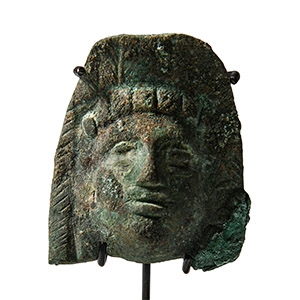
Roman Bronze Actor's Mask Appliqué
Circa 1st-2nd century A.D.Sold for (Inc. bp): £195
With D-shaped flange surrounding the face in place of braided hair, small female face with fleshy features, eyes recessed to accept silver insert; mounted on a custom-made stand. 280 grams total, 88 mm high including stand
Ex P.A., Hertfordshire, UK, specialist collection of Greek art, 1980-1990s. -
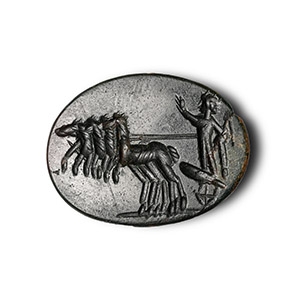
Romano-British Gemstone with Helios Driving Quadriga
2nd-3rd century A.D.Sold for (Inc. bp): £520
Intaglio image of a chariot pulled by four horses and a standing figure. 1.15 grams, 17.77 mm
Found Southern England. Acquired on the UK art market in the 1980s. From an East Anglian private collection. -
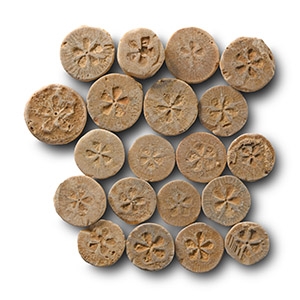
Roman Limestone Gaming Counter Group
1st-4th century A.D.Sold for (Inc. bp): £52
Twenty discoid limestone counters each with an incuse cinquefoil to both faces. 36 grams total, 13-19 mm
Private collection formed in the 1990s. Acquired from a central London gallery. Property of an Essex gentleman.
