
Loading, please wait...
_900x900.jpg "Roman Intaglio Gemstone with Eagle")
_200x200.jpg "Roman Intaglio Gemstone with Eagle")
.jpg "Roman Intaglio Gemstone with Eagle")
LOT 0195
Roman Intaglio Gemstone with Eagle
CIRCA 1ST-2ND CENTURY A.D.
3/8 in. (0.34 grams, 10 mm).
With intaglio profile head of an eagle; supplied with a museum-quality impression.
ProvenanceFrom the collection of a Swiss gentleman formed in Europe from 1970-1980s; thence by descent from the family in London.
CONDITIONTimeLine Auctions follows a vetting process to ensure the authenticity and legality of all items, reinforcing our commitment to integrity and responsible trading. Each antiquity, antique, and coin lot undergoes thorough examination by a vetting committee of at least ten external specialists, professional trade association members, scientists, and archaeologists: Our Vetting Process
AUCTIONS:
TimeLine is a leading auction house specialising in antiquities, ancient art, collectables, natural history, coins, medals, and books. Our auctions offer museums, collectors, historians, and enthusiasts the opportunity to acquire unique and historically significant pieces.
-
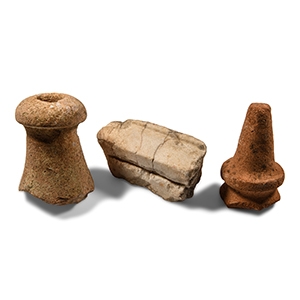
Roman Marble Fragment and Amphora Foot Group
1st-4th century A.D.Sold for (Inc. bp): £8
The marble architectural fragment with a carved groove to the sloped face; the terracotta feet from large wine amphoras, one with a decorative collar and the other with a void to the base. 1.2 kg total, 10.3-12.1 cm
Acquired in the 1970s, thence by descent 2012. Private UK collection, Cambridge, UK. Property of an East Sussex, UK, gentleman. -
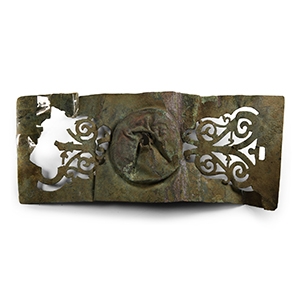
Large Roman Bronze Military Mount
2nd-3rd century A.D.Estimate: £150 - 200 (+bp*)
Opening Bid: £80
Composed of a central domed boss and openwork volutes to the sides; for a sword belt or a chariot. 69 grams, 14 cm wide
Good condition, very rare
Acquired 1960s-1990s. Late Alison Barker collection, a retired London barrister. -
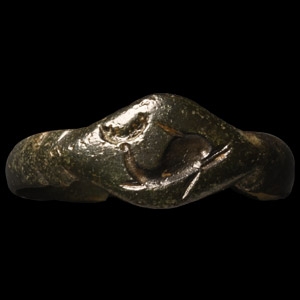
Roman Bronze Ring with Dolphin
Circa 2nd-3rd century A.D.Sold for (Inc. bp): £117
With a large hoop supporting a lozenge-shaped bezel with a stylised dolphin facing right. 2.57 grams, 23.54 mm overall, 20.94 mm internal diameter (approximate size British T, USA 9 1/2, Europe 21.26, Japan 20)
From the collection of a High Wycombe, Buckinghamshire, UK, gentleman, circa 2000.
