
Loading, please wait...
LOT 0105
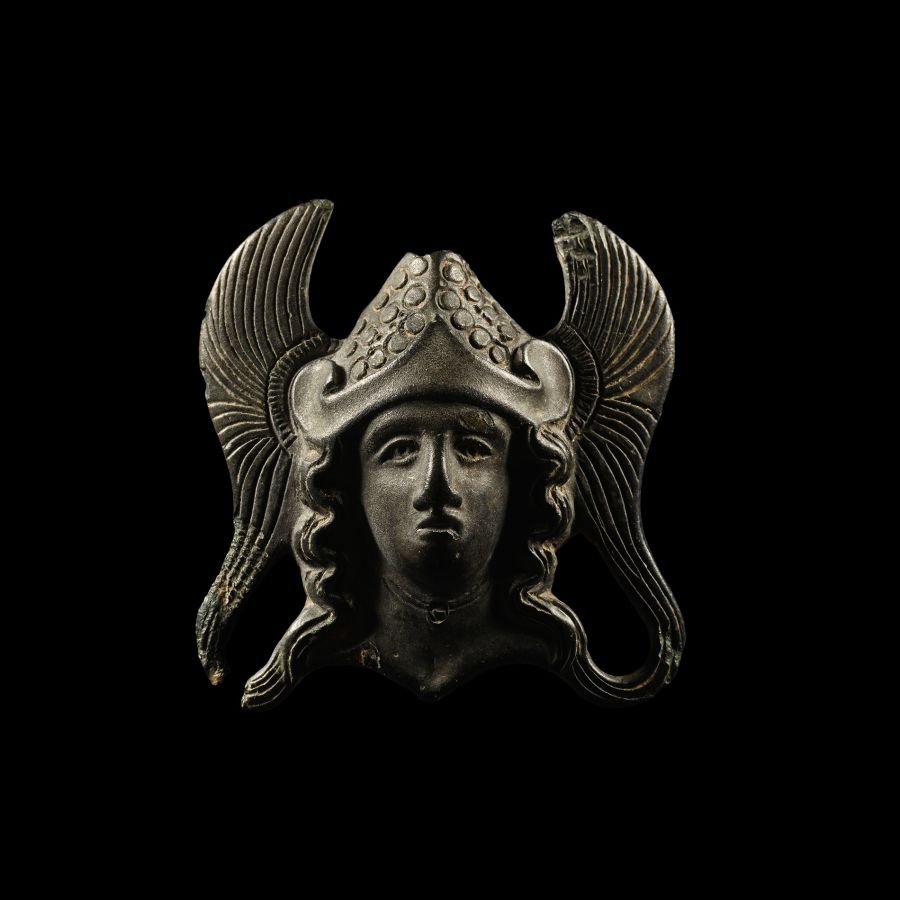
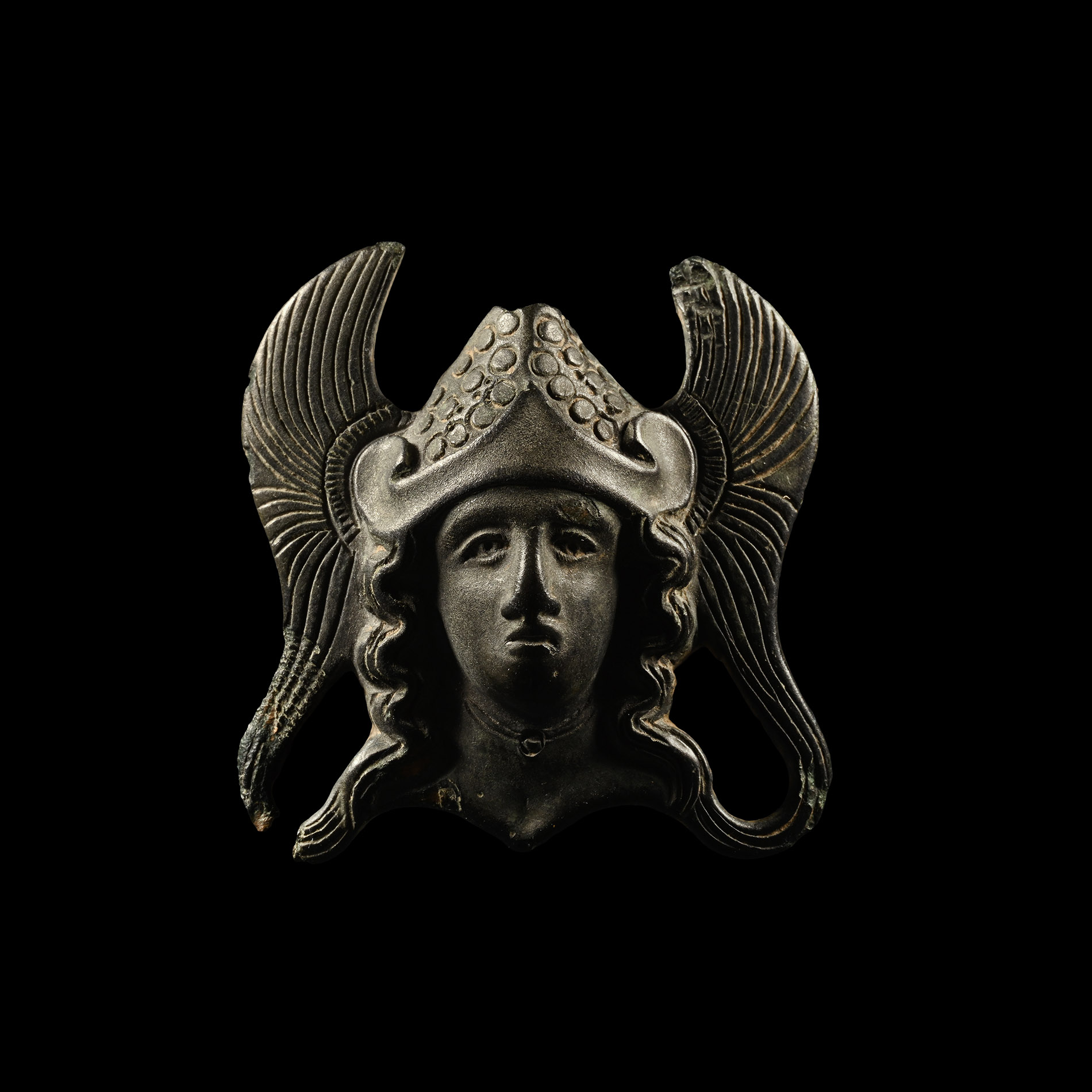
Roman Head of Minerva with Helm Appliqué
2ND-4TH CENTURY A.D.
1 1/2 in. (23.2 grams, 39 mm).
A bronze appliqué formed as the head of Minerva (Greek Athena) wearing a tall helmet with scooped brow-band and lobed ends developing to wings with radiating feather detailing; facing mask with finely detailed eyes and mouth, hanks of flowing hair connecting to the ends of the wings.
ProvenanceAcquired early 1990s.
Ex private American collection; thence by descent.
Private Swiss collection since 1998.
This lot has been checked against the Interpol Database of stolen works of art and is accompanied by search certificate no.11626-199003.
Cf. Rolland, H., Bronzes Antiques de Haute Provence, Paris, 1965, item 328, for type.
CONDITIONTimeLine Auctions follows a vetting process to ensure the authenticity and legality of all items, reinforcing our commitment to integrity and responsible trading. Each antiquity, antique, and coin lot undergoes thorough examination by a vetting committee of at least ten external specialists, professional trade association members, scientists, and archaeologists: Our Vetting Process
AUCTIONS:
TimeLine is a leading auction house specialising in antiquities, ancient art, collectables, natural history, coins, medals, and books. Our auctions offer museums, collectors, historians, and enthusiasts the opportunity to acquire unique and historically significant pieces.
-
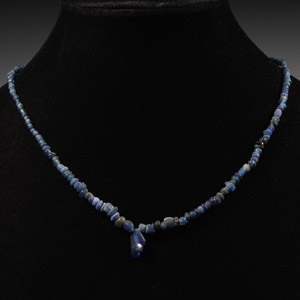
Roman and Other Bead Necklace
1st century A.D. and laterSold for (Inc. bp): £39
A restrung group of mainly opaque blue glass beads of various types. 9.54 grams, 65 cm long
Acquired 1980-2015. Ex Abelita family collection. -
.jpg)
Roman Tragic Mask Applique
1st century A.D. or laterSold for (Inc. bp): £130
A rectangular slate mount showing the head of a tragic mask with angular eyes, straight nose and a clownish, down-turned mouth. 3 grams, 16.2 mm
Very fine condition.
Acquired from Galerie Jean Phillipe Mariaud de Serres, 1990-2000. Property of a French collector.
Small appliqués like this one were common in Roman furniture. In the Graeco-Roman world, comic and tragic masks played an important role in Greek drama, commonly performed in the Roman Empire. The actors had the ability to easily play more than one character in succession with a simple change of masks, and the characters of the masks became popular objects in the material culture. -
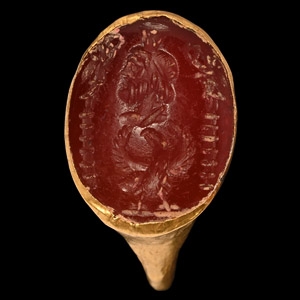
Roman Gold Ring with Serapis Gemstone
1st century A.D.Estimate: £1,500 - 2,000 (‡+bp*)
Opening Bid: £750
A hollow-formed gold finger ring with inset carnelian gemstone engraved with a profile bust of Serapis above a perching eagle flanked by fronds, possibly a marriage. 3.15 grams, 26.98 mm overall, 13.22 mm internal diameter (approximate size British D, USA 1 3/4, Europe 1.15, Japan 1)
Acquired early 1990s. Ex private American collection; thence by descent. Private Swiss collection since 1998.
