
Loading, please wait...
_900x900.jpg "Roman Green Glass Footed Beaker with Trail")
_200x200.jpg "Roman Green Glass Footed Beaker with Trail")
.jpg "Roman Green Glass Footed Beaker with Trail")
LOT 0701
Roman Green Glass Footed Beaker with Trail
4TH-5TH CENTURY A.D.
4 1/4 in. (72 grams, 10.8 cm high).
Composed of a gently tapering U-shaped body with a more convex upper body, everted rim and domed foot, decorative applied trails to the equator.
ProvenanceParis collection, 1990s.
From an important Paris gallery, France.
Ex private Parisian collection.
Cf. The Corning Museum of Glass, accession number 83.1.3, for similar.
CONDITIONTimeLine Auctions follows a vetting process to ensure the authenticity and legality of all items, reinforcing our commitment to integrity and responsible trading. Each antiquity, antique, and coin lot undergoes thorough examination by a vetting committee of at least ten external specialists, professional trade association members, scientists, and archaeologists: Our Vetting Process
AUCTIONS:
TimeLine is a leading auction house specialising in antiquities, ancient art, collectables, natural history, coins, medals, and books. Our auctions offer museums, collectors, historians, and enthusiasts the opportunity to acquire unique and historically significant pieces.
LOT 0701
Roman Green Glass Footed Beaker with Trail
Estimate £400 - 600€460 - 700 (for guidance only)$540 - 810 (for guidance only)
-
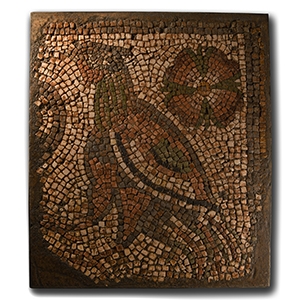
Eastern Roman Mosaic Depicting a Bird
4th-6th century A.D.Sold for (Inc. bp): £2,860
In a rectangular matrix; cream, olive, pink and other tesserae depicting a perching bird with rosette above. 15.4 kg, 43.5 x 50.4 cm
Former collection of Mr Pierre Bart (1889-1964), official of the French mandate in Syria and Lebanon (1919-1936) and delegate to the Lebanese government until 1946. Transmitted by descent. -
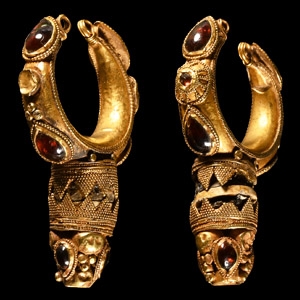
Large Eastern Roman Gold Earrings
2nd-3rd century A.D.Sold for (Inc. bp): £1,690
A hollow-formed hoop with lateral teardrop cells set with cabochon garnets and disc cells to the apex with bulbous central section; filigree and granulation detailing, cells with garnet cloisons; stepped columnar lower section with applied bosses and granulation; Eastern Empire or Parthian. 20.91 grams total, 47-48 mm
From a private collection formed in the 1990s. Ex London, UK, gallery. -
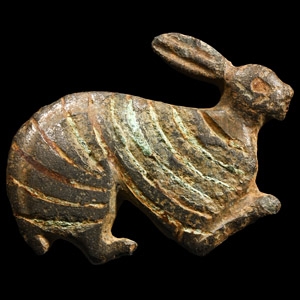
Roman 'Essex' Bronze Hare Brooch
Circa 2nd century A.D.Sold for (Inc. bp): £221
Bronze plate brooch in the form of a hare with remains of enamel stripes to the body; pin-lugs and catch to the reverse. 2.89 grams, 21 mm
Found Essex, UK, in the 1980s. Property of an Essex collector.
