
Loading, please wait...

LOT 0640
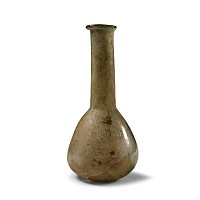
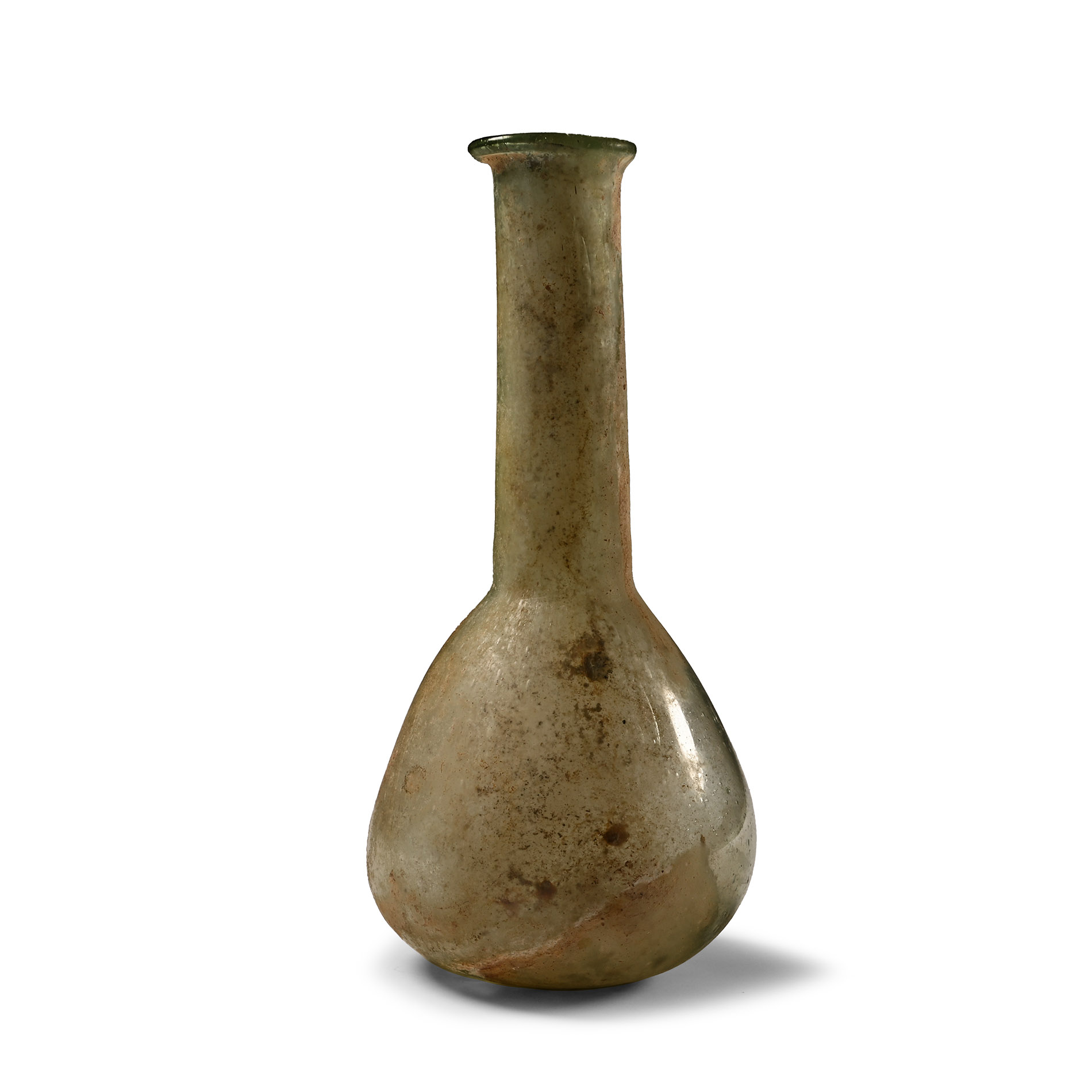
Roman Green Glass Bottle
1ST-2ND CENTURY A.D.
5 1/4 in. (39.8 grams, 13.3 cm).
Small, flattened base with pontil mark; long, cylindrical neck with a slightly everted mouth; lip folded inwards; free-blown, partially with sinter deposits. [No Reserve]
ProvenanceEx Helene Wackernagel-Wenk (1901-1979), Switzerland; thence by descent.
This lot is accompanied by an illustrated lot declaration signed by the Head of the Antiquities Department, Dr Raffaele D’Amato.
Cf. Whitehouse, D., Roman Glass in the Corning Museum of Glass, vol.1, New York, 1997, item 268, for type.
FootnotesHelene Wackernagel-Wenk was a distinguished collector of art and antiquities, celebrated for her refined taste and commitment to preserving cultural heritage. Her collection encompassed a wide range of artifacts, reflecting her deep appreciation for the artistic and historical significance of ancient civilizations. Known for her meticulous curation, Wackernagel-Wenk’s legacy endures through the exceptional pieces that once formed part of her esteemed collection. Artifacts associated with her name are highly valued for their provenance and quality. Pear-shaped body.
CONDITIONTimeLine Auctions follows a vetting process to ensure the authenticity and legality of all items, reinforcing our commitment to integrity and responsible trading. Each antiquity, antique, and coin lot undergoes thorough examination by a vetting committee of at least ten external specialists, professional trade association members, scientists, and archaeologists: Our Vetting Process
AUCTIONS:
TimeLine is a leading auction house specialising in antiquities, ancient art, collectables, natural history, coins, medals, and books. Our auctions offer museums, collectors, historians, and enthusiasts the opportunity to acquire unique and historically significant pieces.
-
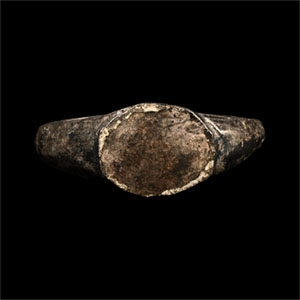
Roman Silver Ring with Plain Bezel
2nd-3rd century A.D.Sold for (Inc. bp): £124
Comprising a thick hoop with angled shoulders, expanding towards a discoid bezel. 3.35 grams, 22.45 mm overall, 17.53 mm internal diameter (approximate size British I, USA 4 1/4, Europe 7.44, Japan 7)
From an English collection formed before 2000. This lot is accompanied by an illustrated lot declaration signed by the Head of the Antiquities Department, Dr Raffaele D’Amato. -
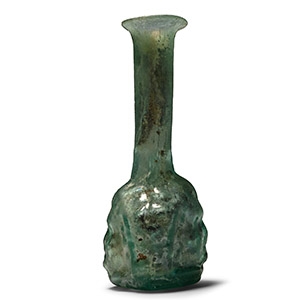
Roman Glass Janiform Ampulla
3rd century A.D.Estimate: £800 - 1,000 (‡+bp*)
Opening Bid: £360
Body formed as two addorsed putto-heads with long, narrow neck separated from the body by a constriction; funicular mouth. 48.9 grams, 11 cm
Ex Anita Zürrer-Bass (1928-2018), Switzerland, formed 1960s-1990s. Thence by descent. This lot is accompanied by an illustrated lot declaration signed by the Head of the Antiquities Department, Dr Raffaele D’Amato.
The body of this type of vessel is formed from two heads joined together at the back. The faces have protruding chins, full cheeks and turned-up noses. The hair, filling the space between the faces, is arranged into spherical curls. This kind of products were often realised in Syrian workshops and widespread across the empire. They are usually dated to the 3rd century A.D. -
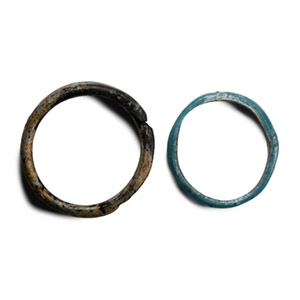
Roman Blue Glass Bangle Pair
Circa 4th century A.D.Sold for (Inc. bp): £72
One flat-section with light blue ribbed outer face; the other flattened at the juncture with some iridescence remaining. 20.4 grams total, 50-58 mm
From an old English collection. Acquired from Helios Gallery in 2011. Ian Wilkinson collection, Nottinghamshire, UK, formed since 1985. This lot is accompanied by an illustrated lot declaration signed by the Head of the Antiquities Department, Dr Raffaele D’Amato.
The mass production of glass in ancient Rome prompted the development of glass jewellery of unique qualities. The ancient Romans considered jewellery to be an essential accessory, being a public display of the wealth of high social classes. Recent excavations have provided better information on the use of glass for necklaces and bracelets, and in some cases it has been possible to understand the exact arrangement of the jewellery.
