
Loading, please wait...
_900x900.jpg "Roman Green Glass Beaker with Blue Stipples")
_200x200.jpg "Roman Green Glass Beaker with Blue Stipples")
.jpg "Roman Green Glass Beaker with Blue Stipples")
LOT 0698
Roman Green Glass Beaker with Blue Stipples
CIRCA 4TH CENTURY A.D.
3 1/2 in. (100 grams, 88 mm wide).
Beaker or lamp with convex wall and convex everted rim; applied blue glass ovals and clusters of stippled dots around the shoulder; iridescent surfaces.
ProvenanceParis collection, 1990s.
From an important Paris gallery, France.
Ex private Parisian collection.
Cf. The Metropolitan Museum, accession numbers 50.1.31 and 66.1.262, for similar form and decoration.
CONDITIONTimeLine Auctions follows a vetting process to ensure the authenticity and legality of all items, reinforcing our commitment to integrity and responsible trading. Each antiquity, antique, and coin lot undergoes thorough examination by a vetting committee of at least ten external specialists, professional trade association members, scientists, and archaeologists: Our Vetting Process
AUCTIONS:
TimeLine is a leading auction house specialising in antiquities, ancient art, collectables, natural history, coins, medals, and books. Our auctions offer museums, collectors, historians, and enthusiasts the opportunity to acquire unique and historically significant pieces.
LOT 0698
Roman Green Glass Beaker with Blue Stipples
Estimate £400 - 600€460 - 700 (for guidance only)$540 - 810 (for guidance only)
-
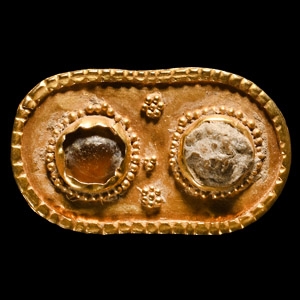
Roman Gold Shield-Shaped Mount
1st-3rd century A.D.Estimate: £300 - 400 (+bp*)
Opening Bid: £150
With beaded rim, granule clusters to the obverse between two cells each with a granule collar and inset glass stud; four loops to the reverse. 1.71 grams, 23 mm
UK private collection formed before 2000. Ex North London, UK, gallery.
The four loops suggest that the plaque formed part of the spacing for a two-strand necklace. -
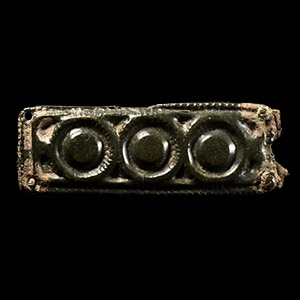
Romano-British Bronze Strap End with Bosses
1st-2nd century A.D.Sold for (Inc. bp): £20
Sheet bronze plaque with pelletted border, three roundel within raised rims, rivet to each corner attaching to the securing plate beneath; old inked collector's find-spot legend 'GRIMSBY'. 6.97 grams, 54 mm
Found Grimsby, UK. -
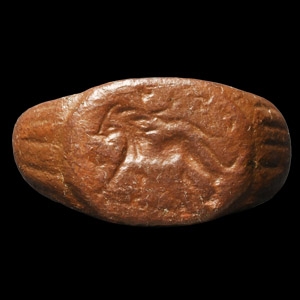
Roman Bronze Ring with Lion
Circa 2nd-4th century A.D.Sold for (Inc. bp): £46
The narrow hoop expanding at the fluted shoulders, oval bezel with intaglio image of an advancing lion with voluminous mane. 5.58 grams, 24.46 mm overall, 19.29 mm internal diameter (approximate size British M 1/2, USA 6 1/4, Europe 13.09, Japan 12)
From the collection of a High Wycombe, Buckinghamshire, UK, gentleman, circa 2000.
