
Loading, please wait...
LOT 0787
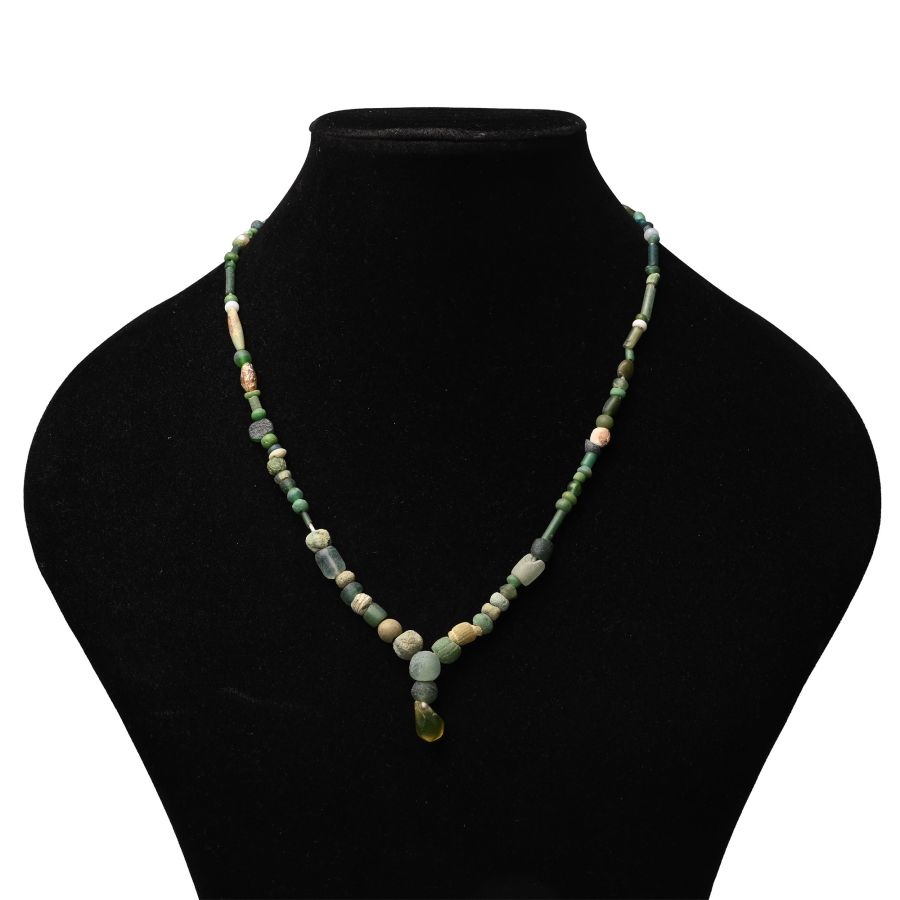
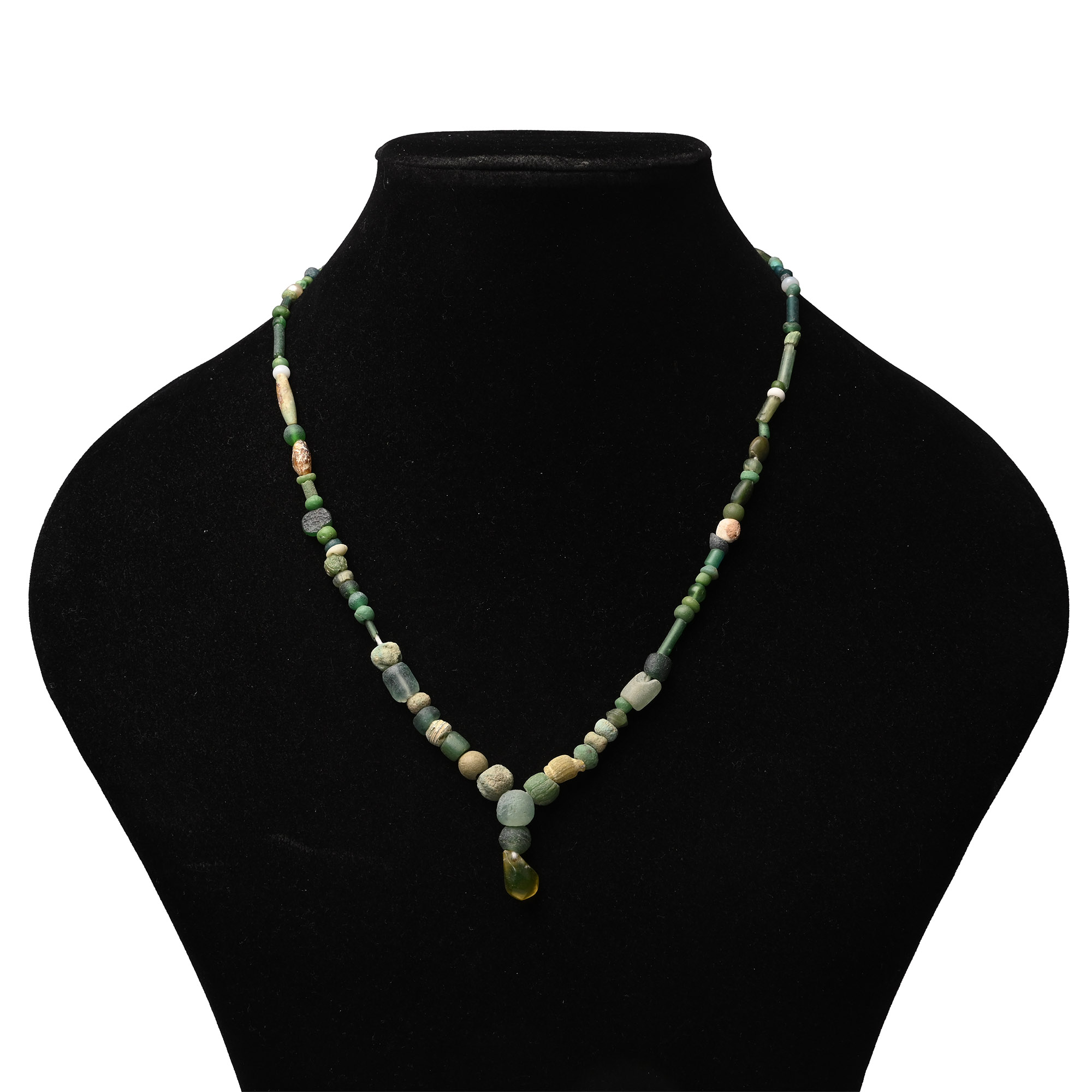
Roman Green Glass Bead Necklace String
1ST-4TH CENTURY A.D. AND LATER
17 3/4 in. (17.3 grams, 45 cm).
Composed mainly of tubular and oblate beads, central feature with a facetted teardrop-shaped pendant; restrung. [No Reserve]
ProvenanceFrom the London, UK, art market in the 1990s.
This lot is accompanied by an illustrated lot declaration signed by the Head of the Antiquities Department, Dr Raffaele D'Amato.
For examples of similar green Roman beads see Then-Obluska, J., ‘Beads and pendants from the Hellenistic to early Byzantine Red Sea port of Berenike, Egypt, Seasons 2014 and 2015’ in Polish Archaeology in the Mediterranean, 27/1, 2018, pp.203–234, figs.3a, 4,5,7.
FootnotesIn the Roman period there was a strong formal and chromatic diversity of glass beads used for necklaces and bracelets. The most common beads in forms were small biconical (lenticular), barrel-shaped, spherical and annular; the most common colours were dark blue, followed by green and yellow. The succession of glass beads often imitates jewellery made of costly materials (gold, silver, semi-precious and precious stones).
CONDITIONTimeLine Auctions follows a vetting process to ensure the authenticity and legality of all items, reinforcing our commitment to integrity and responsible trading. Each antiquity, antique, and coin lot undergoes thorough examination by a vetting committee of at least ten external specialists, professional trade association members, scientists, and archaeologists: Our Vetting Process
AUCTIONS:
TimeLine is a leading auction house specialising in antiquities, ancient art, collectables, natural history, coins, medals, and books. Our auctions offer museums, collectors, historians, and enthusiasts the opportunity to acquire unique and historically significant pieces.
-
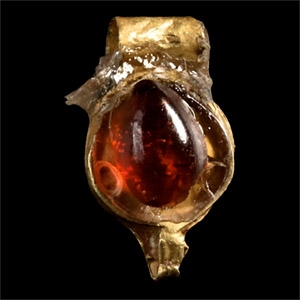
Roman Gold Pendant with Garnet
4th-5th century A.D.Sold for (Inc. bp): £156
Discoid pendant with cell, inset cabochon garnet, integral loop above. 0.15 grams, 9 mm
From the collection of a late Japanese collector, 1970s. This lot is accompanied by an illustrated lot declaration signed by the Head of the Antiquities Department, Dr Raffaele D'Amato.
The object reflect Late Antique/Early Eastern Roman decorative and manufacturing traditions. Flat garnet plates originate with one class of ring-stone intaglios from the Late Hellenistic and Imperial Roman periods, but developed especially in the 4th-6th century, where they preserved the Romano-Greco traditions with the influence of Sassanian and Pontic peoples. They were used for jewellery, weaponry and decorative expensive objects. -
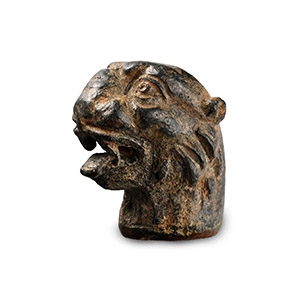
Roman Bronze Knife Pommel with Head of a Lion
1st-4th century A.D.Sold for (Inc. bp): £117
Hollow-formed with collar to the lower rim, voided mouth to accept a ring; probable knife pommel. 26.5 grams, 24 mm
From the collection of a gentleman, acquired on the London art market in the 1990s. This lot is accompanied by an illustrated lot declaration signed by the Head of the Antiquities Department, Dr Raffaele D'Amato. -
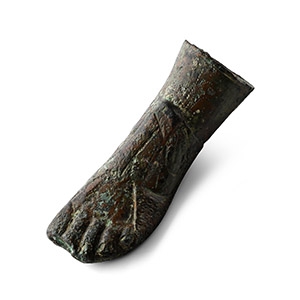
Roman Bronze Sandaled Foot
1st-4th century A.D.Sold for (Inc. bp): £72
Modelled in the half-round with detailed pointillé texture to the leather upper and ankle-band; hole to underside and fixing hole at rear. 85 grams, 72 mm
Acquired on the UK art market during the late 20th century. From the private collection of David King (1940-2024), Hoddesdon, Hertfordshire, UK. This lot is accompanied by an illustrated lot declaration signed by the Head of the Antiquities Department, Dr Raffaele D'Amato.
