Loading, please wait...

Use mousewheel to zoom in and out, click to enlarge

Details

LOT 0209

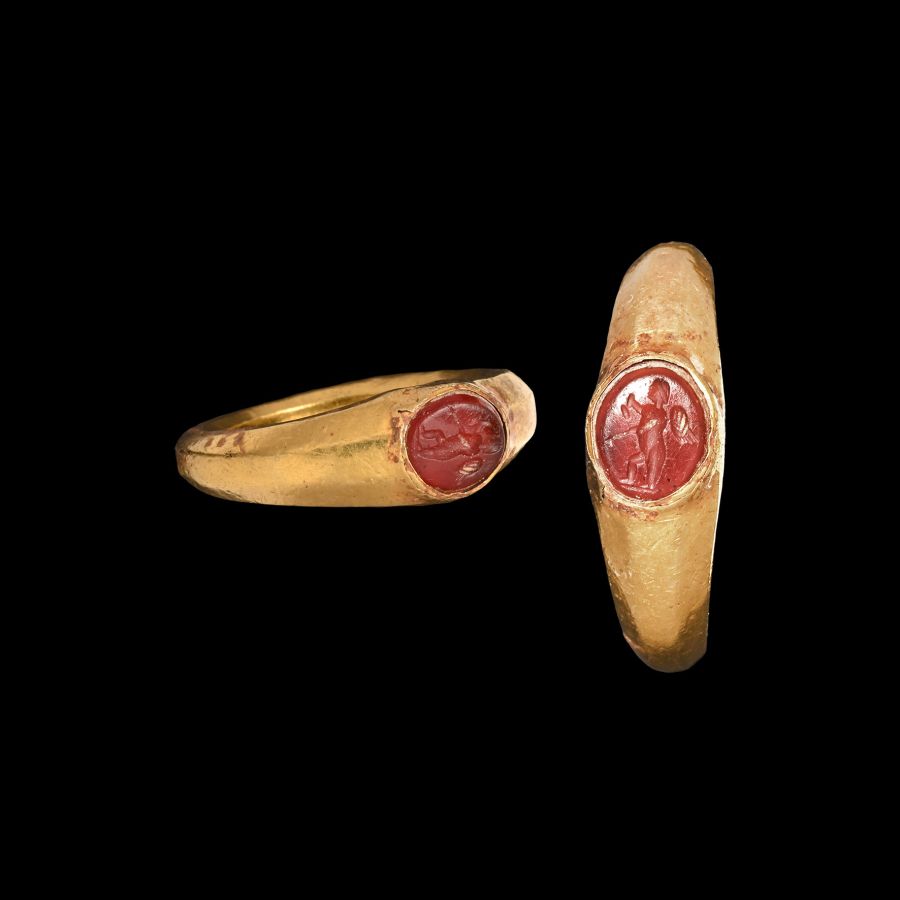
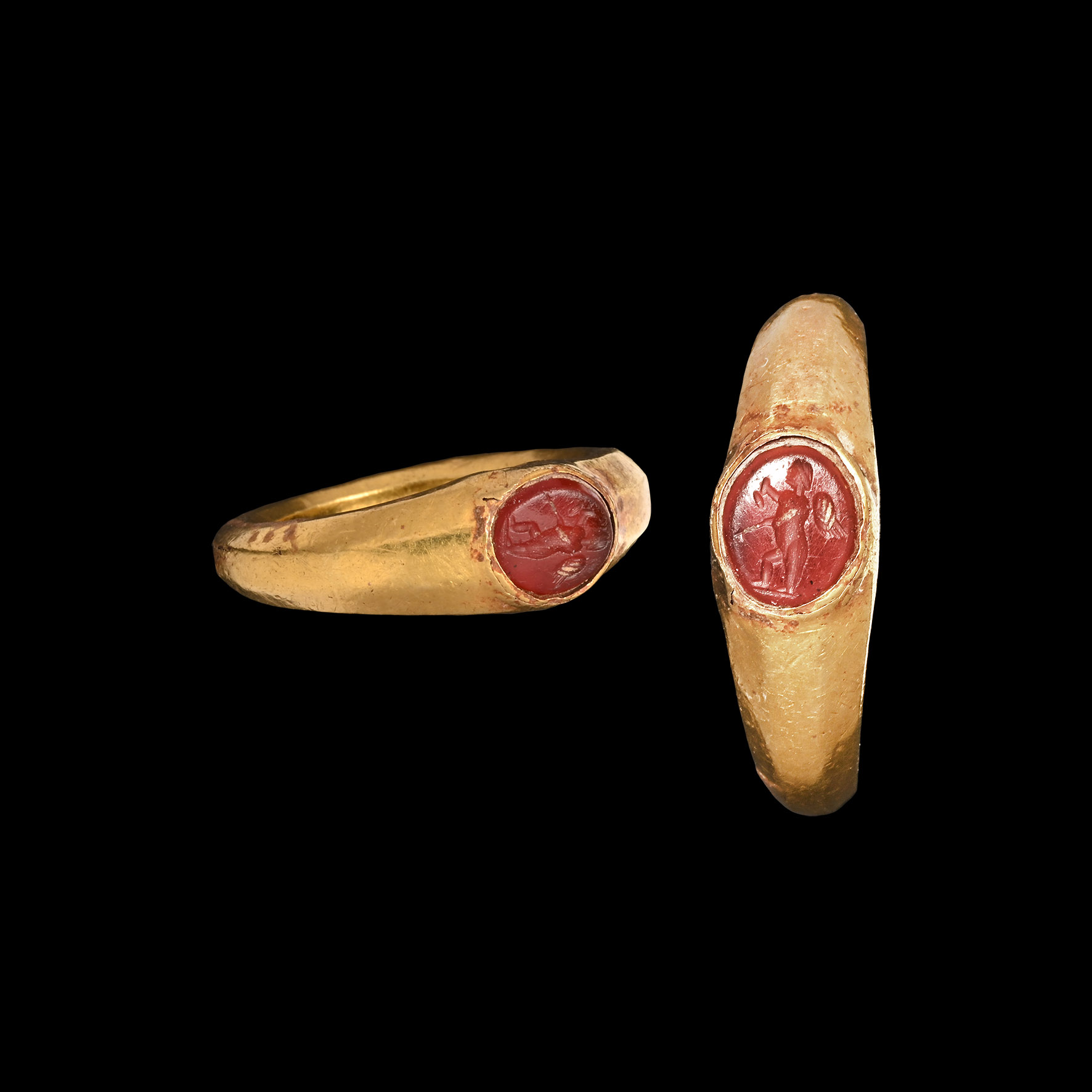
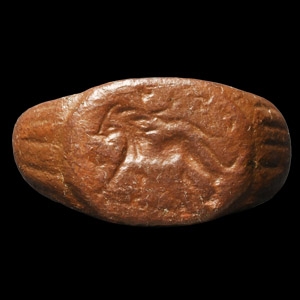
Roman Gold Ring with Winged Eros Gemstone

1ST-2ND CENTURY A.D.

1 in. (3.22 grams, 24.20 mm overall, 16.84 mm internal diameter (approximate size British J 1/2, USA 5, Europe 9.32, Japan 9)).

Hollow-formed with facetted shoulders, inset cabochon intaglio of Eros (Cupid) in flight.

Provenance

Acquired early 1990s.
Ex private American collection; thence by descent.
Private Swiss collection since 1998.

Literature

Cf. Chadour, A.B., Rings. The Alice and Louis Koch Collection, volume I, Leeds, 1994, item 303, for type.

CONDITION

VETTING:

TimeLine Auctions follows a vetting process to ensure the authenticity and legality of all items, reinforcing our commitment to integrity and responsible trading. Each antiquity, antique, and coin lot undergoes thorough examination by a vetting committee of at least ten external specialists, professional trade association members, scientists, and archaeologists: Our Vetting Process


AUCTIONS:

TimeLine is a leading auction house specialising in antiquities, ancient art, collectables, natural history, coins, medals, and books. Our auctions offer museums, collectors, historians, and enthusiasts the opportunity to acquire unique and historically significant pieces.

LOT 0209

Roman Gold Ring with Winged Eros Gemstone

Sold for (Inc. bp): £1,300

Print page

RELATED LOTS

  • Roman Bronze Stamp for Octavian
    Roman Bronze Stamp for Octavian
    Circa 1st century A.D.

    Sold for (Inc. bp): £650

    Formed as a tablet-shaped stamp (signaculum), with raised border above and below containing an inscription in Latin in reverse over two lines, reading: 'Q[UINTI] POM [PONII] CRE [SCONII} ? / OCTAVIAN[I]' possibly translating to: 'Of Quintus Pomponius Cresconius Octavianus', this latter being the owner; with a large loop to verso. 92 grams, 64 mm


    From an old private collection formed before 1985. Accompanied by a copy of a previous dealer's certificate of authenticity including provenance.

    Used to stamp documents and a broad range of different materials and food, signacula came into use in the Roman res publica during the 2nd century B.C., becoming both popular and widely used in many areas of everyday life during the Imperial period. These signacula were not exclusively used in the sphere of economy and property administration, but also in public and private sphere, determining the identity of their owners. The bronze stamp - also definable as a tessera, like the wooden one - was an instrumentum vicarium (auxiliary tool) of the annulus signatorius (seal ring), but compared to the annulus, it was much stronger and more practical, capable of leaving a better recognisable imprint. By analogy, the press note of a wooden or terracotta stamp also had an important certifying function, but the object that produced it only lasted a limited time, while the signaculum ex aere (bronze stamp) lasted a lifetime.

    Lot Details

  • Roman FORTIS Terracotta Oil Lamp
    Roman FORTIS Terracotta Oil Lamp
    Late 1st century A.D.

    Sold for (Inc. bp): £124

    A factory lamp with flat-topped oval body, broad flat shoulder and small concave plain discus; flat bottom with Latin inscription 'FORTIS'. 77.7 grams, 96 mm


    From the collection of a High Wycombe, Buckinghamshire, UK, gentleman, circa 2000.

    At the end of the 1st century B.C., in the Po Valley, began the industrial production of Firmalampen, i.e. lamps signed on the bottom in relief noting the place of production or fabrica. The signature FORTIS, visible on this specimen, is one of the most documented and is attributable to the workshop of L. Aemilius Fortis, recently discovered to have been in Mutina (Modena).

    Lot Details

  • Roman Lead Coffin Panel with Sphinx, Medusa and Dolphins
    Roman Lead Coffin Panel with Sphinx, Medusa and Dolphins
    2nd-3rd century A.D.

    Sold for (Inc. bp): £1,820

    Decorated with patterns comprising sphinxes, dolphins, and masks of Medusa in fields between columns, and floral border strips with laurel leaves. 19.75 kg, 90 cm


    Acquired 1970s-early 1990s. Property of a North American collector. London collection, 2016. This lot has been checked against the Interpol Database of stolen works of art and is accompanied by search certificate no.11993-209841.

    There were many ways of burying bodies during the Roman Empire. Although the majority were buried without coffins, there is evidence for wooden coffins, lead-framed wooden coffins, tile burials and lead and stone coffins. This item belongs to types widespread in the Eastern Mediterranean. The panel is decorated with a columned structure, and within each section are symbols of the outer-world, including gorgons, sphinx and dolphins. The sphinx, having a human head and breasts, legs and paws of a lion, and wings of a bird, was generally associated with protecting imperial tombs and temples. The roundels featuring the head of Medusa, known for her potent gazes that could turn one to stone, was favoured on sarcophagi and architectural ornaments because it was believed that her image would protect those within. The dolphin was considered to ferry the souls of the dead to the afterlife. Very often these sarcophagi were connected by a pipe to the ground above so that mourners could pour in offerings into the grave.

    Lot Details

Stay up-to-date with the latest from TimeLine Auctions by joining our mailing list