
Loading, please wait...
_900x900.jpg "Roman Gold Ring with Sphinx")
_200x200.jpg "Roman Gold Ring with Sphinx")
.jpg "Roman Gold Ring with Sphinx")
LOT 0108
Roman Gold Ring with Sphinx
1ST-2ND CENTURY A.D.
1 in. (5.78 grams, 24.45 mm overall, 15.52 mm internal diameter (approximate size British G, USA 3 1/4, Europe 4.92, Japan 4)).
Hollow-formed shank with carinated profile, inset garnet cabochon with winged sphinx standing on a baseline.
ProvenanceAcquired in the mid 1980s-1990s.
Private collection, Switzerland, thence by descent.
Private collection, since the late 1990s.
Cf. Ruseva-Slokoska, L., Roman Jewellery, Sofia, 1991, item 192, for type.
CONDITIONTimeLine Auctions follows a vetting process to ensure the authenticity and legality of all items, reinforcing our commitment to integrity and responsible trading. Each antiquity, antique, and coin lot undergoes thorough examination by a vetting committee of at least ten external specialists, professional trade association members, scientists, and archaeologists: Our Vetting Process
AUCTIONS:
TimeLine is a leading auction house specialising in antiquities, ancient art, collectables, natural history, coins, medals, and books. Our auctions offer museums, collectors, historians, and enthusiasts the opportunity to acquire unique and historically significant pieces.
-
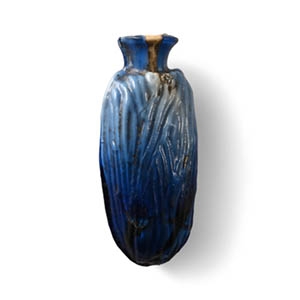
Large Roman Deep Blue Glass Date Flask
1st century A.D.Estimate: £5,000 - 7,000 (‡+bp*)
Opening Bid: £2,500
Mould-blown with elliptical body, short neck and thick everted rim, with modelled wrinkles. 41.7 grams, 80 mm
Dr Gonik & Me Wirth, Geneva, 1970s. Private collection, Europe. This lot has been checked against the Interpol Database of stolen works of art and is accompanied by a search certificate number no.12394-226935. -
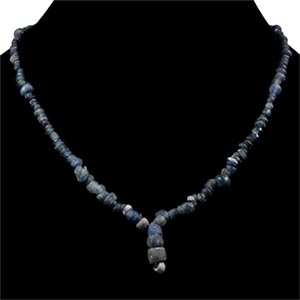
Roman Glass Bead Necklace String
1st-4th century A.D. and laterSold for (Inc. bp): £52
Composed of mainly blue oblate beads, restrung to a Y-shape. 13.7 grams, 36 cm
Ex property of a late Japanese collector, 1970-2000s. -
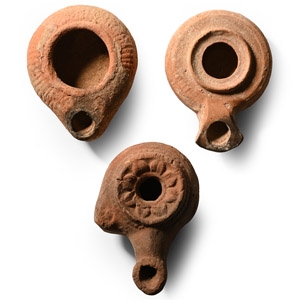
Roman Terracotta Oil Lamp Group
Mid 1st century B.C.-5th century A.D.Sold for (Inc. bp): £78
Comprising a low discoid type with trapezoidal nozzle and radiating lines which appears to be from the Herodian period (50 BC to 70 AD); one with conical nozzle and radiating lines to the shoulder; and one with a long tapering nozzle, lateral spur handle and low-relief rosette to the discus. 150 grams total, 76-83 mm
From a family collection mostly formed in the 1940s-1950s, thence by descent.
The lamp on the upper left side appears to be from the Herodian period (50 BC to 70 AD).
