
Loading, please wait...
LOT 0085
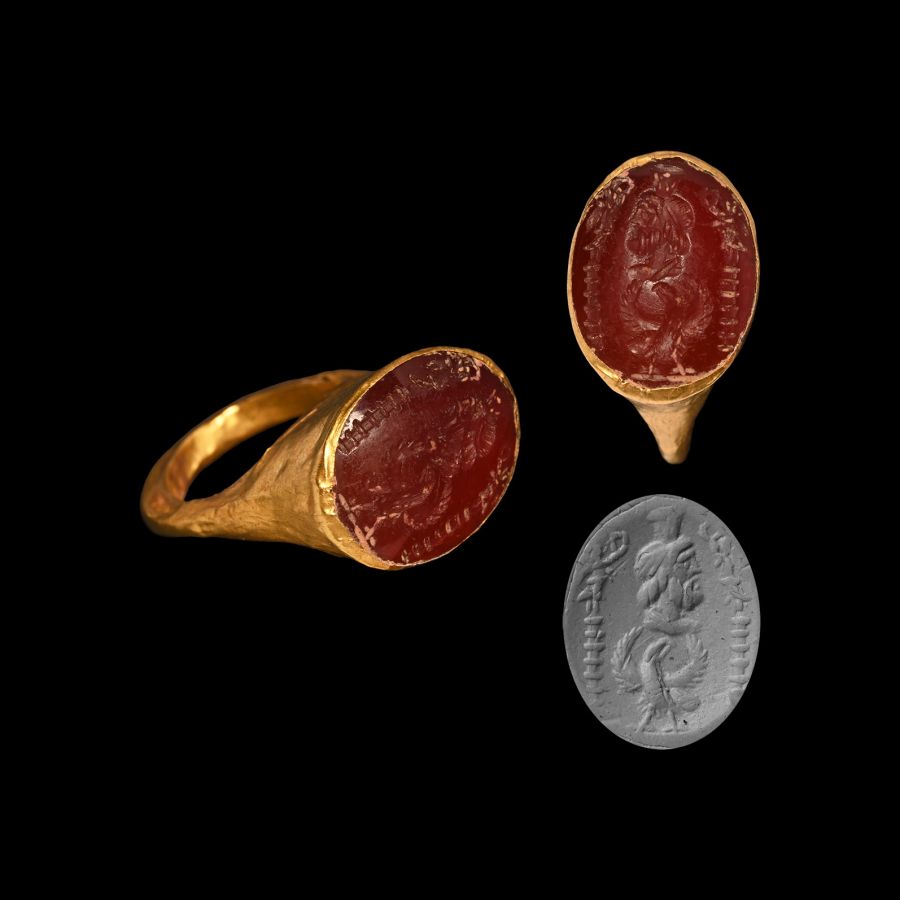
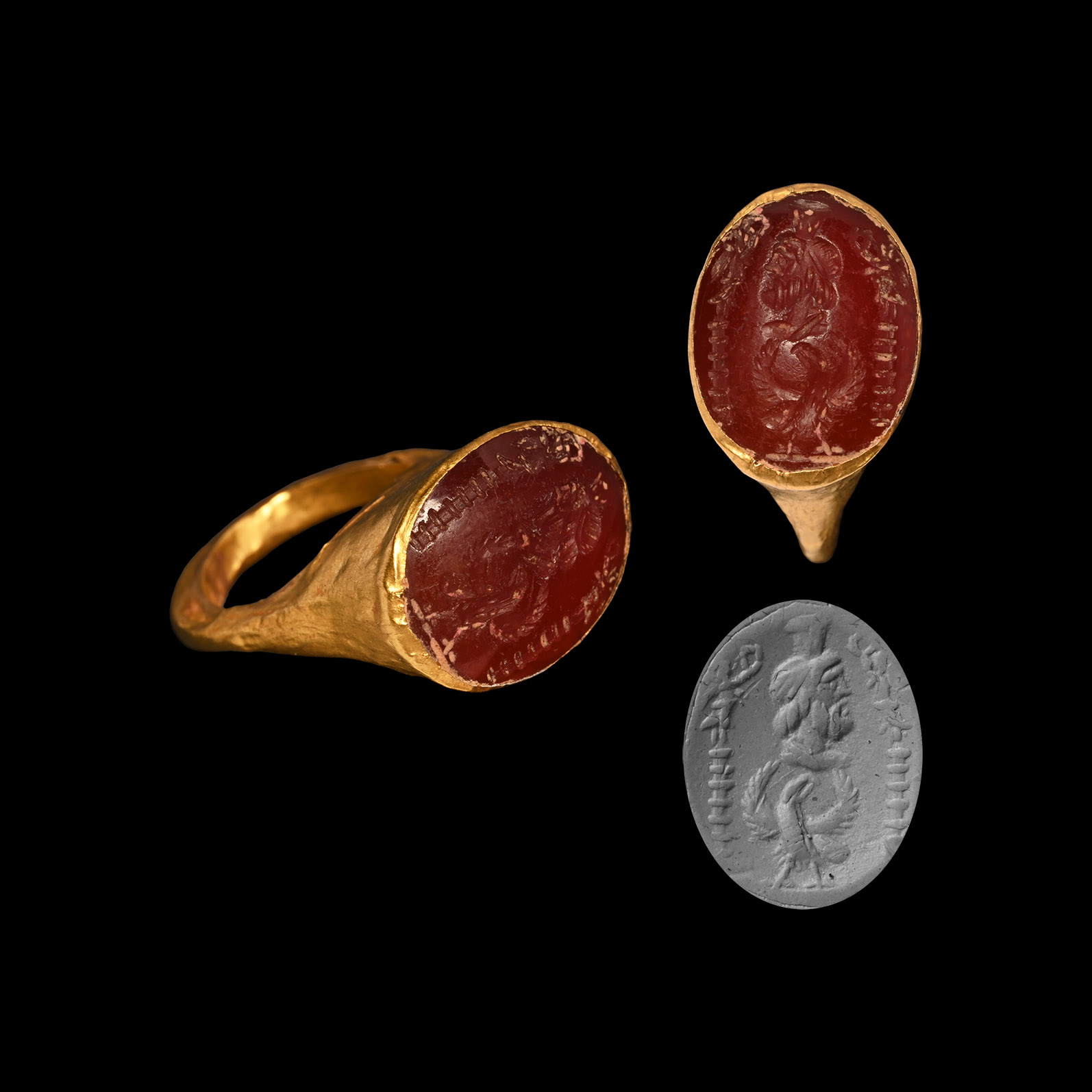
Roman Gold Ring with Serapis Gemstone
1ST CENTURY A.D.
1 in. (3.15 grams, 26.98 mm overall, 13.22 mm internal diameter (approximate size British D, USA 1 3/4, Europe 1.15, Japan 1)).
A hollow-formed gold finger ring with inset carnelian gemstone engraved with a profile bust of Serapis above a perching eagle flanked by fronds, possibly a marriage.
ProvenanceAcquired early 1990s.
Ex private American collection; thence by descent.
Private Swiss collection since 1998.
Cf. Chadour, A.B., Rings. The Alice and Louis Koch Collection, volume I, Leeds, 1994, item 142, for type.
CONDITIONTimeLine Auctions follows a vetting process to ensure the authenticity and legality of all items, reinforcing our commitment to integrity and responsible trading. Each antiquity, antique, and coin lot undergoes thorough examination by a vetting committee of at least ten external specialists, professional trade association members, scientists, and archaeologists: Our Vetting Process
AUCTIONS:
TimeLine is a leading auction house specialising in antiquities, ancient art, collectables, natural history, coins, medals, and books. Our auctions offer museums, collectors, historians, and enthusiasts the opportunity to acquire unique and historically significant pieces.
LOT 0085
Roman Gold Ring with Serapis Gemstone
Estimate £1,500 - 2,000€1,740 - 2,320 (for guidance only)$2,030 - 2,700 (for guidance only)
-
.jpg)
'The Witherley' Roman Lead Pig Ingot
4th century A.D.Sold for (Inc. bp): £2,600
A substantial lead pig (ingot), sub-rectangular in plan and plano-convex in section, reserved partial numerical inscription to central recess on the upper face, possibly: ‘CCCXXXXI’ or 341 Roman libra, a denomination of weight and the original weight of the ingot. 74 kg, 48 cm
Fine condition. Rare.
Found while searching with a metal detector on Wednesday 2nd September 2020 in Witherley, Leicestershire, UK, at a depth of 57cm by Nick Thorpe. Accompanied by Portable Antiquities Scheme Report number LEIC-62F9AF. Accompanied by a copy of a full page article published in Treasure Hunting Magazine, March 2021. Accompanied by copies of four photographs taken during excavation, and a hand written letter from the finder explaining the circumstances of finding. Accompanied by an academic report by Dr Raffaele D’Amato. This lot has been checked against the Interpol Database of stolen works of art and is accompanied by search certificate number no.10791-178320.
Although ingots are known to have been made in many shapes, the plano-convex shape was the most commonly used during the Roman period (Tylecote, 1987, p.204). The Witherley lead pig is certainly, at the moment, one of the largest of its kind found in Britain. The inscription relates to its weight in Roman libra, and it seems that originally the weight of the complete ingot was circa 110 kg. Such inscriptions appear on Roman ingots from the early Imperial Age onwards, see for example Gale Brown (2011, no.61.3ff.) The high percentage of lead in our ingot (97.9% lead, 1.5 % iron by XRF), is far higher than many other known specimens. Roman ingots are particularly important in many respects: in addition to their use for dating various phases of commercial activity, they can reveal the extent to which standardisation of weights was practised. The presence of numerical markings has led to suggestions of the existence of a 'standard weight' of 195 Roman libra (63.85 kg). -
.jpg)
Roman Glass Vessel Group
1st-5th century A.D.Sold for (Inc. bp): £130
A group of two glass vessels comprising: one blue glass toilet bottle with bulbous body, long cylindrical neck and rolled rim; a green glass vessel with squat, tapering body, ogival shoulders and trumpet-style neck and lip, pontil to base. 67 grams total, 5.1-15 cm
Fine condition.
Acquired before 1983. Ex London gallery, 1990s. -
Roman Bone Dice Group
1st-3rd century A.D.Sold for (Inc. bp): £89
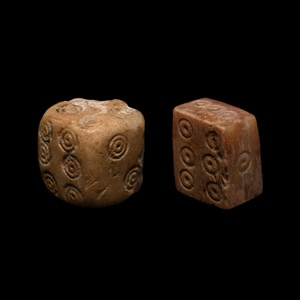
A group of two bone dice: one of tabular form with ring-and-dot markings disposed 1:2, 3:4, 5:6; one cuboid with one damaged face, markings disposed 2:5, 3:4, 6: [1 absent]. 3.79 grams total, 11 mm each
Fine condition; one with damaged face.
Ex UK art market, 1970s. Property of a London gentleman.
