
Loading, please wait...
LOT 0207
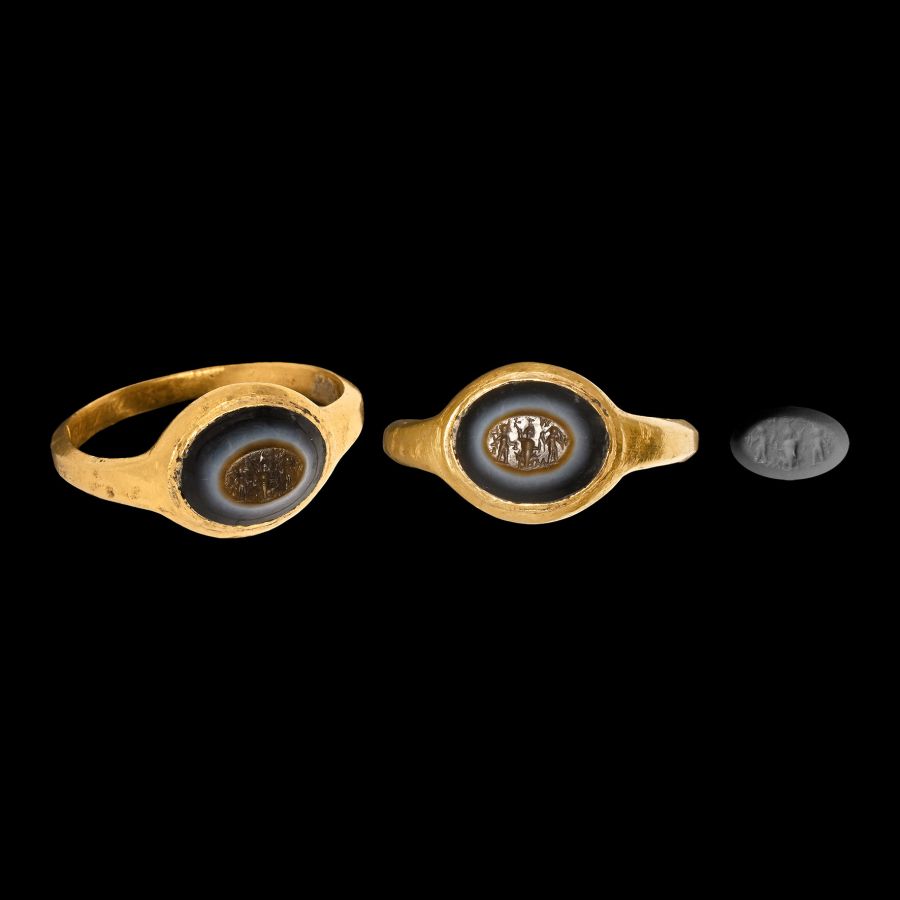
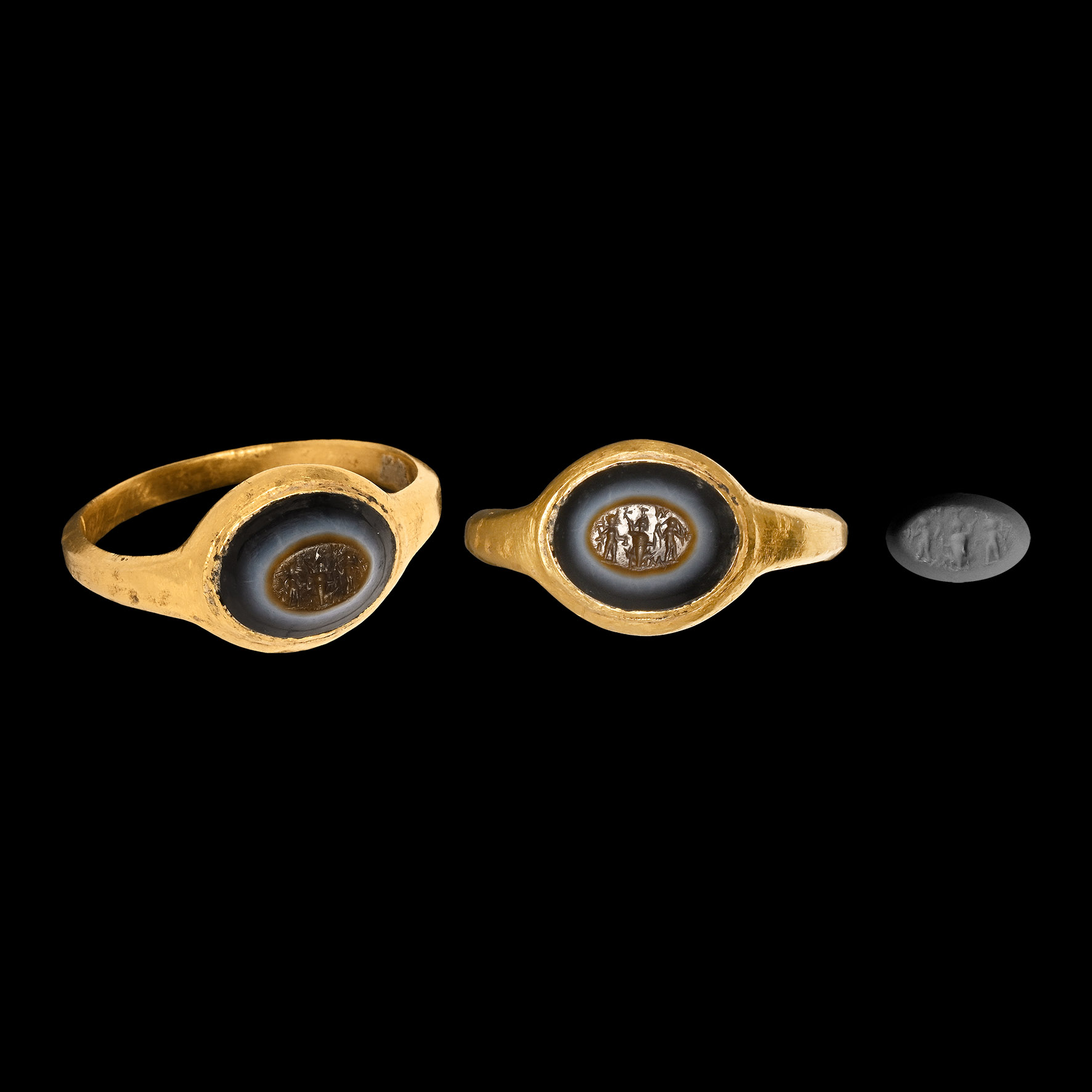
Roman Gold Ring with Sardonyx Gemstone
CIRCA 2ND-3RD CENTURY A.D.
1 in. (6.76 grams, 24.93 mm overall, 21.92 mm internal diameter (approximate size British R 1/2, USA 8 3/4, Europe 19.38, Japan 18)).
Facetted hoop and disc bezel with inset sardonyx depicting three facing goddesses holding attributes.
ProvenanceFrom a collection of a London lady, acquired annually during 1990s-2000s.
This lot has been checked against the Interpol Database of stolen works of art and is accompanied by search certificate no.11962-210875.
Cf. Ruseva-Slokoska, L., Roman Jewellery, Sofia, 1991, item 191, for type.
CONDITIONTimeLine Auctions follows a vetting process to ensure the authenticity and legality of all items, reinforcing our commitment to integrity and responsible trading. Each antiquity, antique, and coin lot undergoes thorough examination by a vetting committee of at least ten external specialists, professional trade association members, scientists, and archaeologists: Our Vetting Process
AUCTIONS:
TimeLine is a leading auction house specialising in antiquities, ancient art, collectables, natural history, coins, medals, and books. Our auctions offer museums, collectors, historians, and enthusiasts the opportunity to acquire unique and historically significant pieces.
LOT 0207
Roman Gold Ring with Sardonyx Gemstone
Estimate £3,500 - 4,500€4,060 - 5,220 (for guidance only)$4,730 - 6,080 (for guidance only)
-
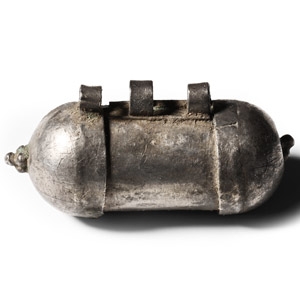
Roman Silver Container Pendant
Circa 2nd-4th century A.D.Estimate: £200 - 300 (+bp*)
Opening Bid: £100
Tubular body with domed cap to each end, applied granule clusters, three suspension loops. 6.3 grams, 35 mm
Acquired on the German art market before 2000. From an EU collection before 2020. -
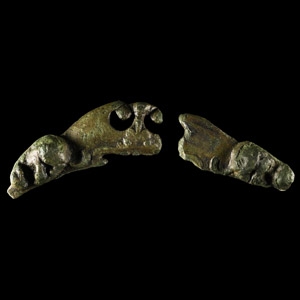
Roman Bronze Apex Mount with Felines
Circa 1st century B.C.-1st century A.D.Estimate: £100 - 140 (+bp*)
Opening Bid: £50
Two military mounts, each roughly triangular with a curved underside; the smaller with a feline modelled in the round at the narrow end; the larger with a similar animal amf comma-leaf detailing at the wider end. 78.2 grams total, 53-67 mm
Found Hampshire, UK.
The comma-leaf ornament on the larger piece is indicative of Roman military metalwork around the time of the conquest of Gaul (circa 55 B.C.), after which large numbers of local troops were recruited into the Roman army. Gallic ornaments of La Tène style influenced the equipment of the legions formed at this time. -
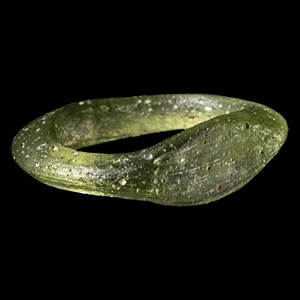
Roman Glass Ring with Bezel
1st-4th century A.D.Sold for (Inc. bp): £78
In light green translucent glass, the hoop widening at the base, lozenge-shaped flat bezel 1.39 grams, 21.56 mm overall, 14.96 mm internal diameter (approximate size British F, USA 2 3/4, Europe 3.67, Japan 3)
Property of a UK gentleman, acquired 1986. Property of an East Sussex, UK, gentleman. Accompanied by an old handwritten identification ticket.
