Loading, please wait...

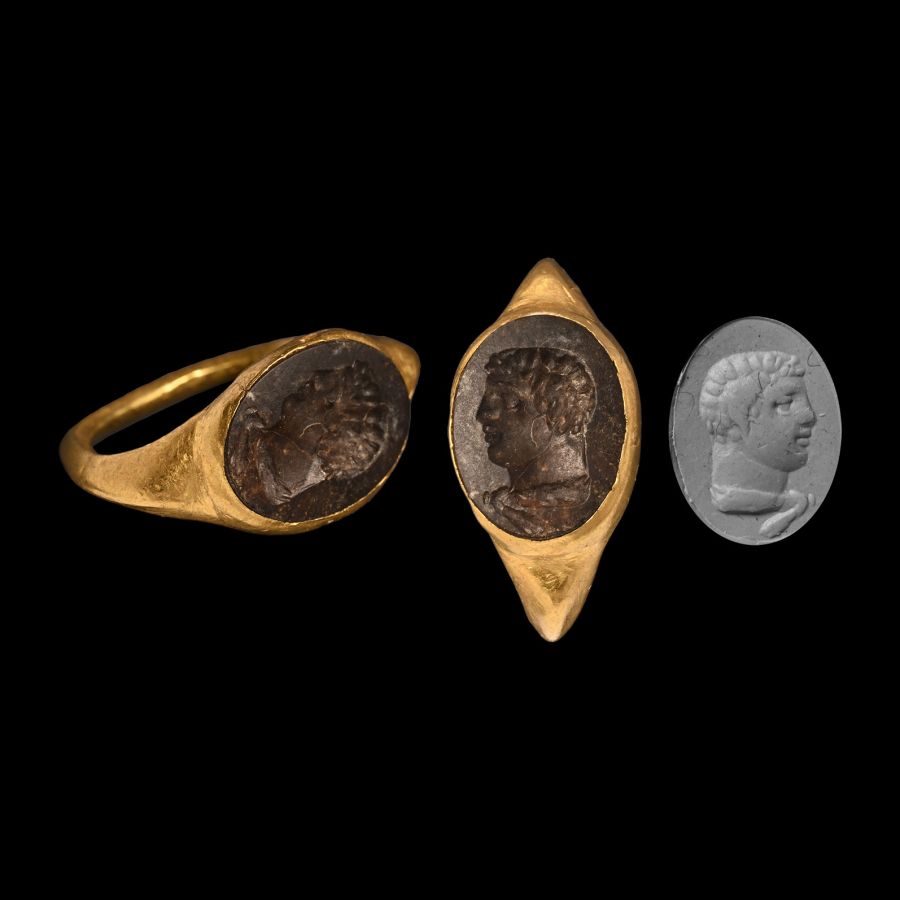
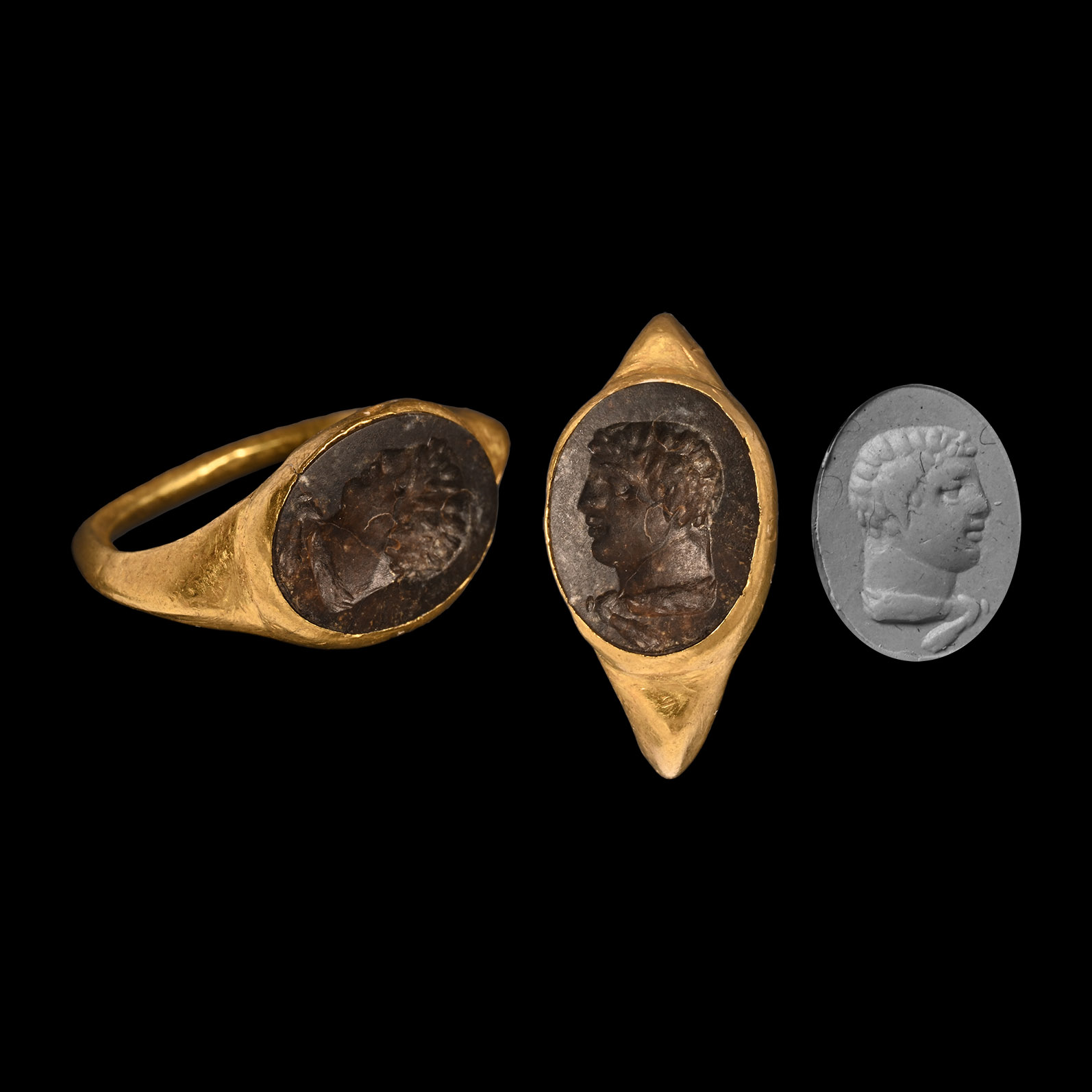
Roman Gold Ring with Herakles Gemstone Roman Gold Ring with Herakles Gemstone Roman Gold Ring with Herakles Gemstone
Use mousewheel to zoom in and out, click to enlarge
Details

LOT 0088

Roman Gold Ring with Herakles Gemstone

2ND CENTURY A.D.

3/4 in. (6.63 grams, 21.95 mm overall, 16.32 mm internal diameter (approximate size British I, USA 4 1/4, Europe 7.44, Japan 7)).

A gold finger ring with flared shoulders, ellipsoid inset haematite intaglio profile bust of young Herakles.

Provenance

Private European collection, acquired 2001.

Literature

Cf. Chadour, A.B., Rings. The Alice and Louis Koch Collection, volume I, Leeds, 1994, item 362.

CONDITION
VETTING:

TimeLine Auctions follows a vetting process to ensure the authenticity and legality of all items, reinforcing our commitment to integrity and responsible trading. Each antiquity, antique, and coin lot undergoes thorough examination by a vetting committee of at least ten external specialists, professional trade association members, scientists, and archaeologists: Our Vetting Process


AUCTIONS:

TimeLine is a leading auction house specialising in antiquities, ancient art, collectables, natural history, coins, medals, and books. Our auctions offer museums, collectors, historians, and enthusiasts the opportunity to acquire unique and historically significant pieces.

LOT 0088

Roman Gold Ring with Herakles Gemstone

Estimate £1,500 - 2,000€1,740 - 2,320 (for guidance only)$2,030 - 2,700 (for guidance only)

Print page

RELATED LOTS
  • Roman Bronze Figurine of Silenus
    Roman Bronze Figurine of Silenus
    1st-2nd century A.D.

    Estimate: £3,500 - 4,500 (‡+bp*)

    Opening Bid: £1,750

    A bronze figure of Silenus standing nude with vine-leaf wreath on the brow, muscular physique, dressed beard and stern facial expression, holding a bunch of grapes in the left hand; accompanied by a custom-made display stand. 104 grams, 65 mm high (127 grams total, 71 mm high including stand)


    Private Swiss collection, acquired 2001. This lot has been checked against the Interpol Database of stolen works of art and is accompanied by search certificate no.11621-199008.

    Silenus was closely associated with the Dionysian cult. He was a deity associated with the forest, wine, drunkenness, the treading-dance of the wine press an orgiastic ritual. Whilst intoxicated, Silenus was belied to possess the power of prophecy. He helped raise the god Dionysus, son of Zeus, after he was entrusted to him by Hermes. Once, whilst travelling with Dionysus through Phrygia, Silenus was captured by king Midas who treated his captive hospitably. As a reward, Dionysus granted the king his famous 'golden touch'. The sacred animal of Silenus is the donkey, the mode of transport he often used according to Greek mythology.

    Lot Details

  • Roman Redware Sherd with Giant Geryon
    Roman Redware Sherd with Giant Geryon
    3rd-4th century A.D.

    Sold for (Inc. bp): £124

    A fragment of redware ceramic from a moulded vessel, low-relief design depicting the giant Geryon as a helmetted Roman Miles advancing, with gladius held ready in both his left hands and a studded round shield; modern mounting loop to the reverse. 36 grams, 78 mm


    Acquired 1960s-1990s. From the late Alison Barker collection, a retired London barrister.

    The image is a representation of the giant Geryon, a monster killed by Herakles usually represented with three bodies and three heads, or three heads and one body, or three bodies and one head. In the Roman iconography (but already visible in Greek iconography) he is often represented as an armoured warrior. The original pottery to which the fragment belonged was probably originally decorated with the labours of Hercules.

    Lot Details

  • Roman Deer Brooch for Flaina
    Roman Deer Brooch for Flaina
    2nd century A.D.

    Sold for (Inc. bp): £845

    A copper-alloy zoomorphic plate brooch, in the shape of a deer with two legs, a short tail and a complete antler, characterised by a series of transverse grooves, the body of the animal with the inscription 'FLAINA' in Latin letters; pin lugs and remains of ferrous pin to the reverse. 11.5 grams, 41 mm


    Acquire in the 1990s. Ex Cambridgeshire, UK, collection.

    Roman fibulae came in a variety of shapes and embellishments. In the Roman Empire, the fibula was both functional and decorative, as men and women wore it to fasten their aprons and cloaks. A similar function was performed by pins intended to hold heavy garments such as cloaks. This type of fibulae were probably produced in Pannonia, from where they were exported around the Empire. Another centre of production of deer fIbulae was probably Roman Britannia.

    Lot Details

Stay up-to-date with the latest from TimeLine Auctions by joining our mailing list