
Loading, please wait...
_900x900.jpg "Roman Gold Ring with Green Chalcedony Gemstone with Pantheistic Deity")
_200x200.jpg "Roman Gold Ring with Green Chalcedony Gemstone with Pantheistic Deity")
.jpg "Roman Gold Ring with Green Chalcedony Gemstone with Pantheistic Deity")
LOT 0145
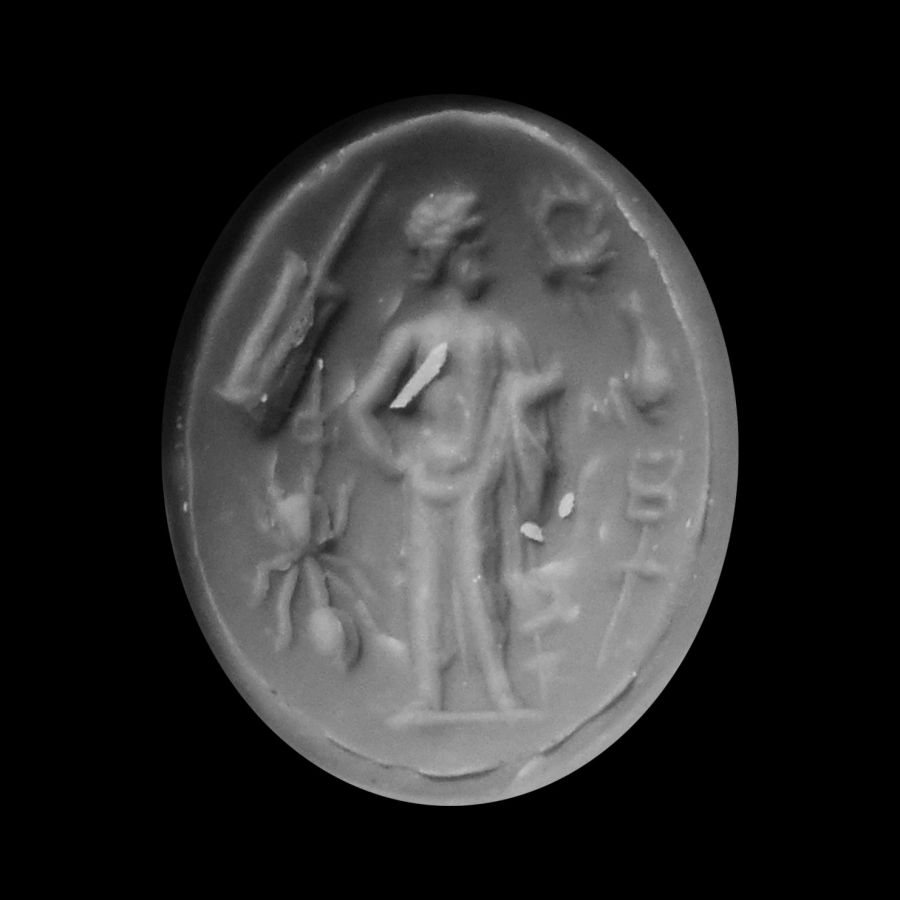
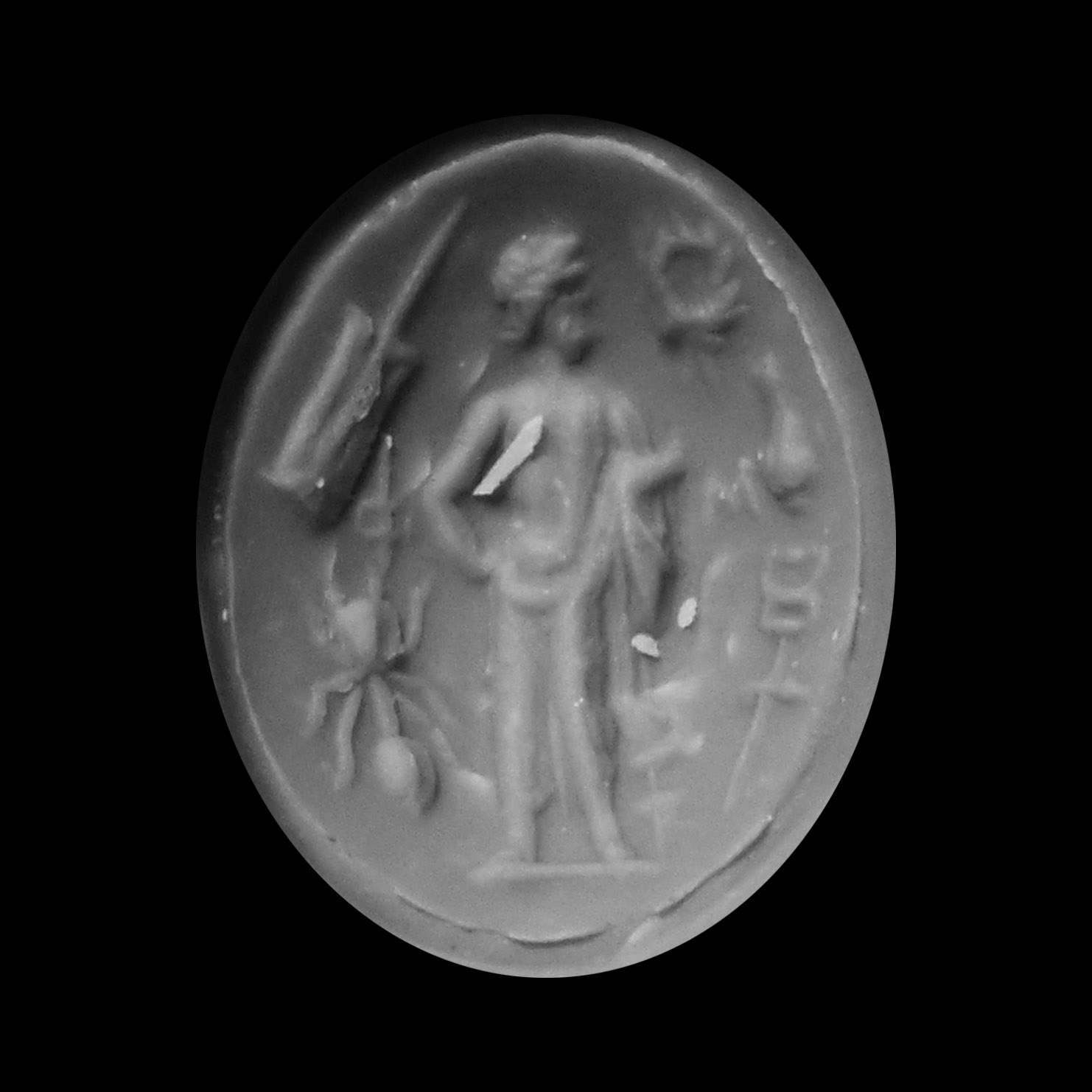
Roman Gold Ring with Green Chalcedony Gemstone with Pantheistic Deity
1ST CENTURY A.D.
1 in. (9.91 grams, 23.93 mm overall, 19.33 mm internal diameter (approximate size British L 1/2, USA 6, Europe 11.87, Japan 11)).
Cabochon with intaglio standing male deity, possibly Asclepius, surrounded by attributes including a wreath, caduceus, ant, sistrum and others; supplied with a museum-quality impression.
ProvenancePrivate collection, England.
LiteratureCf. Chadour, A.B., Rings. The Alice and Louis Koch Collection, volume I, Leeds, 1994, item 148, for type.
CONDITIONTimeLine Auctions follows a vetting process to ensure the authenticity and legality of all items, reinforcing our commitment to integrity and responsible trading. Each antiquity, antique, and coin lot undergoes thorough examination by a vetting committee of at least ten external specialists, professional trade association members, scientists, and archaeologists: Our Vetting Process
AUCTIONS:
TimeLine is a leading auction house specialising in antiquities, ancient art, collectables, natural history, coins, medals, and books. Our auctions offer museums, collectors, historians, and enthusiasts the opportunity to acquire unique and historically significant pieces.
LOT 0145
Roman Gold Ring with Green Chalcedony Gemstone with Pantheistic Deity
Sold for (Inc. bp): £2,340
-
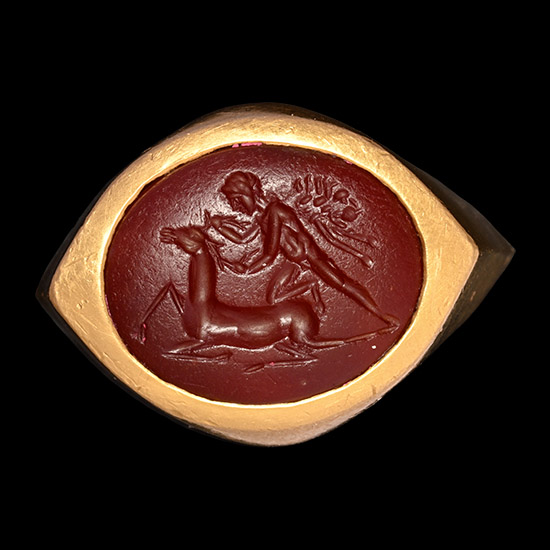
Roman Gemstone of Hercules with Ceryneian Hind in Gold Ring
2nd century A.D.Estimate: £3,000 - 4,000 (+bp*)
Opening Bid: £1,500
Red jasper intaglio engraved with nude Hercules draped in lion's skin, holding antlers of a reclining hind; set into a later substantial gold ring with carinated hoop and enigmatic italic inscription to the inner face with date 1922. 24.05 grams, 29.85 mm overall, 22.95 x 22.30mm internal diameter (approximate size British Z+2, USA 13 1/4, Europe 31.31, Japan 30)
Private collection, England. This lot has been checked against the Interpol Database of stolen works of art and is accompanied by search certificate number no.13171-249502.
The third labour of Hercules was to capture the Ceryneian hind, a swift, golden-antlered animal sacred to the goddess Artemis (Diana), required to bring it alive to the court of King Eurystheus. He accomplished the task after a year-long chase, when he wounded the hind's legs with an arrow near the Ladon River. He explained the situation to Artemis, and after he showed the hind to the king, the animal was released back into nature. -
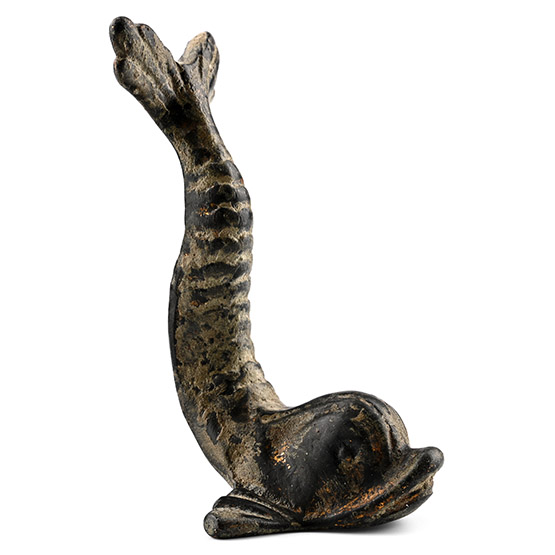
Large Roman Bronze Dolphin Mount
1st-4th century A.D.Sold for (Inc. bp): £494
Hollow to the reverse, formed as a dolphin with body and tail raised, lateral fins flared. 101 grams, 90 mm
Ex German art market, 2000s. Acquired from an EU collector living in London. From the collection of a Surrey, UK, gentleman. -
.jpg)
Roman Agate Cameo of the Emperor Augustus
1st century A.D.Estimate: £20,000 - 30,000 (‡+bp*)
Opening Bid: £11,111
Ellipsoid cameo with profile portrait bust in antique gold pendant frame with surrounding cabochons: emerald, sapphire, ruby - and clusters of pearls; marked to reverse '750', in a rectangle 'Bd G' (believed to be an upstate New York jeweller's stamp) and an indeterminate third mark; supplied with a custom-made display stand. 99 grams total, pendant: 50 mm
American collection, early 20th century, New York. with Robert Haber Gallery, New York, 1990. Ex Jean Clostre, Geneva, Switzerland. Accompanied by a scholarly report by Dr Ittai Gradel. This lot has been checked against the Interpol Database of stolen works of art and is accompanied by search certificate number no.12223-222312.
Dr Ittai Gradel says: 'The cameo, of exquisite technical quality, has a close parallel in the Cabinet des médailles, Paris .. The TimeLine auction cameo is not, however, an exact copy .. though details are so close to the larger Paris cameo that the same gem carver, or at least workshop, probably produced both.'
