
Loading, please wait...
Details
LOT 253952
Roman Gold Ring with Greek Glass Boar Intaglio
4TH CENTURY B.C. - 1ST CENTURY B.C.
7/8 in. (1.93 grams, 22.40 mm overall, 15.77 mm internal diameter (approximate size British J, USA 4 3/4, Europe 8.69, Japan 8)).
Hollow-formed and widening at the shoulders to a high elliptical bezel set with a black and white banded glass intaglio depicting a running boar in profile on a baseline; Greek letters KΠ on the surface under the boar; supplied with a museum-quality impression.
Provenance
Ex private collection, Contessa L.G., since the 1980s.
Private collection, acquired in 1997.
Literature
Cf. for the Greek Intaglio Spier, J. Ancient gems and Finger Rings, Catalogue of the Collections, The J. Paul Getty Museum, p.61 no.119.
Footnotes
The motif and style, a running boar with tube like body, seems to fit into Boardman's Wyndham Cook Group, and could be ascribed to the Graeco-Persian period, although the gemstone was later incorporated in a Roman ring.
CONDITIONVETTING:
TimeLine Auctions follows a vetting process to ensure the authenticity and legality of all items, reinforcing our commitment to integrity and responsible trading. Each antiquity, antique, and coin lot undergoes thorough examination by a vetting committee of at least ten external specialists, professional trade association members, scientists, and archaeologists: Our Vetting Process
AUCTIONS:
TimeLine is a leading auction house specialising in antiquities, ancient art, collectables, natural history, coins, medals, and books. Our auctions offer museums, collectors, historians, and enthusiasts the opportunity to acquire unique and historically significant pieces.
LOT 253952
Roman Gold Ring with Greek Glass Boar Intaglio
Estimate £600 - 800€700 - 930 (for guidance only)$810 - 1,080 (for guidance only)
Opening Bid
£333 (EUR 387; USD 450) ‡+BP*
RELATED LOTS
-
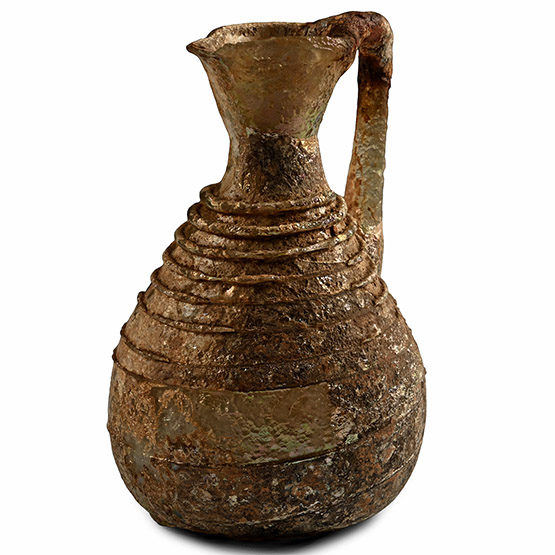
Roman Glass Jug with Trails
4th-5th century A.D.Estimate: £350 - 450 (‡+bp*)
Opening Bid: £190
A small pale yellow collared globular jug with short neck, angular ribbon handle with two narrow prominent ribs, folded upper attachment to the cylindrical neck, several horizontal lines on the globular body, trefoil mouth. 32 grams, 74 mm
with H.A.C., Basel, prior 1999.
These globular jugs were typical of the Eastern Mediterranean in the late Roman period. The body was often decorated with ornamental threads. The jugs were often used in a manner similar to pilgrim flasks, to collect oil and water from early Christian sanctuaries. -
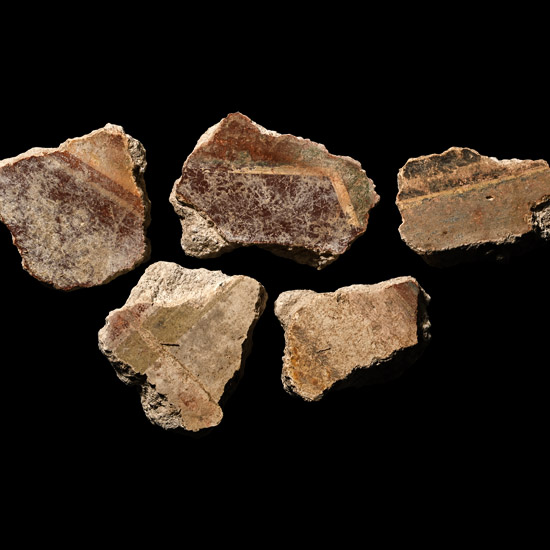
Roman Fresco Wall Plaster Collection
1st century A.D.Estimate: £50 - 70 (+bp*)
Opening Bid: £5
Fragments of wall plaster with rendered surface painted with mainly Pompeii red, pale blue and white detailing; some with impression of timber laths to the reverse. 499 grams total, 69-85 mm
Acquired in the 19th century. Ex Jeger collection, Switzerland. UK gallery, early 2000s.
These small fragments, for analogies with the fragments of Pompeii, seem to belong to the second style of Roman painting, red panels representing highlight and shadow, decorated with vegetal interlaces. Some panels were probably framed by a red grenade fillet. A fragment shows alternate blue and red colour over a cream background, maybe pertinent to a socle. -
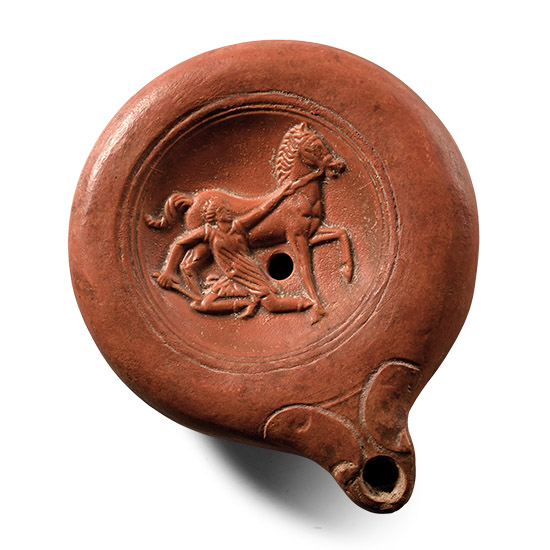
Large Roman Terracotta Oil Lamp with 'Fallen Amazon' and Horse
Circa 1st-2nd century A.D.Estimate: £150 - 200 (+bp*)
Opening Bid: £50
Shallow oil lamp with narrow nozzle, the discus with a dynamic scene of an advancing horse moving to the right with a fallen Amazon hanging on to its bridle; inked collector's number '220' on the base. 115 grams, 12.3 cm
Ex important German collection, 1960-1990.
