
Loading, please wait...
LOT 0089
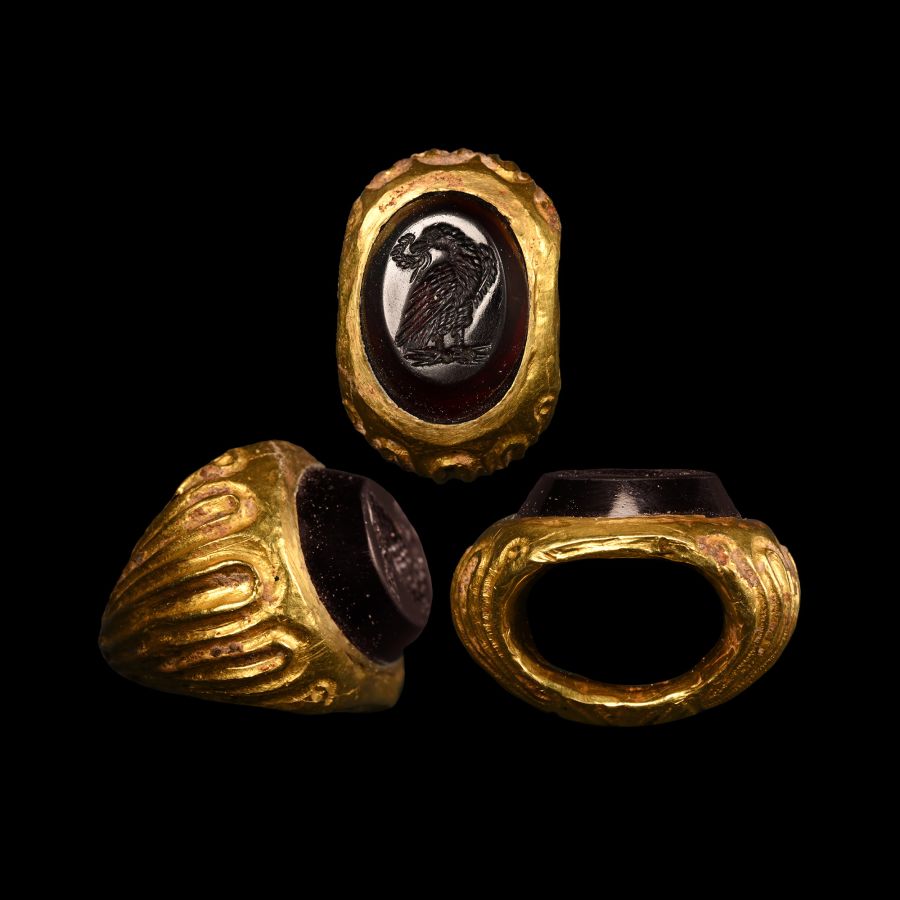
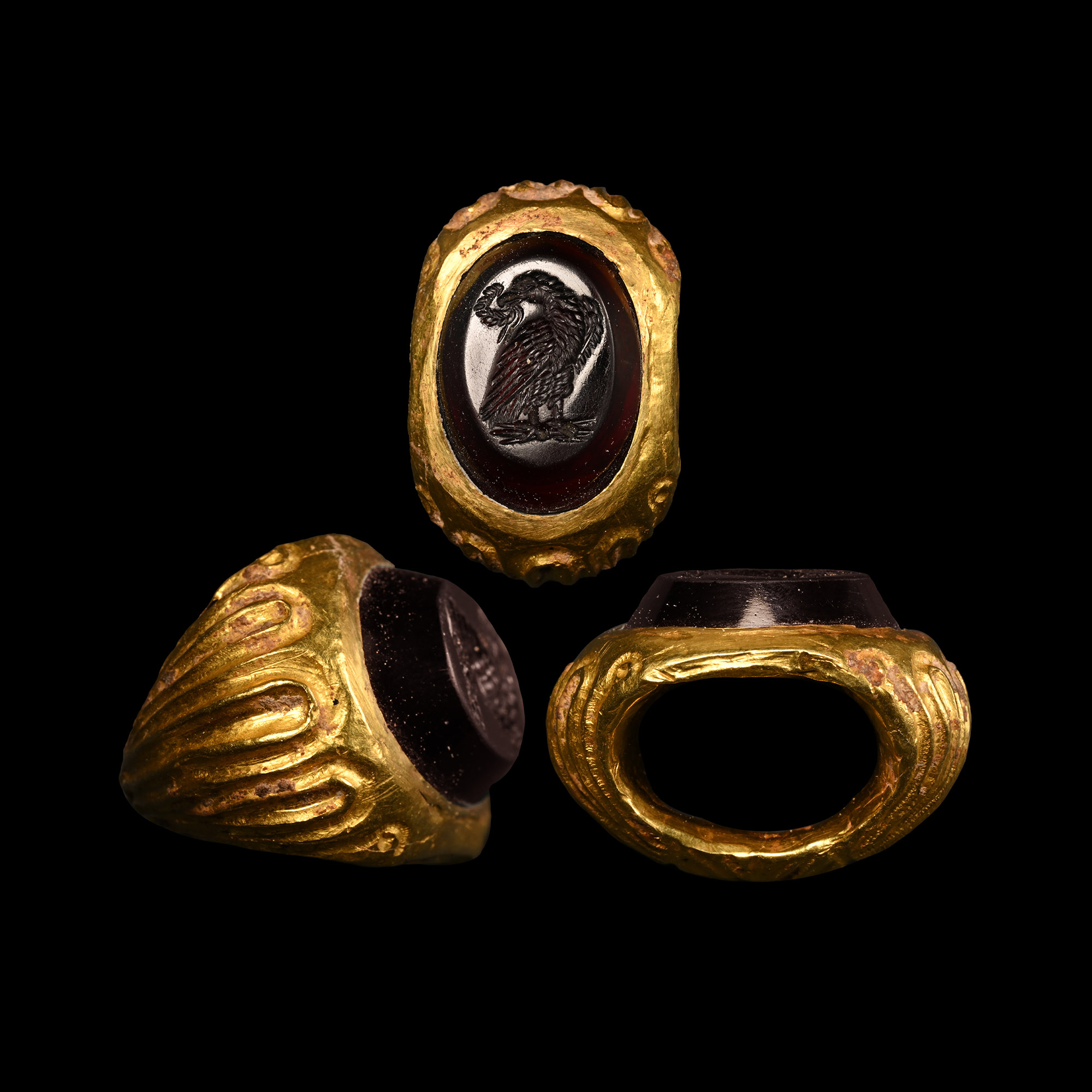
Roman Gold Ring with Eagle of Jupiter
2ND-3RD CENTURY A.D.
1 1/8 in. (11.80 grams, 30.64 mm overall, 17.06 x 12.36 mm internal diameter (approximate size British F, USA 2 3/4, Europe 3.67, Japan 2 3/4)).
Hollow-formed with fluting to the shoulders and foliage panel to the underside, plaque with inset garnet cabochon bearing an eagle in three-quarter view gripping a lightning bolt, head turned, laurel wreath in the beak; supplied with a museum-quality impression.
ProvenanceFrom the collection of a deceased lady, 1990s.
Ex London, UK, gentleman, 2000s.
This lot has been checked against the Interpol Database of stolen works of art and is accompanied by a search certificate number no.12523-231876.
This lot has been cleared against the Art Loss Register database, and is accompanied by an illustrated lot declaration signed by the Head of the Antiquities Department, Dr Raffaele D’Amato.
Cf. Ruseva-Slokoska, L., Roman Jewellery, Sofia, 1991, items 186, 211, for type.
FootnotesThis splendid intaglio of an eagle depicts what Pliny the Elder calls the: ‘most honourable and strongest of all birds’ (Naturalis Historis.10.3.1), and Aelian remarks that it possesses the ‘keenest sight of all birds’ (De natura animalium. 1.42). However, the animal was not revered in antiquity solely out of admiration for its natural attributes, it was esteemed during the Greek, Roman Republican and Imperial times as the bird that held the lightning of the sky god Zeus/Jupiter, whose identifying symbol is the thunderbolt and his primary sacred animal is the eagle. It is also a symbol of Victory, power and immortality, since it is associated with the passage of a deified emperor’s spirit into the world of the immortals. The primary military use of the eagle was as a standard, which comprised of a golden or gilded metal eagle, clutching thunderbolts in its talons, perched atop a long metal pole with a butt-spike for planting in the ground.
Both Ovid and Plutarch place the inception of manipular ensigns with Romulus, where bundles (manipuli) of hay were tied to high poles which served as rallying points for units of the army. Eventually, icons of animals replaced these ensigns: the eagle, wolf, Minotaur, horse, and boar. In 107 B.C., Gaius Marius made sweeping military reforms and the Aquila became the sole standard of the legion, which according to (Pliny NH. 10.5.16) ‘By making the Aquila the standard for all legions improved unity and gave soldiers a symbol that expressed their attachment to an all-encompassing body, to which the soldiers’ loyalty could be directed’. Due to its place at the head of each legion, it became the emblem of the Roman legions, which enforced Roman rule in the provinces, giving the eagle its connotation of dominion.
TimeLine Auctions follows a vetting process to ensure the authenticity and legality of all items, reinforcing our commitment to integrity and responsible trading. Each antiquity, antique, and coin lot undergoes thorough examination by a vetting committee of at least ten external specialists, professional trade association members, scientists, and archaeologists: Our Vetting Process
AUCTIONS:
TimeLine is a leading auction house specialising in antiquities, ancient art, collectables, natural history, coins, medals, and books. Our auctions offer museums, collectors, historians, and enthusiasts the opportunity to acquire unique and historically significant pieces.
-
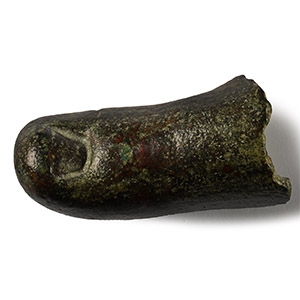
Roman Bronze Statue Thumb
1st-4th century A.D.Sold for (Inc. bp): £156
Modelled in the round with accurate anatomical detailing. 40.7 grams, 36 mm
Ex German art market, 2000s. Acquired from an EU collector living in London. From the collection of Surrey, UK, gentleman. This lot is accompanied by an illustrated lot declaration signed by the Head of the Antiquities Department, Dr Raffaele D’Amato. -
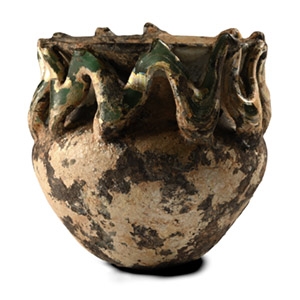
Roman Glass Flask with Gallery
3rd-4th century A.D.Estimate: £1,000 - 1,400 (+bp*)
Opening Bid: £500
Globular in profile with wide double-stepped rolled rim, applied wavy line trails forming a gallery from rim to body. 113 grams, 81 mm wide
From an important glass collection, London, UK, 1980-1990. This lot is accompanied by an illustrated lot declaration signed by the Head of the Antiquities Department, Dr Raffaele D’Amato. -
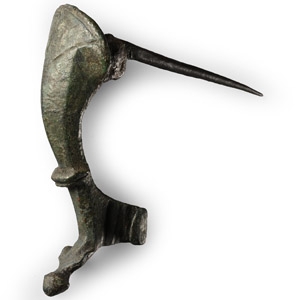
Roman Bronze Trumpet-Derivative Brooch
Circa 2nd century A.D.Sold for (Inc. bp): £33
Substantial D-section bow with flared upper section and fan-shaped head, ribbed ledge below the equator and scooped foot with lateral wings and ball finial; hooked catch to rear, hinged pin intact. 29.3 grams, 58 mm
Acquired on the UK art market before 2000. Property of an Essex, UK, gentleman. This lot is accompanied by an illustrated lot declaration signed by the Head of the Antiquities Department, Dr Raffaele D’Amato.
The brooch lacks the loop at the apex of the head which is characteristic of true trumpet brooches; its hinged pin did not require this feature which originates in the coiled spring mechanism.
