
Loading, please wait...
LOT 0144
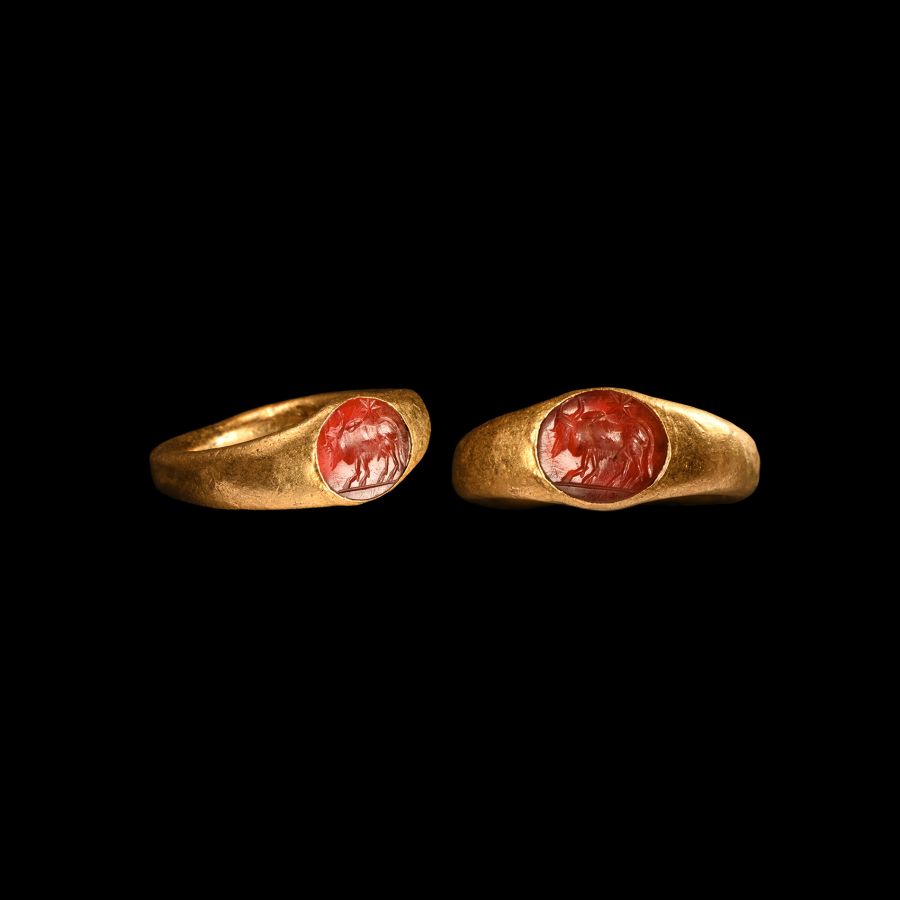
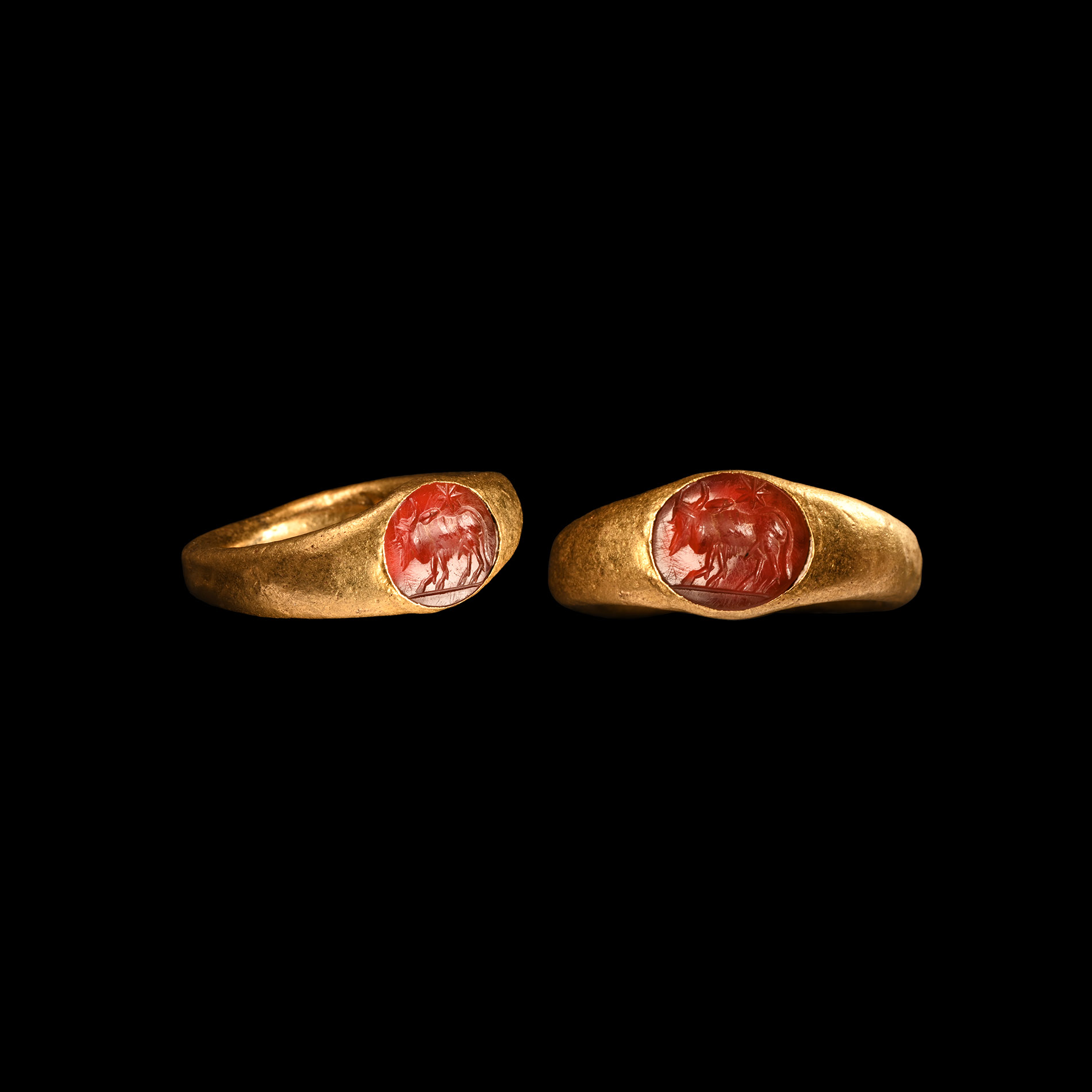
Roman Gold Ring with Cult of Jupiter Dolichenus Bull Gemstone
2ND CENTURY A.D.
1 in. (4.41 grams, 26.31 mm overall, 18.49 mm internal diameter (approximate size British Q 1/2, USA 8 1/4, Europe 18.12, Japan 17)).
A solid, smooth gold ring with D-shaped hoop, oval carnelian intaglio with a bull surmounted by a star; repaired.
ProvenanceAcquired 1970-2000s.
Ex Abelita family collection.
Cf. Beutler, F. et al., Der Adler Roms. Carnuntum und der Armee der Cäsaren, Bad-Deutsch Altenberg, 2017, item 153, for type; for the Dolichenus cult see Kusseven, P., The Cult of Iupiter Dolichenus: origins and iconography, Ankara, 2007, p.120, fig.B15.
FootnotesThe bull, symbol of thunder and fertility, was an important component of the cult of Jupiter Dolichenus, to which this ring is probably connected. The god is usually represented as standing on a bull holding an axe in his upraised right hand and a bolt of lightning in the left. This bull perpetuated the connection with storms, a frequent and rather obvious identification of power and ferocity. This was a Hittite concept inherited from the Anatolians and then by the Romans.
CONDITIONTimeLine Auctions follows a vetting process to ensure the authenticity and legality of all items, reinforcing our commitment to integrity and responsible trading. Each antiquity, antique, and coin lot undergoes thorough examination by a vetting committee of at least ten external specialists, professional trade association members, scientists, and archaeologists: Our Vetting Process
AUCTIONS:
TimeLine is a leading auction house specialising in antiquities, ancient art, collectables, natural history, coins, medals, and books. Our auctions offer museums, collectors, historians, and enthusiasts the opportunity to acquire unique and historically significant pieces.
LOT 0144
Roman Gold Ring with Cult of Jupiter Dolichenus Bull Gemstone
Sold for (Inc. bp): £1,105
-
.jpg)
Roman Vine Leaf Mount
1st-2nd century A.D.Sold for (Inc. bp): £39
A bronze mount or harness fitting in the form of a vine leaf displaying simple stylised detailing to the front face, together with a raised perforated lug and scooped plaque above; suspension loop to the reverse. 57 grams, 58 mm
Found Cambridgeshire in the 1990s. -
Roman Repousse Plaque with Muse Terpsichore
4th century A.D.Estimate: £700 - 900 (+bp*)
Opening Bid: £389
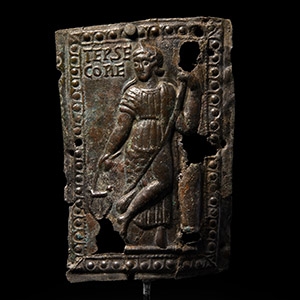
A square plaque from a casket or votive panel with the embossed image of the Muse Terpsichore, dressed in a short sleeved tunica talaris, standing with the weight on the right leg, the other leg bent in front of the body, the right hand holding a lyre hanging from a strap, in the left hand a staff; inscription in late Latin beside the right part of the head reading 'TEPSECORE'; the figure framed with an embossed edge; accompanied by a custom-made display stand. 41 grams total, 10.6 cm high including stand
Fine condition.
Acquired in the 1970s. Ex London collection.
The plaque probably came from a casket similar to the one of Carnuntum, which represent the images of the Muses on one side and biblical scenes to the other side. These scenes were popular motifs in Late Antiquity, where caskets with Christian and mythological images were widespread, especially in Pannonia. -
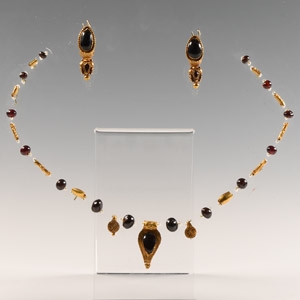
Roman Gold Necklace Element and Earring Set
2nd century A.D.Estimate: £3,000 - 4,000 (‡+bp*)
Opening Bid: £1,500
A suite of gold and garnet jewellery, comprising a matching pair of gold earrings, each composed of a hollow crescentic body tapering to slender coiled wire terminals, a suspension loop to each shoulder, large tear-shaped cell to front with granulated border, set with a polished garnet cabochon, gold bulbs below in the form of a bunch of grapes, adorned with smaller granules and three cells set with polished garnet cabochons; the necklace elements comprising graduated beads, alternating between roughly spherical polished garnets and sheet-gold beads of various types including gusseted, biconical and tubular, two floral filigree pendants flanking a central pendant ornamented with 'plaited' and plain filigree wire with granules to the outside, finial of trefoil bulbs, central corrugated cell set with a polished garnet cabochon; mounted on a custom-made perspex display base. 435 grams total, display stand: 30 x 23.5 cm (earrings: 38 mm each)
Ex private European collection, 1970s. with Genève Enchères, 14 December 2017, Lot 999. Accompanied by an academic report by Dr Raffaele D’Amato. This lot has been checked against the Interpol Database of stolen works of art and is accompanied by search certificate number no.11584-199015.
Beryls, used as small pendants, and not placed horizontally, characterised Roman necklaces of 2nd century A.D. A typical example is the necklace found in the grave of Crepereia Tryphaena. The contents of the grave are dated to the Antonine age based on the sarcophagus, the inscription and the hairstyle of the doll it contains.
