
Loading, please wait...
LOT 0734
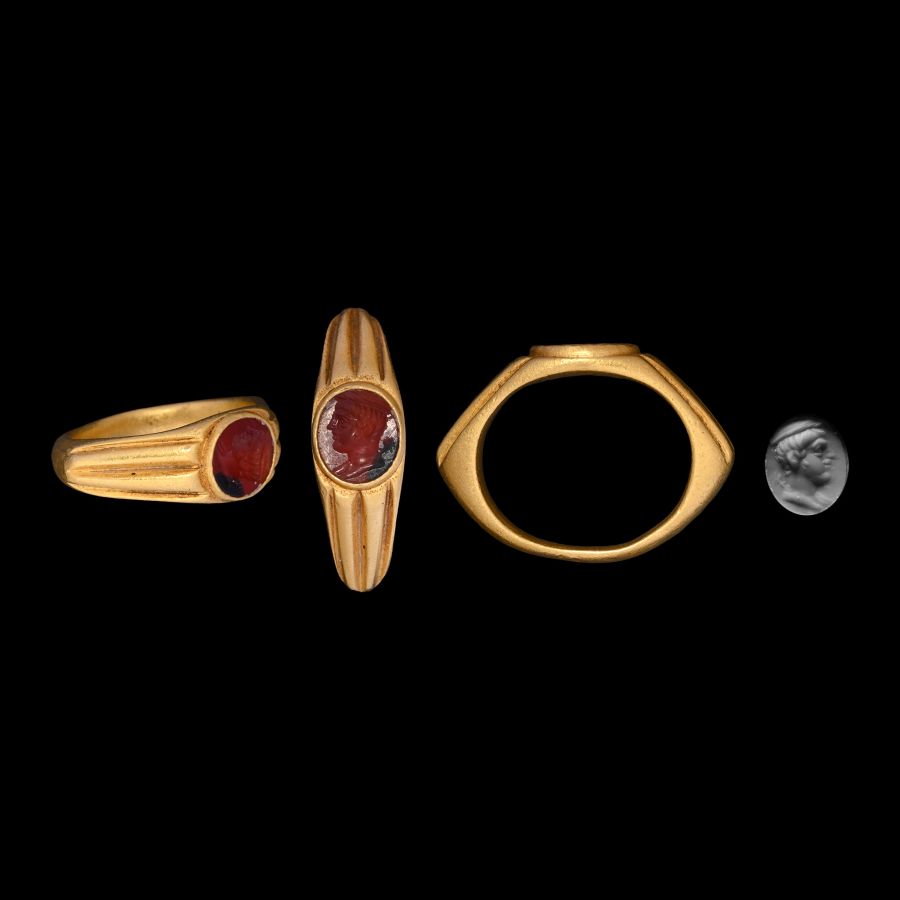
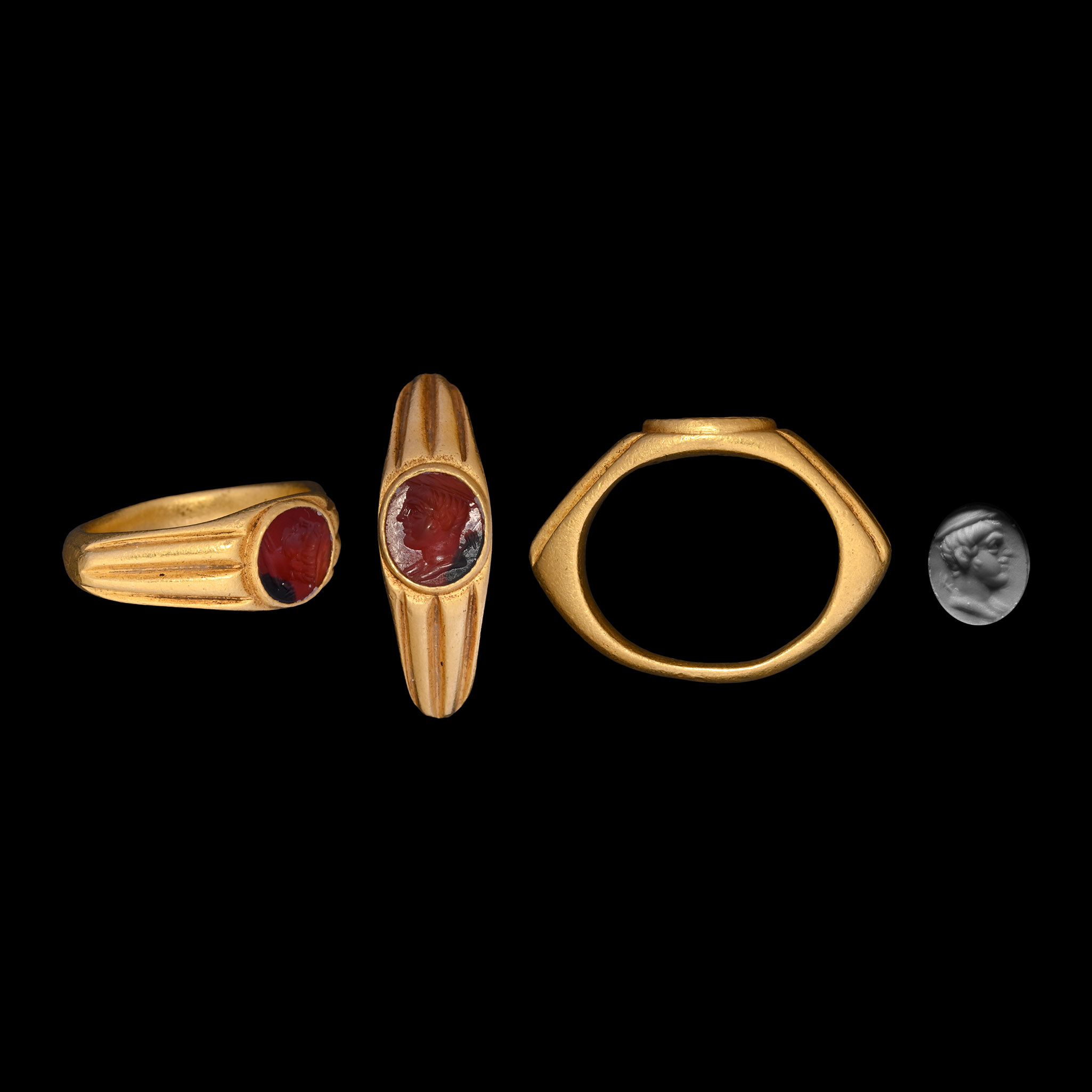
Roman Gold Ring with Carnelian Mercury Gemstone
2ND-3RD CENTURY A.D.
1 in. (9.17 grams, 25.33 mm overall, 17.63 x 14.43 mm internal diameter (approximate size British J 1/2, USA 5, Europe 9.32, Japan 9)).
Intaglio bust of Mercury turned to the left, with a petasos on his head and a caduceus on his shoulder; natural black inclusions in the red stone; mirror-finish polishing; gold mounting/setting with flattened and jutting hoop; mounted in an ancient gold ring; supplied with a museum-quality impression.
ProvenanceAcquired on the UK art market.
Private collection, England.
This lot has been checked against the Interpol Database of stolen works of art and is accompanied by search certificate number no.13169-249498.
TimeLine Auctions follows a vetting process to ensure the authenticity and legality of all items, reinforcing our commitment to integrity and responsible trading. Each antiquity, antique, and coin lot undergoes thorough examination by a vetting committee of at least ten external specialists, professional trade association members, scientists, and archaeologists: Our Vetting Process
AUCTIONS:
TimeLine is a leading auction house specialising in antiquities, ancient art, collectables, natural history, coins, medals, and books. Our auctions offer museums, collectors, historians, and enthusiasts the opportunity to acquire unique and historically significant pieces.
LOT 0734
Roman Gold Ring with Carnelian Mercury Gemstone
Estimate £2,000 - 3,000€2,320 - 3,480 (for guidance only)$2,700 - 4,050 (for guidance only)
-
.jpg)
Roman Miniature Military Silver Eagle Statuette
2nd century A.D.Estimate: £100 - 140 (+bp*)
Opening Bid: £50
Modelled in the round with folded wings andsplit tail; socket to the chest. 11.6 grams, 28 mm
Private collection, England. -
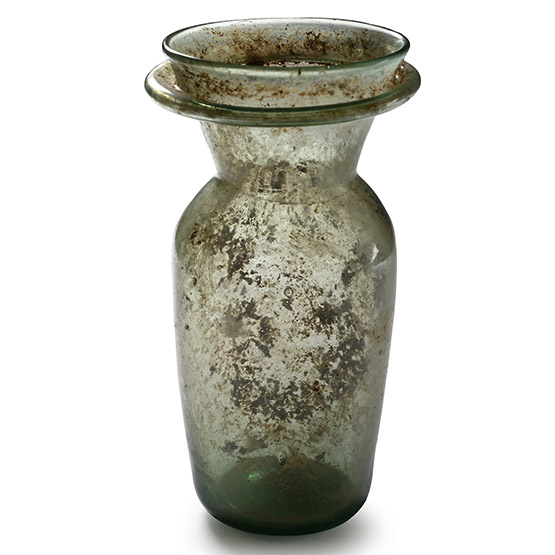
Roman Glass Bottle
3rd-4th century A.D.Sold for (Inc. bp): £234
With dimpled base, flared neck and carinated flange below the mouth, rounded rim. 102 grams, 12.9 cm
From an important London collection of glass, 1990s.
The vessel's shape is a simplified version of a cup decorated with a zigzag line. This is characteristic of Palestinian workshops. Two similar vessels, similar to this one, have been found in Palestine: one in Beit Fajjar, dating to the late 3rd-4th century CE, the other in an unidentified location. -
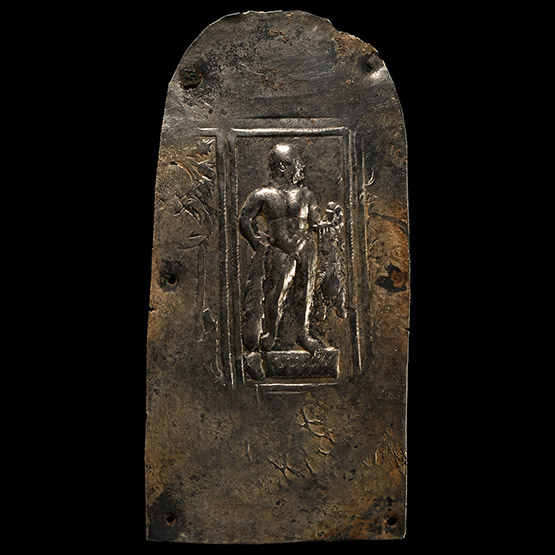
Roman Silver Votive Plaque with Hercules
2nd-4th century A.D.Sold for (Inc. bp): £780
Tongue-shaped with central repoussé motif of Hercules standing nude on a plinth supporting his club and with lionskin mantle draped over his bent forearm; rectangular frame surrounding; traces of similar frames to both sides; six holes for attachment. 30 grams, 99 mm
Acquired in the mid 1980s-1990s. Private collection, Switzerland, thence by descent. Private collection, since the late 1990s.
The panel has clearly been cut from a larger sheet of silver which was stamped with low-relief figures: to the left of Hercules is a frame with fronds at the top and the bent arms of a figure wearing a palla.
