
Loading, please wait...
_900x900.jpg "Roman Gold Ring with Carnelian Intaglio Depicting Castor")
_200x200.jpg "Roman Gold Ring with Carnelian Intaglio Depicting Castor")
.jpg "Roman Gold Ring with Carnelian Intaglio Depicting Castor")
LOT 0106
Roman Gold Ring with Carnelian Intaglio Depicting Castor
1ST-3RD CENTURY A.D.
1 in. (6.24 grams, 27.39 mm overall, 18.70 mm internal diameter (approximate size British K, USA 5 1/4, Europe 9.95, Japan 9)).
Hollow-formed ring with inset intaglio, profile bust of Castor, son of Zeus, with star above his brow; supplied with a museum-quality impression.
ProvenanceAcquired on the German art market, 1989-1995.
with The Museum Gallery, 19 Bury Place, London, WC1, UK, 1998-2003.
Property of a London based academic, 2003-present.
This lot has been checked against the Interpol Database of stolen works of art and is accompanied by a search certificate number no.12391-226043.
Cf. Ruseva-Slokoska, L. Roman Jewellery, Sofia, 1991, item 186 for a more ornate example of the type.
CONDITIONTimeLine Auctions follows a vetting process to ensure the authenticity and legality of all items, reinforcing our commitment to integrity and responsible trading. Each antiquity, antique, and coin lot undergoes thorough examination by a vetting committee of at least ten external specialists, professional trade association members, scientists, and archaeologists: Our Vetting Process
AUCTIONS:
TimeLine is a leading auction house specialising in antiquities, ancient art, collectables, natural history, coins, medals, and books. Our auctions offer museums, collectors, historians, and enthusiasts the opportunity to acquire unique and historically significant pieces.
LOT 0106
Roman Gold Ring with Carnelian Intaglio Depicting Castor
Estimate £1,800 - 2,400€2,090 - 2,780 (for guidance only)$2,430 - 3,240 (for guidance only)
-
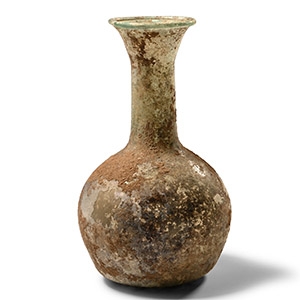
Roman Glass Toilet Bottle
1st century B.C.-1st century A.D.Sold for (Inc. bp): £156
With globular body, everted rim, cylindrical neck, rounded shoulder merging with concave wall, rounded base. 61 grams, 14 cm
Ex London, UK, collection, 1980-1990s.
This toilet bottle could be associated with the Isings form 6 and De Tommaso type 7. These small bottles are among the earliest known blown glass. The everted rim seems to distinguish examples made in Italy and the western Mediterranean provinces from those of the Eastern Mediterranean, on which the rim is usually folded in the form of a flange. -
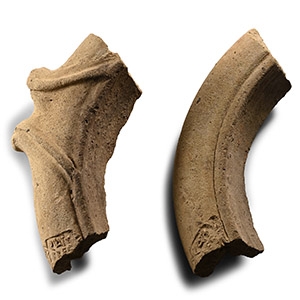
Roman Terracotta Mortarium Fragments with Maker's Stamps in Tabula Ansata
2nd century A.D.Sold for (Inc. bp): £46
Two fragments of the returned rim of a mortarium, one with the convergent ribs for the pouring lip; each stamped with legend 'Q[I]V[S]-A / CRE[S]C = Quintus Iustius Crescens ?' in tabula ansata. 707 grams total, 17.5-19.8 cm
Found UK, possibly from Lincolnshire. From the collection of a late East Anglian teacher and antiquarian who retired to the Isle of Wight in Hampshire, UK. He amassed a large collection of objects between the 1960s-1980s.
Significant mortaria were manufactured at several sites in and around Lincoln during 2nd century A.D.; they had a wide distribution across northern England and southern Scotland. Quintus Iustius Crescens was active producer in Lincolnshire during 100-140 A.D. -
.jpg)
Romano-British Enamelled Bronze Military Lunar Horse Harness Pendant and Hanger
Circa 2nd century A.D.Sold for (Inc. bp): £182
Composed of a pelta-shaped pendant (lunula) attached to a drop hanger decorated with concentric circles, the central one with remains of light blue and crimson enamel. 5.79 grams, 60 mm
Found Yorkshire, UK, in 2022. Property of a Yorkshire gentleman.
Horse harness pendants were often characterised by lunulae (small moons, i.e. pelta-shaped artefacts) and drop hangers. They were decorated with enamels of different colours.
