
Loading, please wait...
LOT 0574
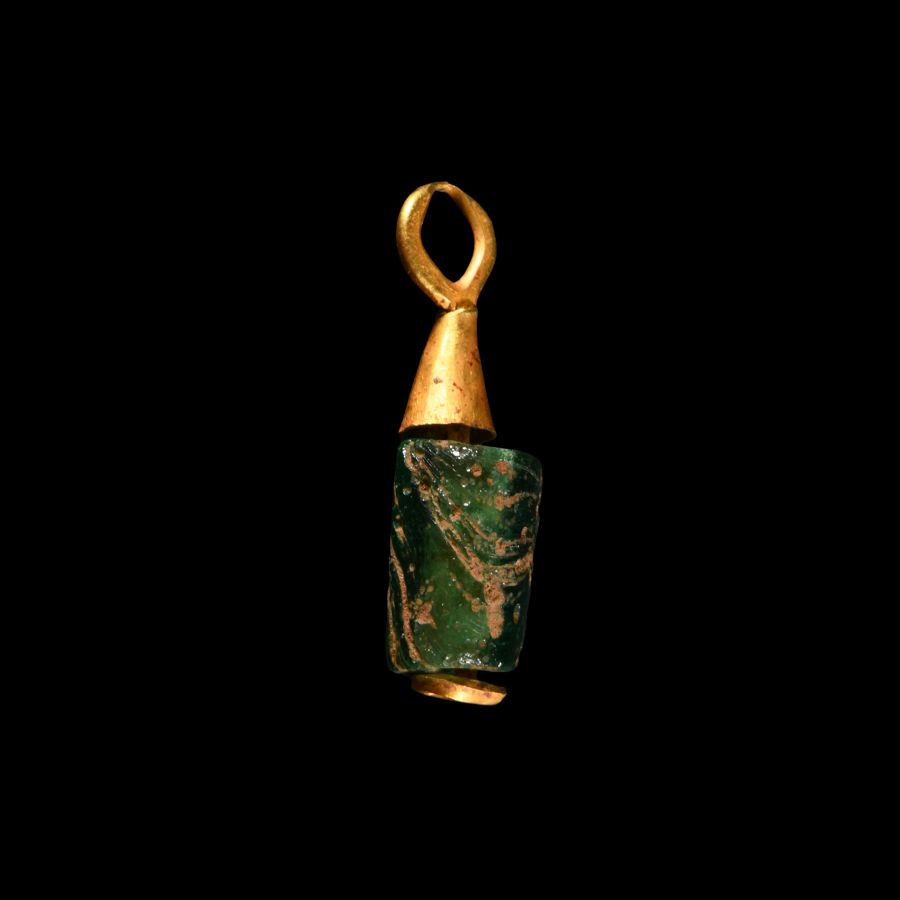
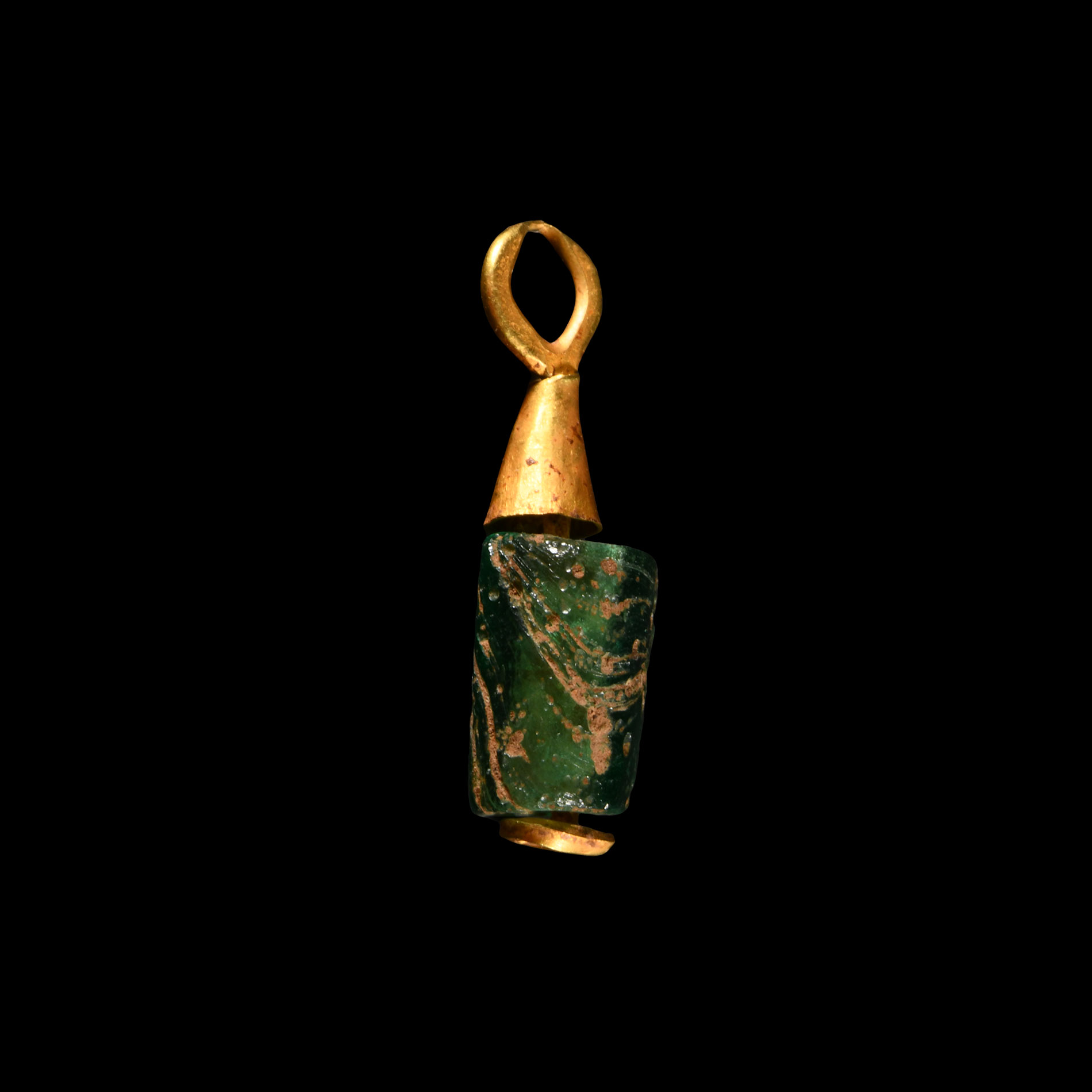
Roman Gold Pendant with Bead Drop
1ST-4TH CENTURY A.D.
1/2 in. (0.38 grams, 14 mm high).
With an emerald green cylindrical bead, conical gold collar beneath the suspension loop. [No Reserve]
ProvenanceProperty of a UK gentleman, acquired in the 1970s.
Property of an East Sussex, UK, gentleman.
Accompanied by an old identification ticket.
TimeLine Auctions follows a vetting process to ensure the authenticity and legality of all items, reinforcing our commitment to integrity and responsible trading. Each antiquity, antique, and coin lot undergoes thorough examination by a vetting committee of at least ten external specialists, professional trade association members, scientists, and archaeologists: Our Vetting Process
AUCTIONS:
TimeLine is a leading auction house specialising in antiquities, ancient art, collectables, natural history, coins, medals, and books. Our auctions offer museums, collectors, historians, and enthusiasts the opportunity to acquire unique and historically significant pieces.
-
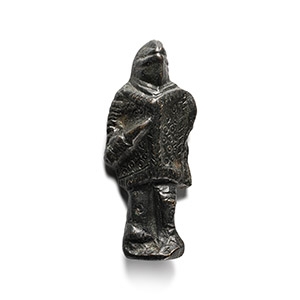
Roman Bronze Gladiator Mount
Circa 1st-2nd century A.D.Sold for (Inc. bp): £338
Modelled in the half-round with hollow reverse and fixing stud; gladiator advancing with a gladius short-sword drawn in right hand, holding a rectangular shield (scutum) and wearing greaves (ocreae); the arm protected by an armoured manica. 48 grams, 62 mm
From the French collection of M Garcia, 1990s.
The gladiator represented here belongs to the class of the scutarii (wearers of big shields) of the familia of the secutor or provocatores. The secutor was the chronological evolution of samnite gladiators. The title of secutor appears historically only in the imperial era and is closely linked to the title of contraretiarius, the retiarius being his true and only opponent. The secutor's armament consisted of the gladius and a large shield, a short ocrea on the left leg and a padded or armoured sleeve with chiroteca to protect his arm and hand. -
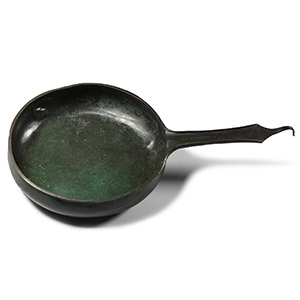
Roman Bronze Pan with Handle
1st century B.C.-1st century A.D.Estimate: £1,200 - 1,700 (+bp*)
Opening Bid: £667
The bowl with a wide flat bottom and convex sides; the inside with incised concentric circles; flat handle with raised edges and hooked finial for suspension. 483 grams, 39.5 cm
German private collection, Mr O., collecting in the 1950s-1960s; thence by descent. with Bonhams, London, 7 July 2016, lot 191. Accompanied by an academic report by Dr Raffaele D’Amato. This lot has been checked against the Interpol Database of stolen works of art and is accompanied by search certificate number no.11735-201189.
This vessel was part of Roman and provincial bronze instrumentum domesticum, i.e. culinary or domestic utility ware. Such cooking vessels are rare: some are found in central and northern Italy, in Pannonia, Germany and in Britain. The Aylesford Pan, today in the British Museum (inventory no.1886.1112.1), is one of the most important finds. This specimen (Eggers type 130), probably pre-Caesarian or Caesarian, was found in a grave together with a Celtic bucket and a jug. -

Roman Bronze Nibbling Rat Figurine
1st-2nd century A.D.Sold for (Inc. bp): £52
Modelled in the half-round on an elliptical base, forelegs bent clutching a piece of food, saly tail to the rear. 29 grams, 30 mm
UK art market, acquired prior to 1980. Property of an East Sussex, UK, private collector.
Rats can be distinguished from mice by their thick, scaly tails.
