
Loading, please wait...
LOT 0592
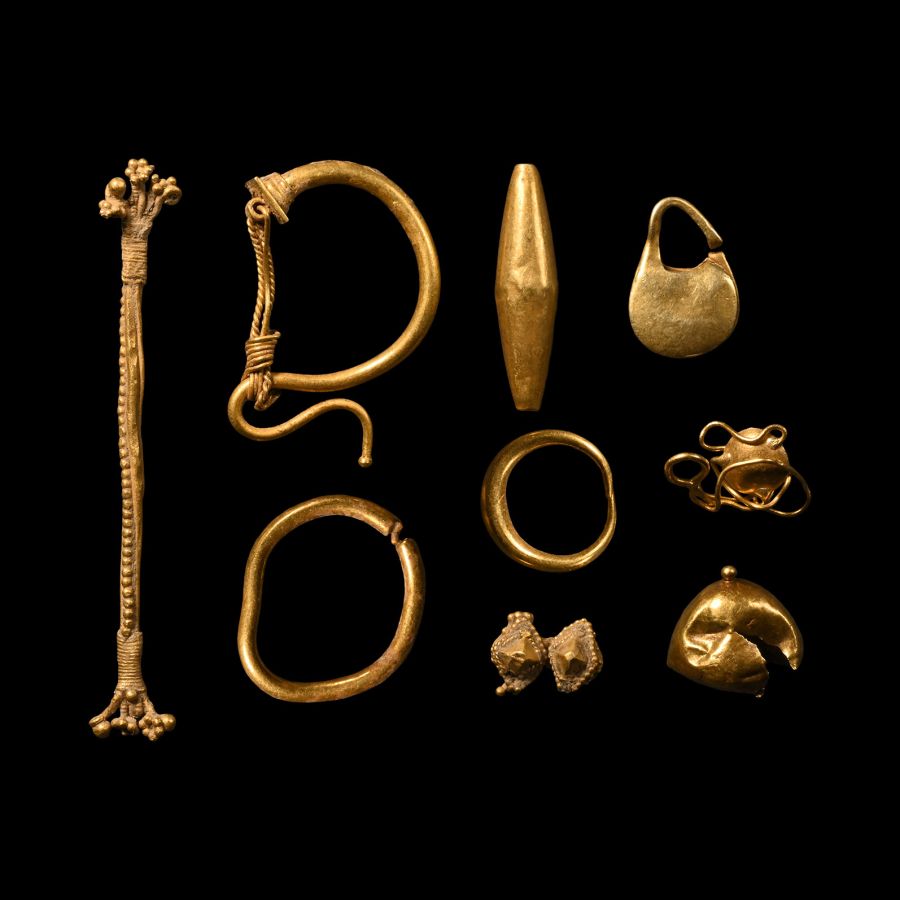
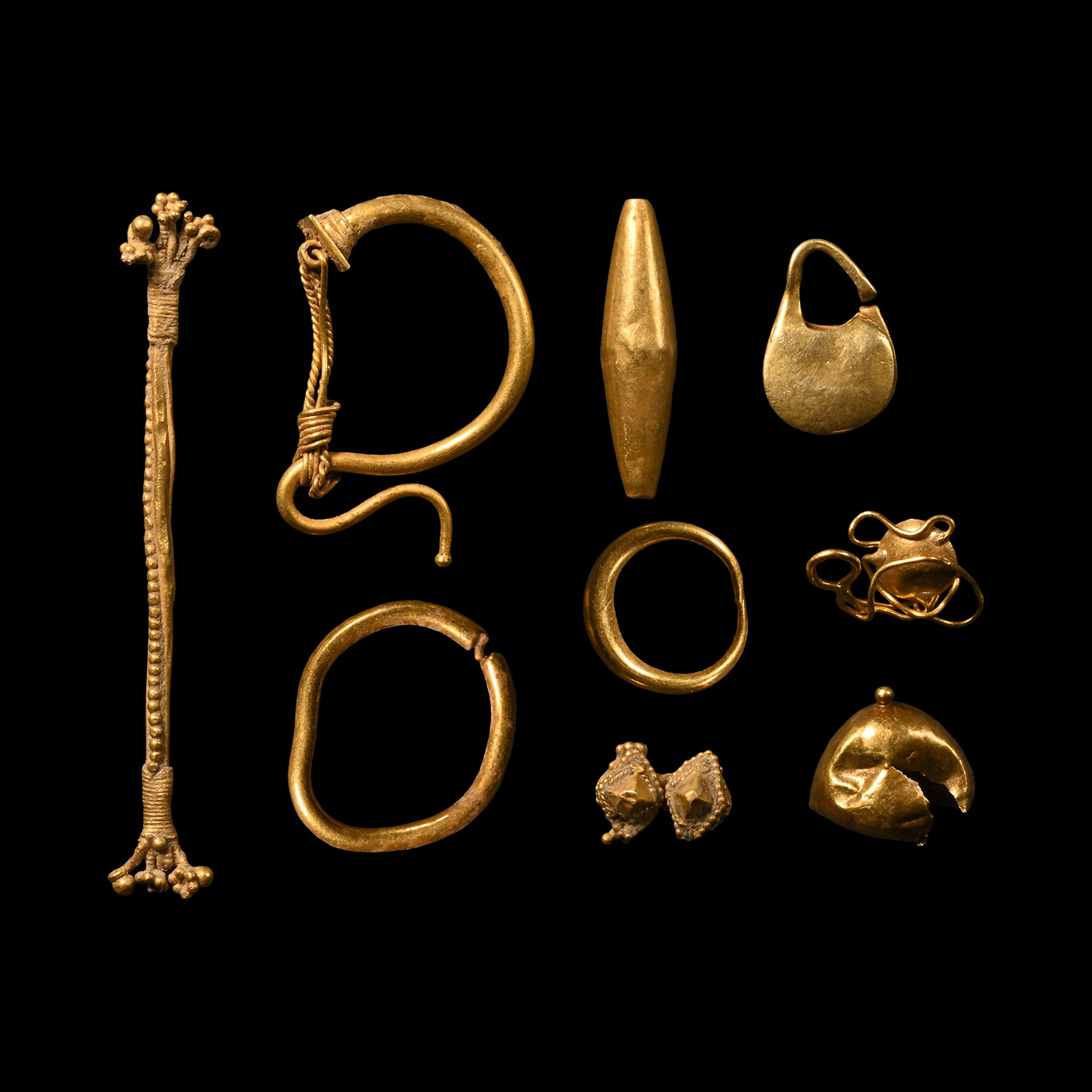
Roman Gold Jewellery Group
1ST-3RD CENTURY A.D.
3/8 - 2 1/4 in. (18 grams total, 11-58 mm).
A mixed group of gold items including a biconical bead, an earring with recurved bow, granule finial and filigree closure, a domed bell-pendant with granule to the apex and other items. [9]
ProvenanceAcquired early 1990s.
Ex private American collection; thence by descent.
Private collection since 1998.
TimeLine Auctions follows a vetting process to ensure the authenticity and legality of all items, reinforcing our commitment to integrity and responsible trading. Each antiquity, antique, and coin lot undergoes thorough examination by a vetting committee of at least ten external specialists, professional trade association members, scientists, and archaeologists: Our Vetting Process
AUCTIONS:
TimeLine is a leading auction house specialising in antiquities, ancient art, collectables, natural history, coins, medals, and books. Our auctions offer museums, collectors, historians, and enthusiasts the opportunity to acquire unique and historically significant pieces.
-
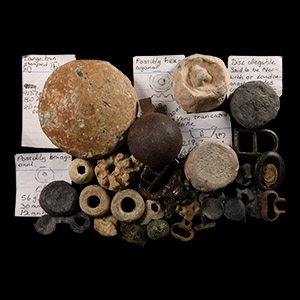
Roman to Civil War Artefact Group
1st-17th century A.D.Sold for (Inc. bp): £26
A group of detector finds including lead trade weights, thimbles, buckles, seals, buttons and other items. 1.87 kg total, 19-78 mm
Found UK. Ex property of a Nottingham, UK, collector. -
.jpg)
Large Roman Rectangular Glass Bottle
3rd-4th century A.D.Estimate: £2,000 - 3,000 (‡+bp*)
Opening Bid: £500
A mottled aqua-green glass bottle, the body square in plan with tall tubular trumpet-shaped mouth and neck, folded ribbed-strap handle; moulded detail to the underside of four anchor-shaped motifs radiating from the centre; cracked. 479 grams, 20.2 cm high
Acquired early 1990s. Ex private American collection; thence by descent. Private Swiss collection since 1998. This lot has been checked against the Interpol Database of stolen works of art and is accompanied by search certificate no.11634-199024. -
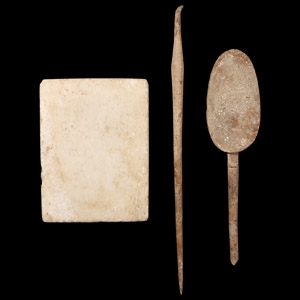
Roman Palette and Bone Implement Group
1st-4th century A.D.Estimate: £200 - 300 (‡+bp*)
Opening Bid: £100
A rectangular stone palette with bevelled edges, accompanied by a bone spoon and probe implement. 152 grams total, 7.5-15.5 cm
Acquired early 1990s. Ex private American collection; thence by descent. Private collection since 1998.
