
Loading, please wait...
LOT 0214
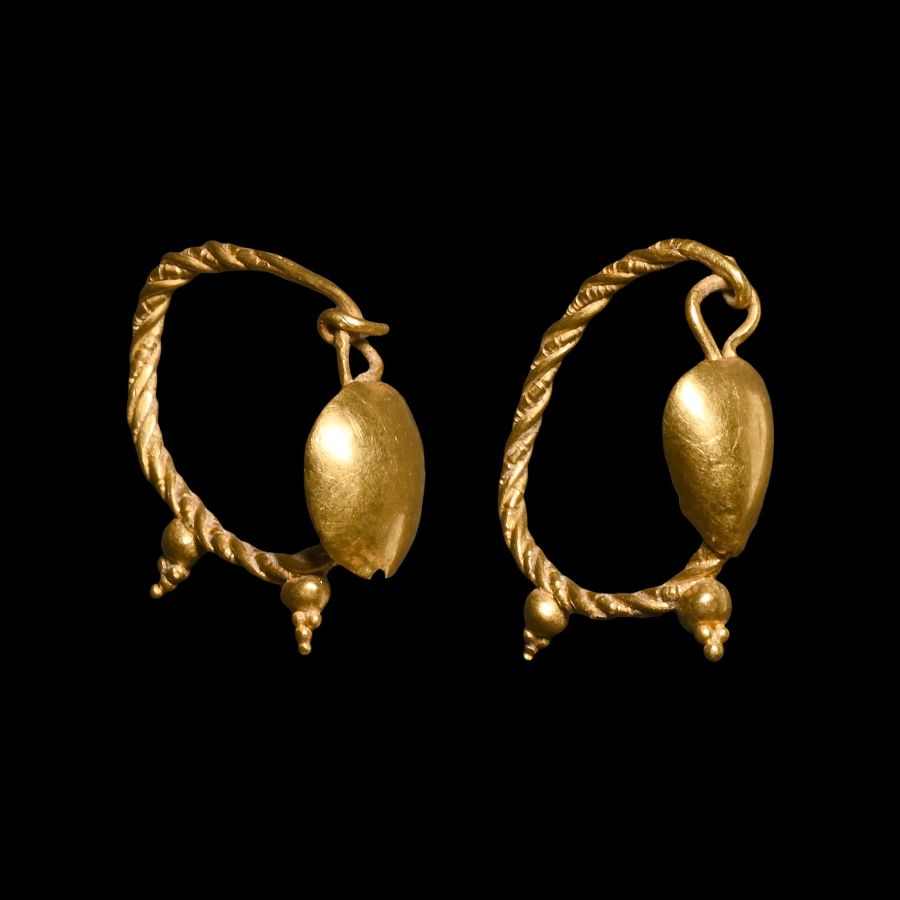
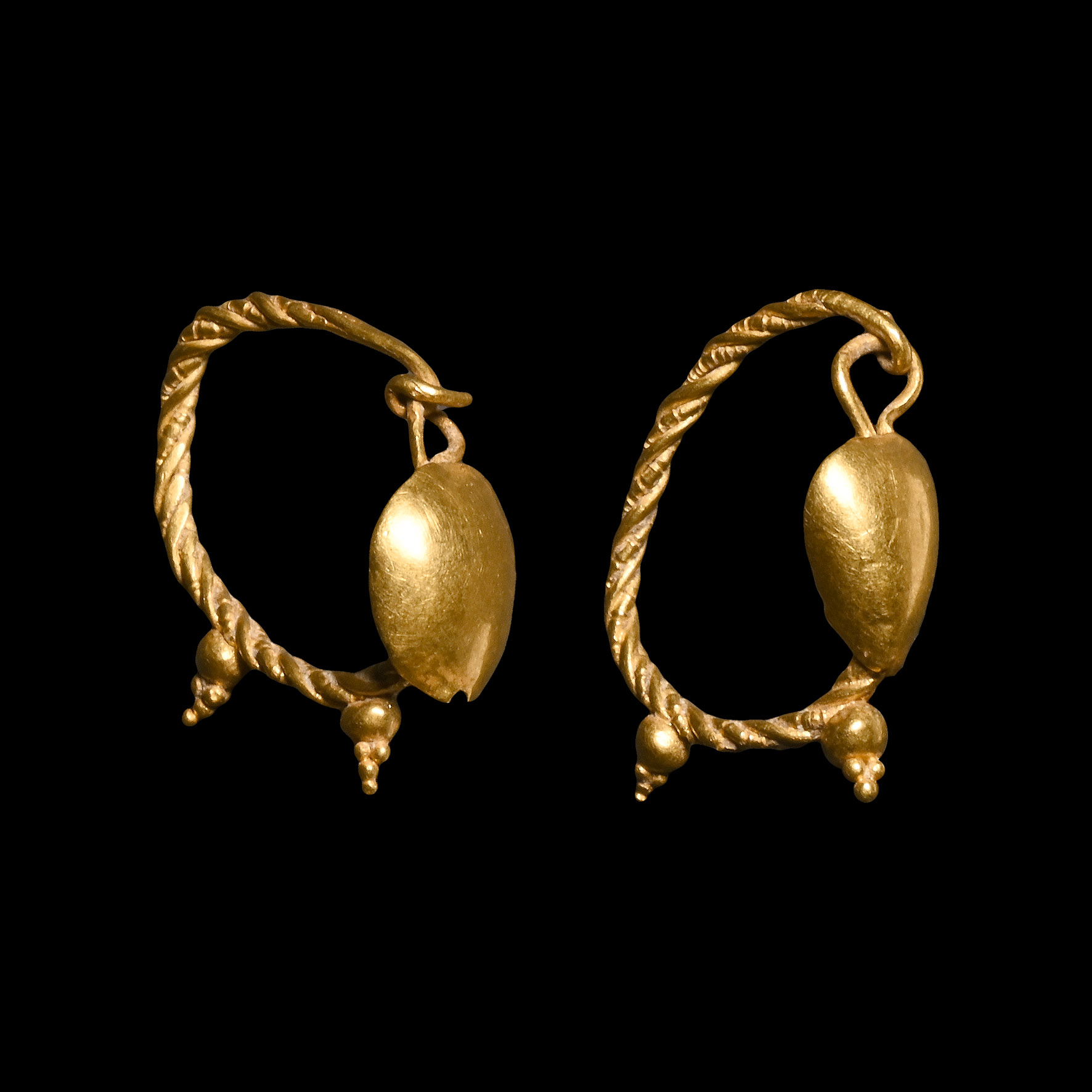
Roman Gold Earrings with Bosses
CIRCA 1ST-2ND CENTURY A.D.
3/4 in. (1.97 grams total, 17-18 mm).
Matched pair of gold earrings, each a twisted wire hoop with domed ellipsoid shield and hook-and-eye closure; two radiating granules to the lower edge each with a graduated granule cluster below. [2]
ProvenanceFrom a collection of a London lady, acquired annually during 1990s-2000s.
LiteratureCf. Marshall, F.H., Catalogue of the Jewellery, Greek, Etruscan and Roman, in the Department of Antiquities, British Museum, London, 1911, pl.LIII, item 2508, for type.
CONDITIONTimeLine Auctions follows a vetting process to ensure the authenticity and legality of all items, reinforcing our commitment to integrity and responsible trading. Each antiquity, antique, and coin lot undergoes thorough examination by a vetting committee of at least ten external specialists, professional trade association members, scientists, and archaeologists: Our Vetting Process
AUCTIONS:
TimeLine is a leading auction house specialising in antiquities, ancient art, collectables, natural history, coins, medals, and books. Our auctions offer museums, collectors, historians, and enthusiasts the opportunity to acquire unique and historically significant pieces.
LOT 0214
Roman Gold Earrings with Bosses
Estimate £1,000 - 1,400€1,160 - 1,620 (for guidance only)$1,350 - 1,890 (for guidance only)
-
Eastern Roman Stone Relief of Medusa
2nd-3rd century A.D.Sold for (Inc. bp): £1,300
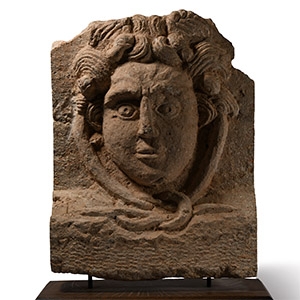
With a ledge to the base, carved high-relief mask of Medusa with complex banded hairstyle with diadem to the brow, lateral tresses framing the face developing to serpents forming a 'Hercules knot' beneath the chin; the face with deep-set eyes beneath a heavy brow, prominent nose above pursed lip; the base keyed to accept a plaster overlay; mounted on a custom-made stand. 33.1 kg total, 53 cm including stand
Ex P.A., Hertfordshire, UK, specialist collection of Greek art, 1980-1990s. -
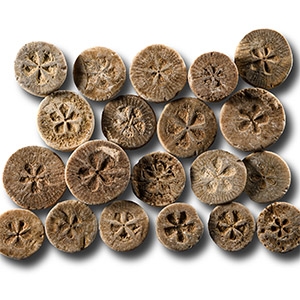
Roman Limestone Gaming Counter Group
1st-4th century A.D.Sold for (Inc. bp): £65
Twenty discoid limestone counters each with an incuse cinquefoil to both faces. 32 grams total, 13-17 mm
Private collection formed in the 1990s. Acquired from a central London gallery. Property of an Essex gentleman. -
.jpg)
Roman Glass Intaglio Showing Two Gryphons Attacking a Deer
2nd-3rd century A.D.Sold for (Inc. bp): £416
Ellipsoid glass cloison with incuse image of two gryphons attacking a deer; set in a later silver ring. 18.57 grams, 30.95 mm overall, 22.99 mm internal diameter (approximate size British N 1/2, USA 6 3/4, Europe 14.35, Japan 13)
From the collection of a North American gentleman, formed in the 1990s.
The subject of griffins attacking a deer has a long history and remained popular during the Hellenistic and Roman period throughout the Mediterranean area and beyond. It may be a symbol of the inevitability of death.
