
Loading, please wait...
LOT 0216
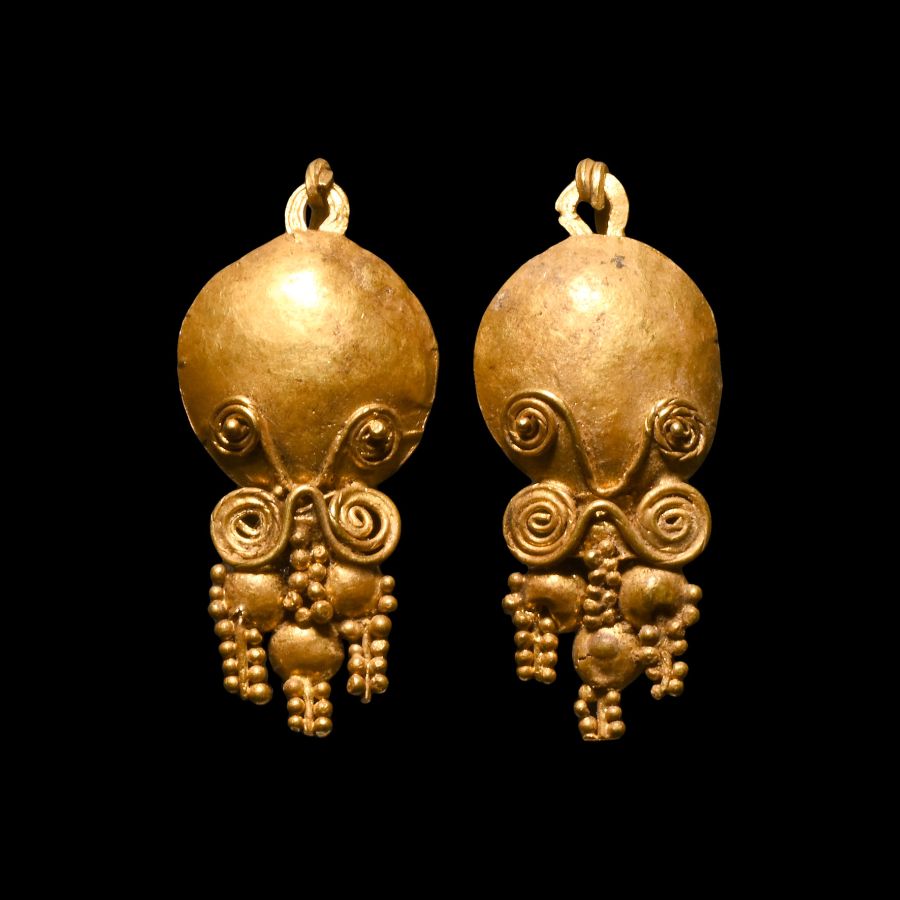
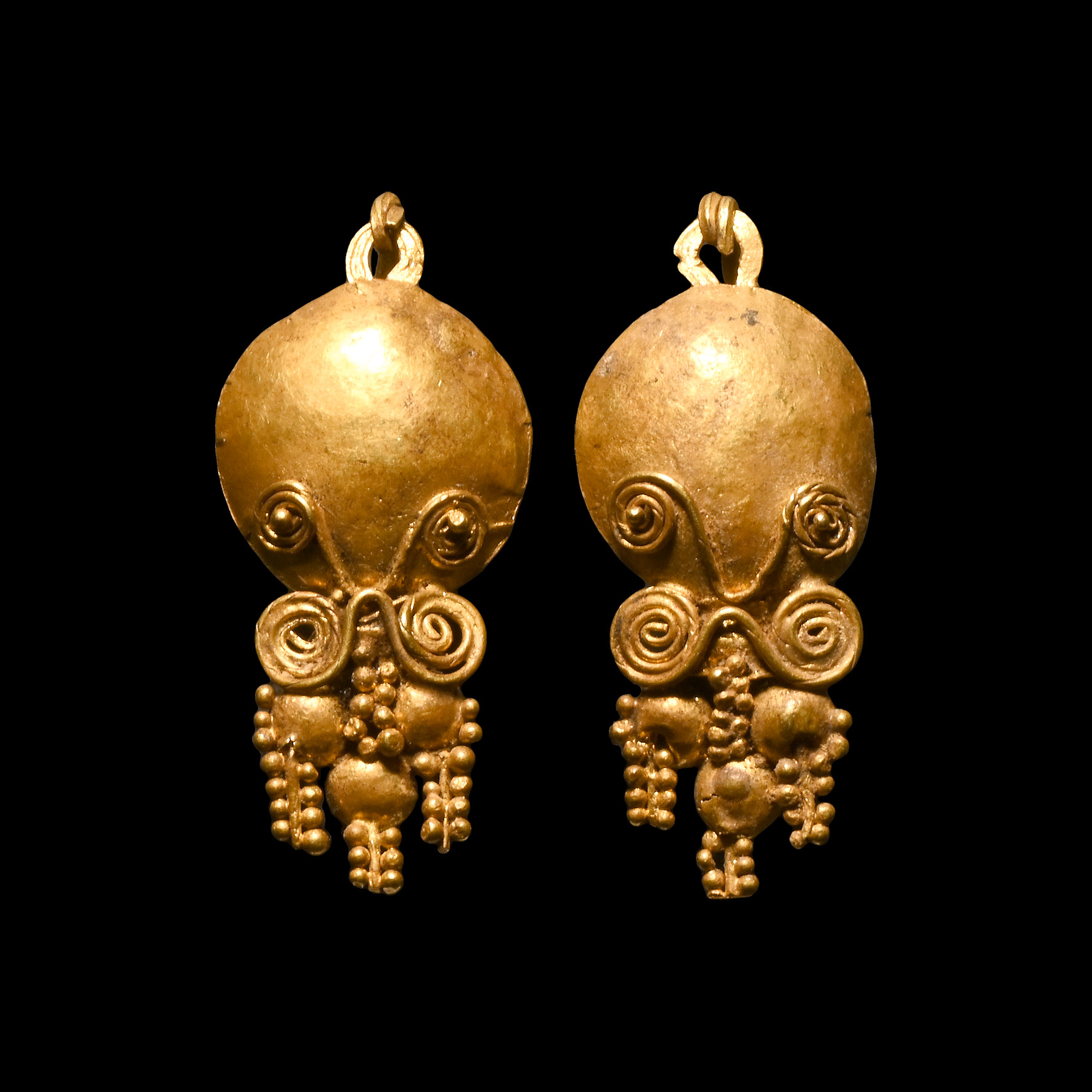
Roman Gold Earrings with Bosses
CIRCA 1ST-2ND CENTURY A.D.
1 3/8 in. (6.58 grams total, 34 mm each).
Matched pair of gold earrings, each adomed shield with substantial hoop to the reverse, hook-and-eye closure, applied filigree ram's head scrolls above a cluster of hollow balls with vertical granule clusters. [2]
ProvenanceFrom a collection of a London lady, acquired annually during 1990s-2000s.
LiteratureCf. Ruseva-Slokoska, L., Roman Jewellery, Sofia, 1991, items 38, 60a, for type.
CONDITIONTimeLine Auctions follows a vetting process to ensure the authenticity and legality of all items, reinforcing our commitment to integrity and responsible trading. Each antiquity, antique, and coin lot undergoes thorough examination by a vetting committee of at least ten external specialists, professional trade association members, scientists, and archaeologists: Our Vetting Process
AUCTIONS:
TimeLine is a leading auction house specialising in antiquities, ancient art, collectables, natural history, coins, medals, and books. Our auctions offer museums, collectors, historians, and enthusiasts the opportunity to acquire unique and historically significant pieces.
LOT 0216
Roman Gold Earrings with Bosses
Estimate £1,200 - 1,700€1,390 - 1,970 (for guidance only)$1,620 - 2,300 (for guidance only)
-

Roman Putto Gemstone
Circa 2nd-3rd century A.D.Sold for (Inc. bp): £169
Carnelian with intaglio winged putto with a rod in his extended hand; supplied with a museum-quality impression. 0.33 grams, 10 mm
From the collection of a Swiss gentleman formed in Europe from 1970-1980s; thence by descent from the family in London. -

Roman Carnelian Figural Gemstone
Circa 2nd-3rd century A.D.Estimate: £300 - 400 (+bp*)
Opening Bid: £150
With a seated female and goat, tree to the rear, all on a baseline; supplied with a museum-quality impression. 0.58 grams, 12 mm
From the collection of a Swiss gentleman formed in Europe from 1970-1980s; thence by descent from the family in London. -
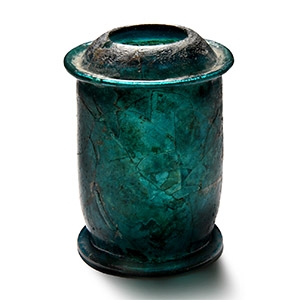
Roman Turquoise Glass Pyxis
1st-4th century A.D.Sold for (Inc. bp): £468
With a broadly barrel-shaped body, everted foot and shoulder, domed inverted neck; areas of iridescence; repaired. 42 grams, 85 mm high
Acquired early 1990s. Ex private American collection; thence by descent. Private collection since 1998.
Originally used principally by women to hold cosmetics, jewellery or even poisonous substances, some pyxides have even been identified as ink pots. Most surviving examples are green terracotta examples.
