
Loading, please wait...
_900x900.jpg "Roman Gold Drop Earring Pair")
_200x200.jpg "Roman Gold Drop Earring Pair")
.jpg "Roman Gold Drop Earring Pair")
LOT 0799
Roman Gold Drop Earring Pair
3RD-4TH CENTURY A.D.
1 3/8 in. (4.17 grams total, 37-38 mm).
Matched pair, each an ellipsoid cell with rosette surround, hook to the reverse, hollow teardrop dangle below. [2]
ProvenanceEx European private collection, 1990s.
Acquired from a London, UK, gallery.
property of an Essex gentleman.
TimeLine Auctions follows a vetting process to ensure the authenticity and legality of all items, reinforcing our commitment to integrity and responsible trading. Each antiquity, antique, and coin lot undergoes thorough examination by a vetting committee of at least ten external specialists, professional trade association members, scientists, and archaeologists: Our Vetting Process
AUCTIONS:
TimeLine is a leading auction house specialising in antiquities, ancient art, collectables, natural history, coins, medals, and books. Our auctions offer museums, collectors, historians, and enthusiasts the opportunity to acquire unique and historically significant pieces.
-
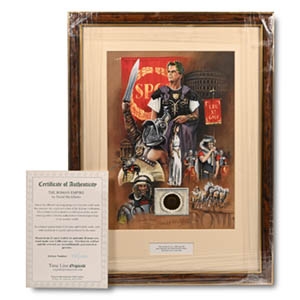
Bronze Roman Coin and Framed Limited Edition Print
3rd century A.D. and laterSold for (Inc. bp): £33
The coin of Constantine the Great (272-337 A.D.) mounted on 22 carat gold foil, framed with an art print signed by the artist David McAllister, depicting scenes of Roman military activity; limited edition number 192/1150. 1.26 kg, 49.5 x 37.5 cm
UK gallery, early 2000s. Accompanied by a previous certificate of authenticity.
David McAllister's exciting design is a 'one of a kind' work that portrays the might and riches of the Roman civilisation. This limited edition print is a celebration of the award winning artist's lifetime dedication to historical paintings of the ancient world. To enhance appreciation of this rare and historic work, each individual print is signed and numbered by the artist. -
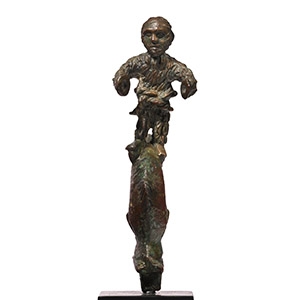
Roman Bronze Grotesque Silenus on Dolphin Handle
Circa 2nd century A.D.Sold for (Inc. bp): £390
Formed as a dolphin with hollow-formed curved body attached at the mouth to the base; standing on the dolphin's lower back, a grotesque bearded figure of Silenus with a furry body, and with a rope tied around his waist, his arms spread holding a cymbal in each hand; stub to the rear where the dolphin's tail joined to form a loop; mounted on a custom-made stand. 370 grams total, 17.5 cm including stand
From a collection acquired on the UK art market from various auction houses and collections mostly before 2000. From an important Cambridgeshire estate; thence by descent.
Silenus is here represented as Papposilenus, a representation of Silenus that emphasises his old age, particularly as a stock character in satyr play or comedy. His costuming includes a body stocking tufted with hair (mallōtos chitōn) that seems to have come into use in the mid-5th century B.C. -
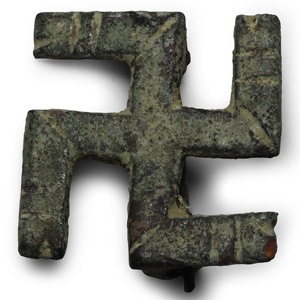
Roman Bronze Fylfot Brooch
3rd-4th century A.D.Sold for (Inc. bp): £117
With incised line decoration to the arms, pin-lugs, pin and catchplate to the reverse. 11.9 grams, 28 mm
Acquired in the mid 1980s-1990s. Private collection, Switzerland, thence by descent. Private collection, since the late 1990s.
