
Loading, please wait...
_900x900.jpg "Roman Gold Chain with Clasps")
_200x200.jpg "Roman Gold Chain with Clasps")
.jpg "Roman Gold Chain with Clasps")
LOT 0112
Roman Gold Chain with Clasps
1ST-2ND CENTURY A.D.
12 3/4 in. (17.05 grams, 32.5 cm long).
Gold trichinopoly chain with beaded collar finials, hook-and-eye closure.
ProvenanceAcquired in London, 1985.
Private collection, London.
This lot has been checked against the Interpol Database of stolen works of art and is accompanied by a search certificate number no.12392-226871.
Cf. Marshall, F.H., Catalogue of the Jewellery, Greek, Etruscan and Roman, in the Department of Antiquities, British Museum, London, 1911, item 2720, for type.
CONDITIONTimeLine Auctions follows a vetting process to ensure the authenticity and legality of all items, reinforcing our commitment to integrity and responsible trading. Each antiquity, antique, and coin lot undergoes thorough examination by a vetting committee of at least ten external specialists, professional trade association members, scientists, and archaeologists: Our Vetting Process
AUCTIONS:
TimeLine is a leading auction house specialising in antiquities, ancient art, collectables, natural history, coins, medals, and books. Our auctions offer museums, collectors, historians, and enthusiasts the opportunity to acquire unique and historically significant pieces.
LOT 0112
Roman Gold Chain with Clasps
Estimate £5,000 - 7,000€5,800 - 8,120 (for guidance only)$6,750 - 9,450 (for guidance only)
-
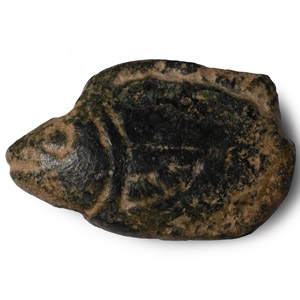
Roman Bronze Fish Weight
1st-4th century A.D.Sold for (Inc. bp): £59
Modelled in the round with fin and gill detailing, slot to the underside. 9.9 grams, 23 mm
From the collection of a gentleman, acquired on the London art market in the 1990s. -
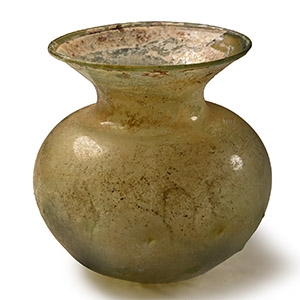
Large Roman Glass Jar with Dimples
1st-4th century A.D.Estimate: £400 - 600 (+bp*)
Opening Bid: £210
Squat in profile with trumpet-shaped neck and mouth, rolled rim, dimple base, pinched lobes to the body; some iridescence. 102 grams, 11.1 cm
From a London, UK, collection, 1990s. -
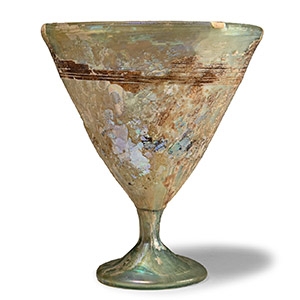
Late Roman Green Glass Footed Goblet
Circa 5th-6th century A.D.Sold for (Inc. bp): £520
An aqua glass goblet with conical foot, curved body, rolled rim with applied trail below. 45 grams, 10.5 cm
From the collection du Comte de..., formed from the end of the 19th century. Thierry de Maigret, Paris, 16 April 2010, lot 44. Al Thani Princely collection, acquired at the above sale.
