
Loading, please wait...
LOT 0211
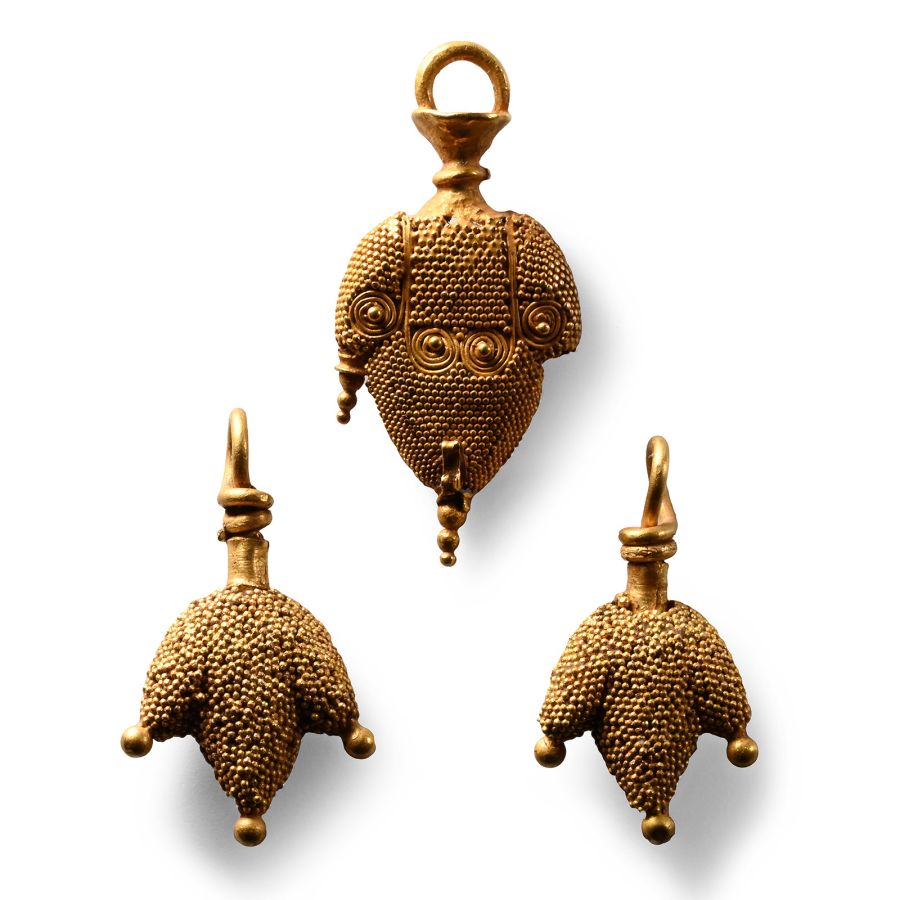
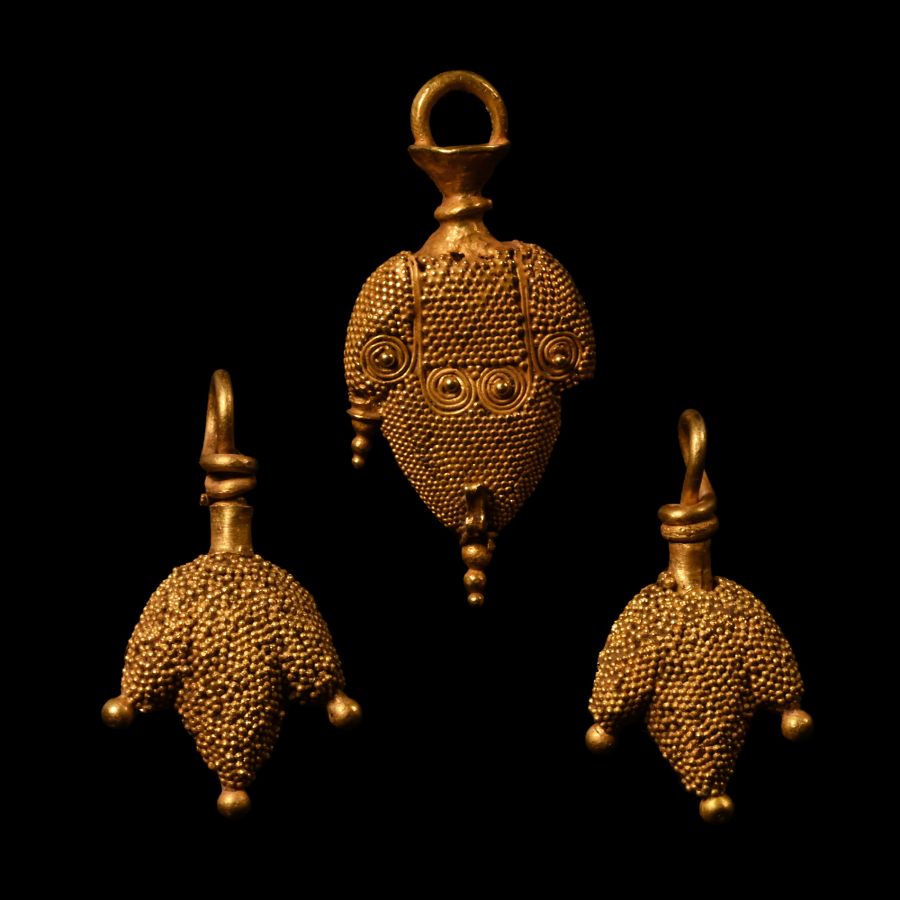
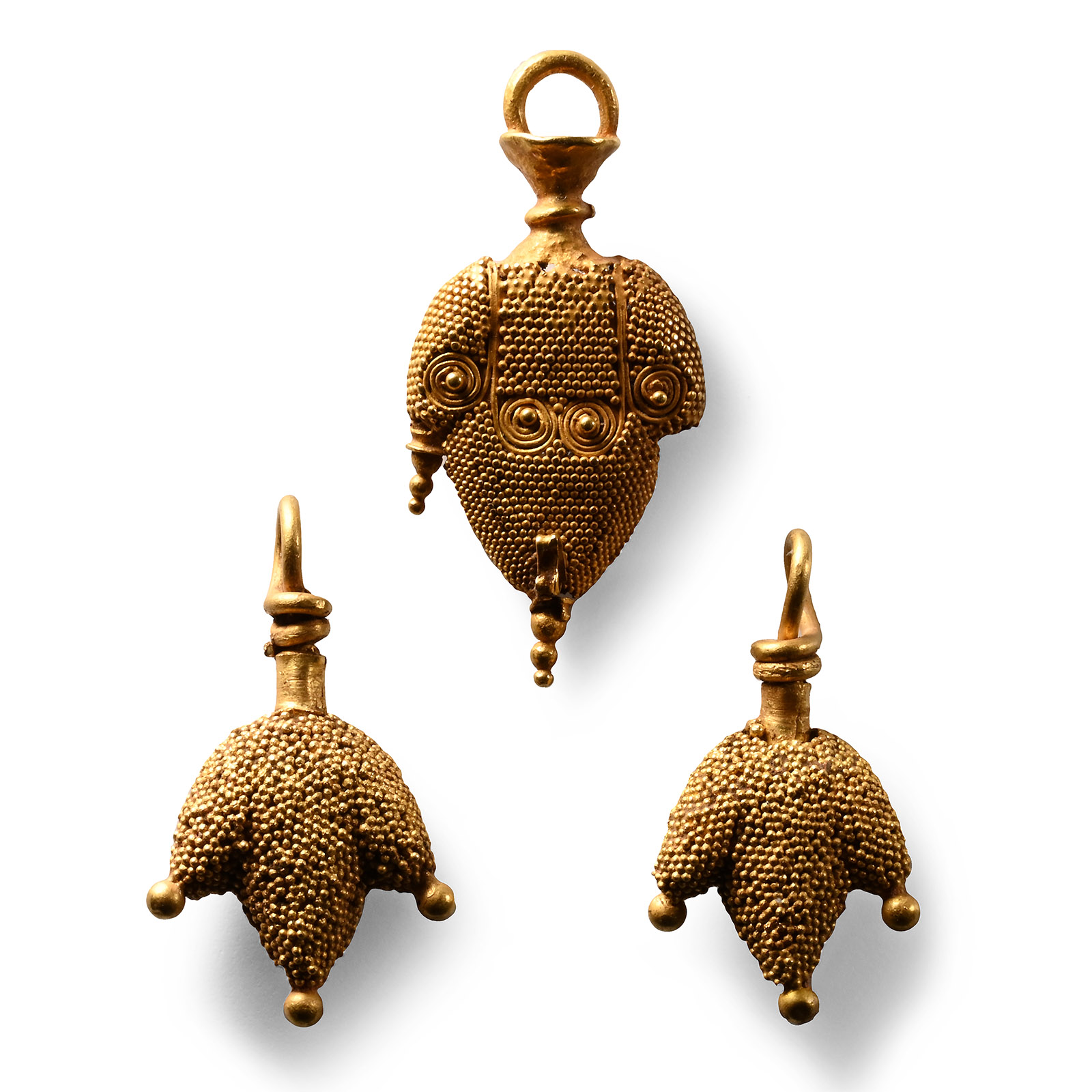
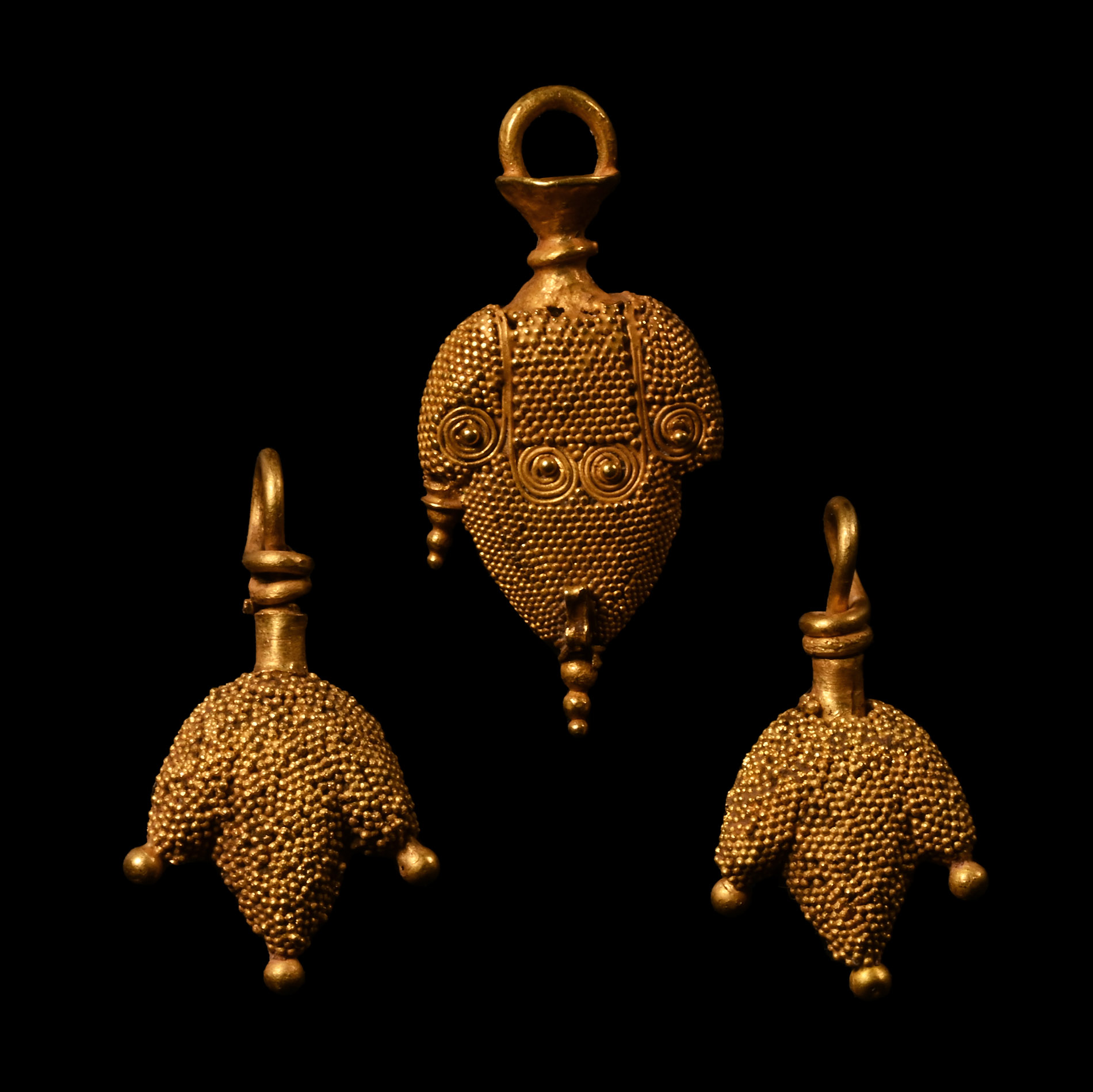
Roman Gold 'Bunched Grape' Jewellery Set
1ST CENTURY A.D.
1 - 1 1/4 in. (8.83 grams total, 24-32 mm).
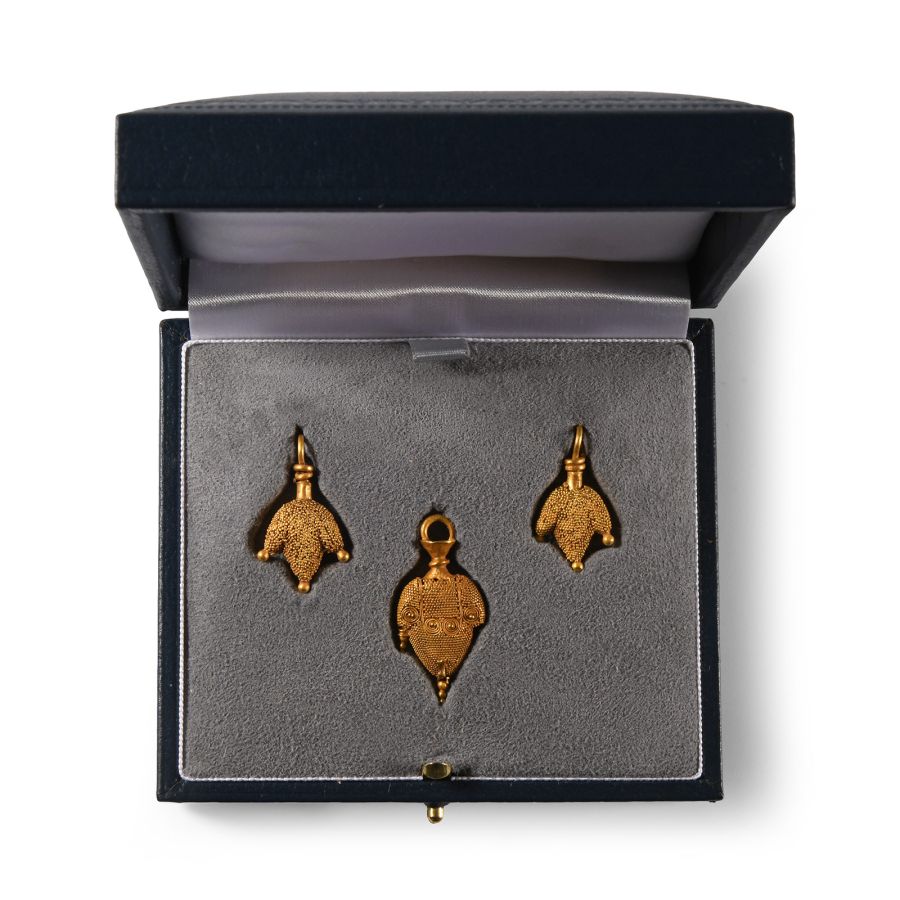
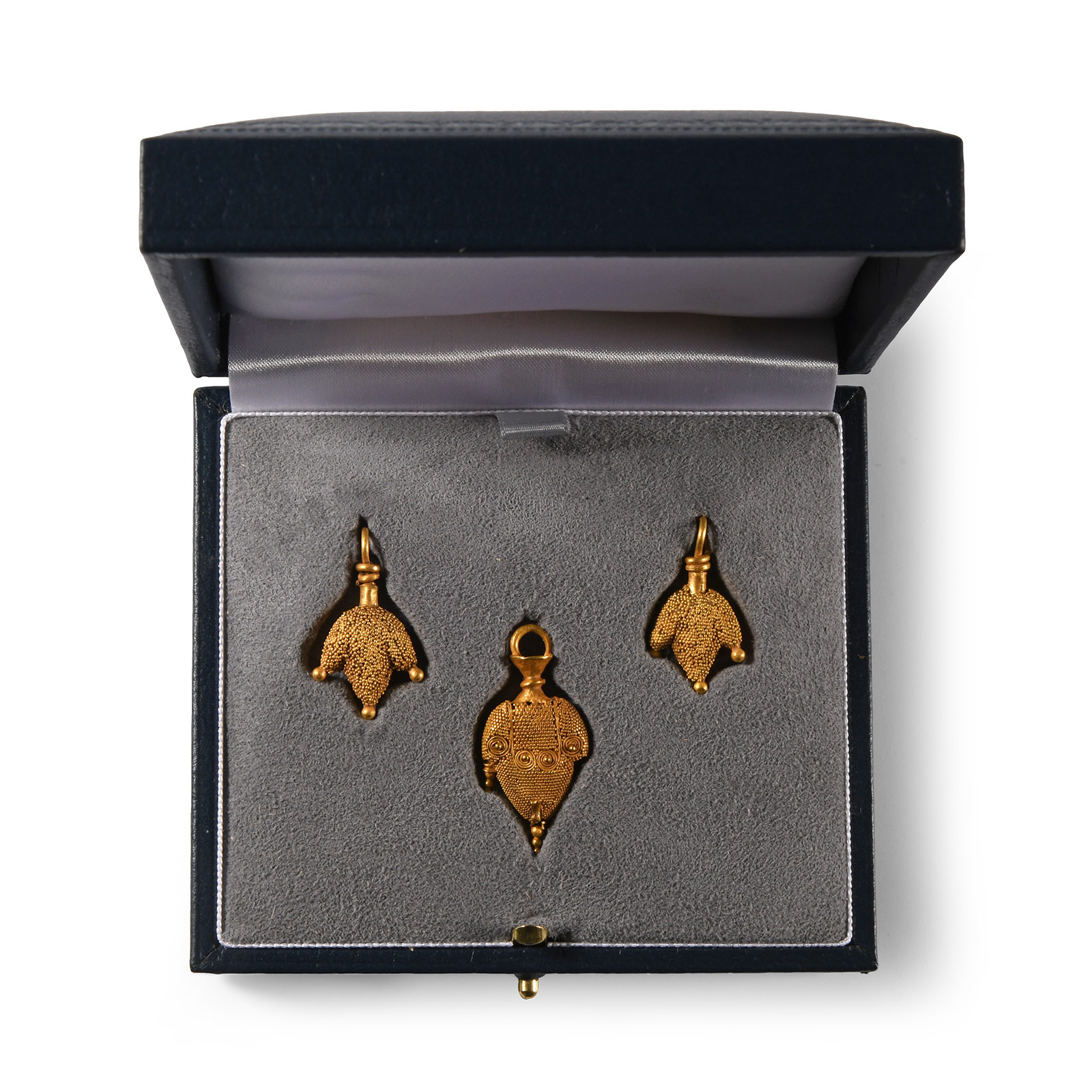
Group of three gold pendants comprising: two formed as a cluster of granules with three lobes, larger granule to each apex and coiled wire suspension; one of similar profile, larger with filigree lines and coils to both faces, trumpet-shaped finial with loop; repaired; housed in a custom-made display case. [3]
ProvenanceAcquired in the late 1980s-early 1990s.
Important North West London collection.
Accompanied by an academic report by Dr Raffaele D’Amato.
This lot has been checked against the Interpol Database of stolen works of art and is accompanied by search certificate number no.11934-210479.
See De Ridder, Les bijoux et les pierres gravées, Paris, 1911, no.568, pl.2, 572, pl.3; Pollak, L., Klassisch-Antike Goldschmiedearbeiten im Besitze Sr. Exc. des Herrn von Nelidow in Rom, Leipzig, 1903, no.74, pl.8 (similar, late Hellenistic, with heads of Maenads); Piatischewa, ‘Juwelirnie Isdelija Chersonesa (Jewelry of Chersonesos)’ in TGIM Pamjatniki Kulturi, 18, 1956, p.49, pl,8, 11.11a; Greifenhagen, A., Schmuckarbeiten in Edelmetall, Banden I-II, Berlin, 1970, band II, no.4, p.66.
FootnotesTypologically related earrings were particularly common in the Caucasus, where they have been dated by archaeologists to the first centuries A.D. This was a product of Hellenised workers of the area of Pontus or Asia Minor, mainly, and the material culture of the Greek cities of the North Pontus region was completely absorbed by their new Roman rulers and largely diffused in style and orientation in the Eastern Roman provinces.
CONDITIONTimeLine Auctions follows a vetting process to ensure the authenticity and legality of all items, reinforcing our commitment to integrity and responsible trading. Each antiquity, antique, and coin lot undergoes thorough examination by a vetting committee of at least ten external specialists, professional trade association members, scientists, and archaeologists: Our Vetting Process
AUCTIONS:
TimeLine is a leading auction house specialising in antiquities, ancient art, collectables, natural history, coins, medals, and books. Our auctions offer museums, collectors, historians, and enthusiasts the opportunity to acquire unique and historically significant pieces.
LOT 0211
Roman Gold 'Bunched Grape' Jewellery Set
Estimate £5,000 - 7,000€5,800 - 8,120 (for guidance only)$6,750 - 9,450 (for guidance only)
-
Eastern Roman Mosaic Depicting a Bird
4th century A.D.Sold for (Inc. bp): £2,860
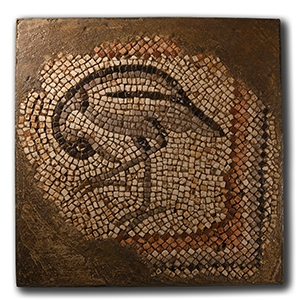
In a rectangular matrix; cream, olive, pink and other tesserae depicting a bird advancing with head bowed, with banded frame. 10.35 kg, 40.3 x 40.3 cm
Former collection of Mr Pierre Bart (1889-1964), official of the French mandate in Syria and Lebanon (1919-1936) and delegate to the Lebanese government until 1946. Transmitted by descent. -
Roman Silver Container Pendant
Circa 2nd-4th century A.D.Estimate: £200 - 300 (+bp*)
Opening Bid: £100
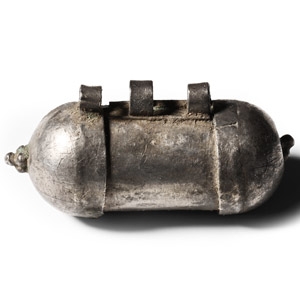
Tubular body with domed cap to each end, applied granule clusters, three suspension loops. 6.3 grams, 35 mm
Acquired on the German art market before 2000. From an EU collection before 2020. -
Roman Gold Earrings with Bosses
Circa 1st-2nd century A.D.Estimate: £1,000 - 1,400 (+bp*)
Opening Bid: £475
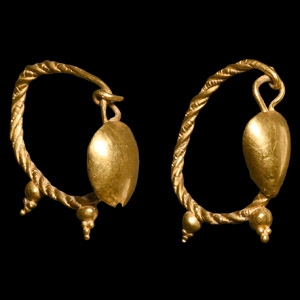
Matched pair of gold earrings, each a twisted wire hoop with domed ellipsoid shield and hook-and-eye closure; two radiating granules to the lower edge each with a graduated granule cluster below. 1.97 grams total, 17-18 mm
From a collection of a London lady, acquired annually during 1990s-2000s.
