
Loading, please wait...
_900x900.jpg "Roman Gold Boat-Shaped Earring Pair")
_200x200.jpg "Roman Gold Boat-Shaped Earring Pair")
.jpg "Roman Gold Boat-Shaped Earring Pair")
LOT 0728
Roman Gold Boat-Shaped Earring Pair
1ST-3RD CENTURY A.D.
1 1/8 in. (5.06 grams total, 28-29 mm).
Matched pair, each a hollow-formed crescent with filigree closure, cluster of hollow granules to the underside. [2]
ProvenanceAcquired in the 1994.
Private collection, Switzerland, thence by descent.
Private collection, since the late 1990s.
This lot is accompanied by an illustrated lot declaration signed by the Head of the Antiquities Department, Dr Raffaele D'Amato.
Cf. Ruseva-Slokoska, L., Roman Jewellery, Sofia, 1991, item 1, for type.
CONDITIONTimeLine Auctions follows a vetting process to ensure the authenticity and legality of all items, reinforcing our commitment to integrity and responsible trading. Each antiquity, antique, and coin lot undergoes thorough examination by a vetting committee of at least ten external specialists, professional trade association members, scientists, and archaeologists: Our Vetting Process
AUCTIONS:
TimeLine is a leading auction house specialising in antiquities, ancient art, collectables, natural history, coins, medals, and books. Our auctions offer museums, collectors, historians, and enthusiasts the opportunity to acquire unique and historically significant pieces.
-
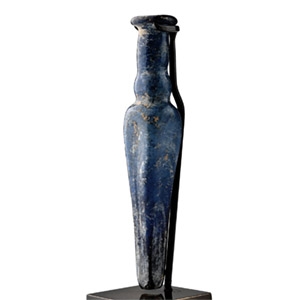
Roman Fine Blue Glass Flask
2nd-3rd century A.D.Sold for (Inc. bp): £364
Iridescent square-section vessel with dimpled sides, tall neck and everted rim; mounted on a custom-made stand. 82 grams total, 14.3 cm including stand
Ex Mayfair, London, UK, gallery, 1990s-2000s. From an important collection of glass, the property of a London gentleman. This lot is accompanied by an illustrated lot declaration signed by the Head of the Antiquities Department, Dr Raffaele D'Amato. -
.jpg)
Roman Green Glazed Terracotta Cup with Signature
1st-2nd century A.D.Sold for (Inc. bp): £3,380
Barrel-shaped in profile with low flared foot, stepped inner rim, two loop handles below the rim with palmette detailing; sidewall with applied motifs: clusters of discs, rosette, seated bearded man in long robe, winged female in profile, human foot - one with neatly incised retrograde legend '[T]POKOΛ' (abbreviated maker's name). 273 grams, 16.2 cm
UK private collection before 2000. Acquired on the UK art market. Private collection, London, UK. This lot has been checked against the Interpol Database of stolen works of art and is accompanied by a search certificate number no.12833-240780. This lot has been cleared against the Art Loss Register database, and is accompanied by an illustrated lot declaration signed by the Head of the Antiquities Department, Dr Raffaele D'Amato. -
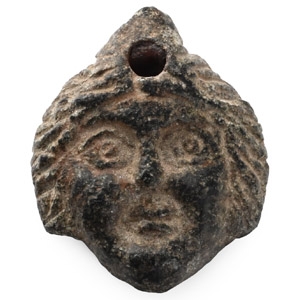
Roman Steatite Head of Eros Pendant
1st-4th century A.D.Sold for (Inc. bp): £124
Plano-convex in section, one side with carved head of youthful Eros, almond-shaped eyes, chubby cheeks, cascading hair with top knot; pierced above. 7.18 grams, 30 mm
Ex London, UK, art market, late 1990s. From a private UK collection. This lot is accompanied by an illustrated lot declaration signed by the Head of the Antiquities Department, Dr Raffaele D'Amato.
