
Loading, please wait...
_900x900.jpg "Roman Gold and Garnet Gemstone Ring with Bird")
_200x200.jpg "Roman Gold and Garnet Gemstone Ring with Bird")
.jpg "Roman Gold and Garnet Gemstone Ring with Bird")
LOT 0165
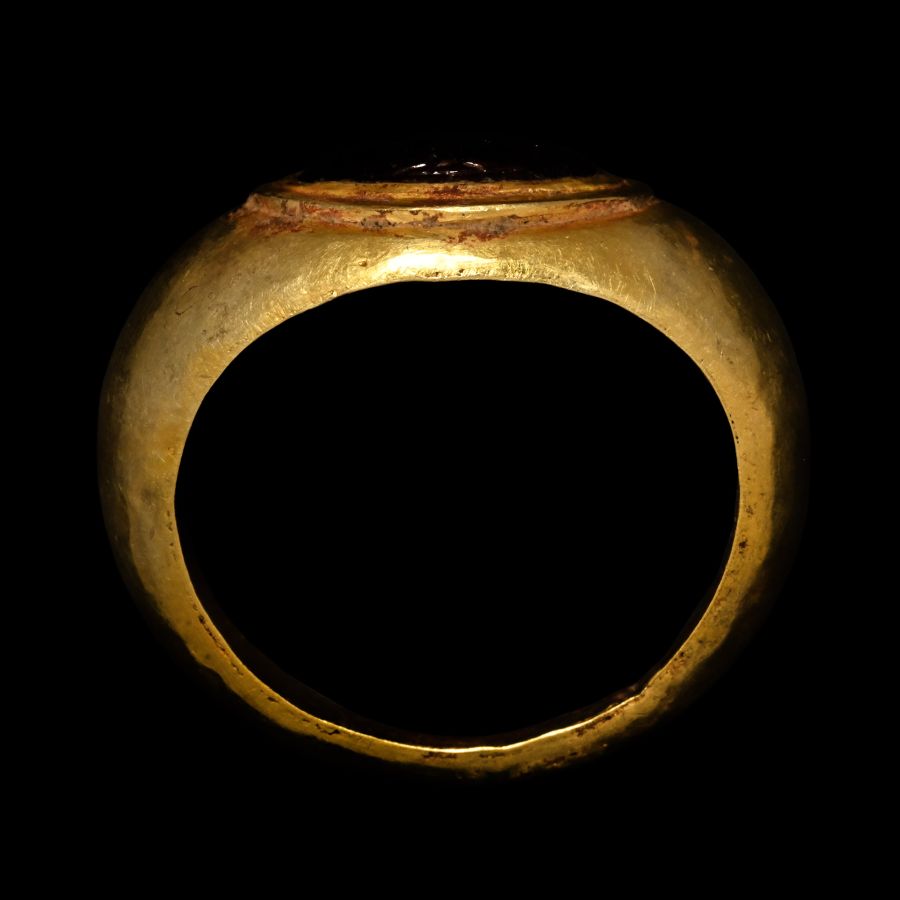
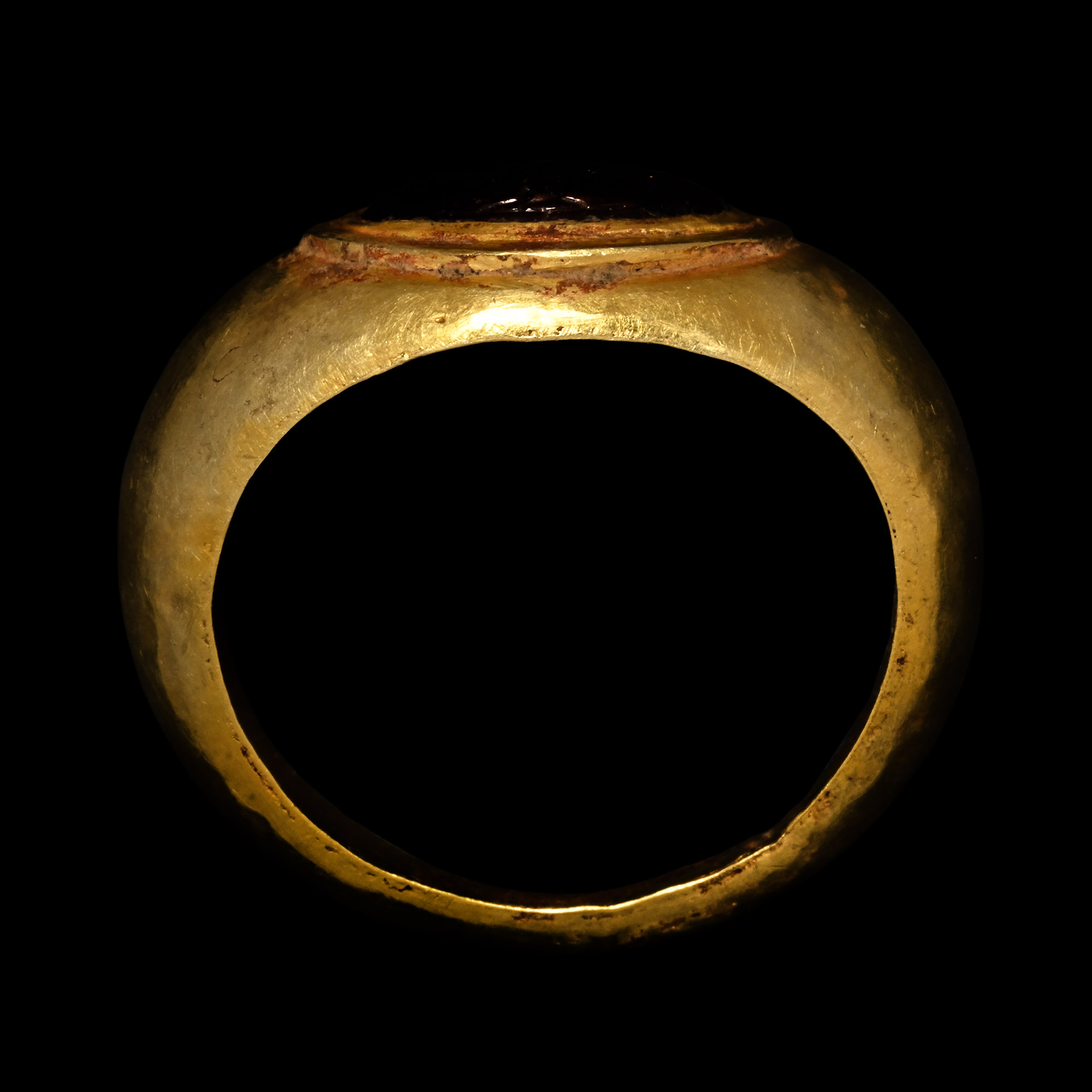
Roman Gold and Garnet Gemstone Ring with Bird
1ST-3RD CENTURY A.D.
7/8 in. (3.52 grams, 22.74 mm overall, 17.38 mm internal diameter (approximate size British K 1/2, USA 5 1/2, Europe 10.58, Japan 10)).
Hollow-formed with inset cloison, incuse profile bird motif.
ProvenancePrivate collection, acquired on the German art market in 1993; thence by descent.
LiteratureCf. Ruseva-Slokoska, L., Roman Jewellery, Sofia, 1991, item 193, for type.
FootnotesThe ring belongs to the type I, variant 3, of Roman gold rings according to Ruseva-Slokoska’s classification. These rings had massive ellipsoid hoops with bands semi-circular to the outside, wider and thicker towards the shoulders.
CONDITIONTimeLine Auctions follows a vetting process to ensure the authenticity and legality of all items, reinforcing our commitment to integrity and responsible trading. Each antiquity, antique, and coin lot undergoes thorough examination by a vetting committee of at least ten external specialists, professional trade association members, scientists, and archaeologists: Our Vetting Process
AUCTIONS:
TimeLine is a leading auction house specialising in antiquities, ancient art, collectables, natural history, coins, medals, and books. Our auctions offer museums, collectors, historians, and enthusiasts the opportunity to acquire unique and historically significant pieces.
LOT 0165
Roman Gold and Garnet Gemstone Ring with Bird
Estimate £1,500 - 2,000€1,740 - 2,320 (for guidance only)$2,030 - 2,700 (for guidance only)
-
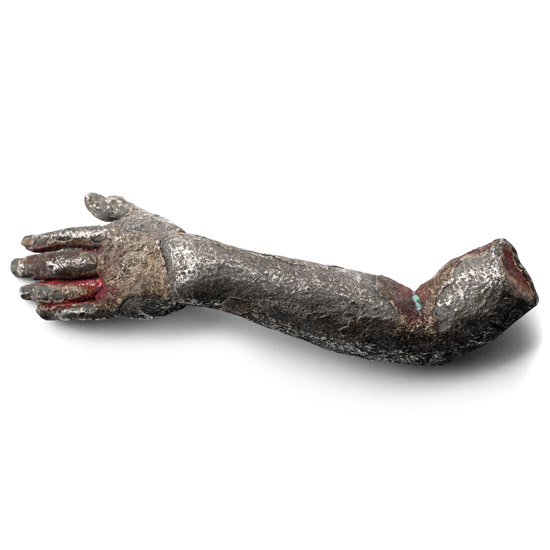
Roman Silver Arm from a Statuette
1st-2nd century A.D.Sold for (Inc. bp): £65
Featuring slender fingers and a bent elbow, likely once belonging to a statue depicting a goddess. 13.3 grams, 45.9 mm
From the private collection of a European gentleman (1942-2024), formed since the 1970s. -
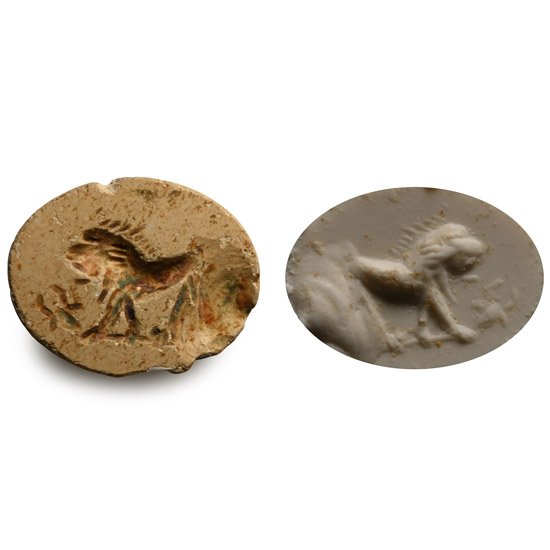
Roman Yellow Jasper Gemstone with Lion and Bull's Skull
2nd-3rd century A.D.Sold for (Inc. bp): £65
With intaglio lion advancing towards a bull's skull; supplied with a museum-quality impression. 0.52 grams, 14.15 mm
From the private collection of a European gentleman (1942-2024), formed since the 1970s. -
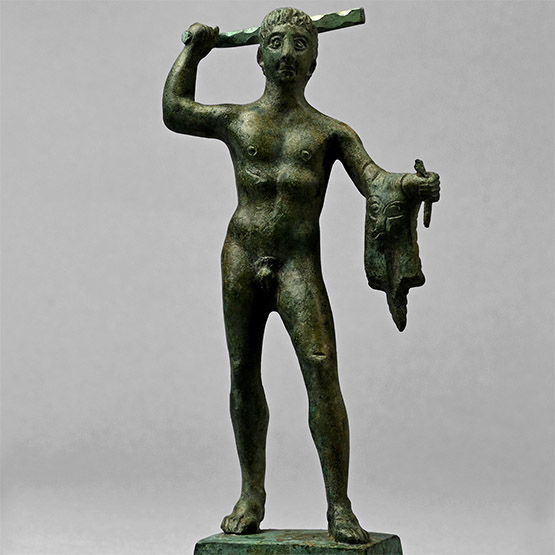
Roman Bronze Statuette of Hercules
Circa 2nd-3rd century A.D.Estimate: £5,000 - 7,000 (‡+bp*)
Opening Bid: £2,500
Modelled in the round with a lionskin mantle over his extended forearm, standing nude with a club raised over his shoulder; provided with a contemporary custom-made stand. 244 grams, 13.5 cm
Private collection, USA and Switzerland, before 1992; thence by descent. This lot has been checked against the Interpol Database of stolen works of art and is accompanied by search certificate number no.13195-249254.
This type of representation of Hercules, inspired by Etruscan or Italic models, was widespread in Gallo-Roman sanctuaries dedicated to the god, where several votive statues attributable to this type have been found. The musculature of the back is well-executed, as are the facial features and the details on the Nemean lion's skin.
