
Loading, please wait...
LOT 0941
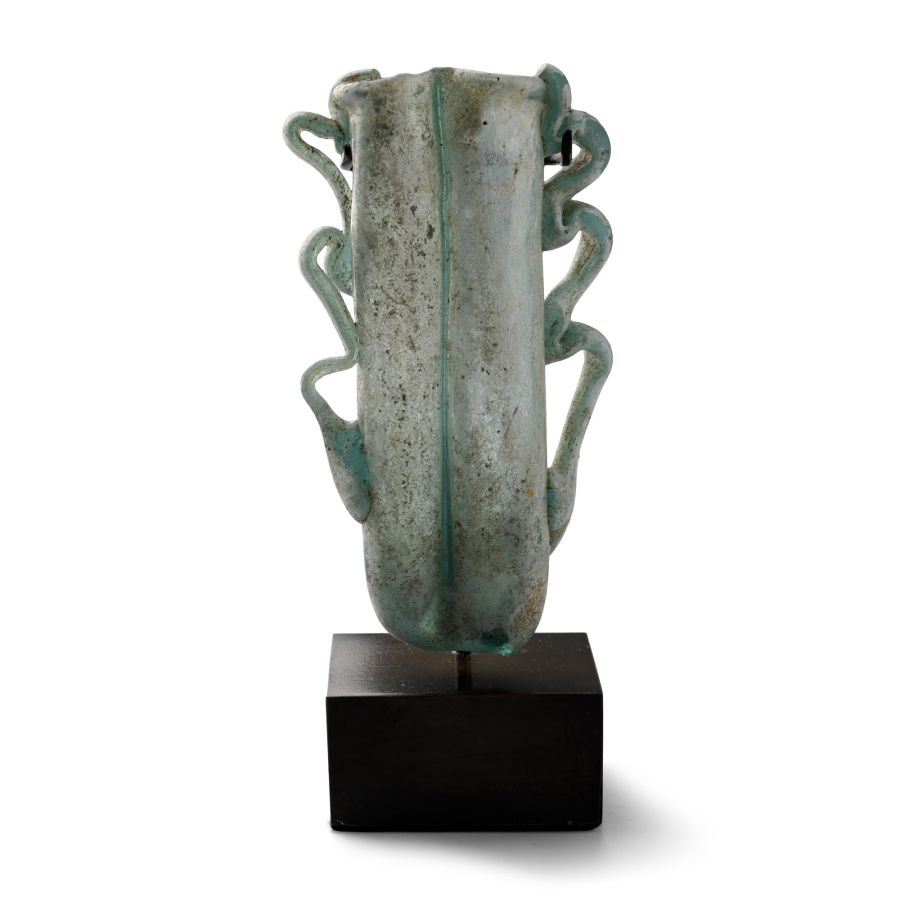
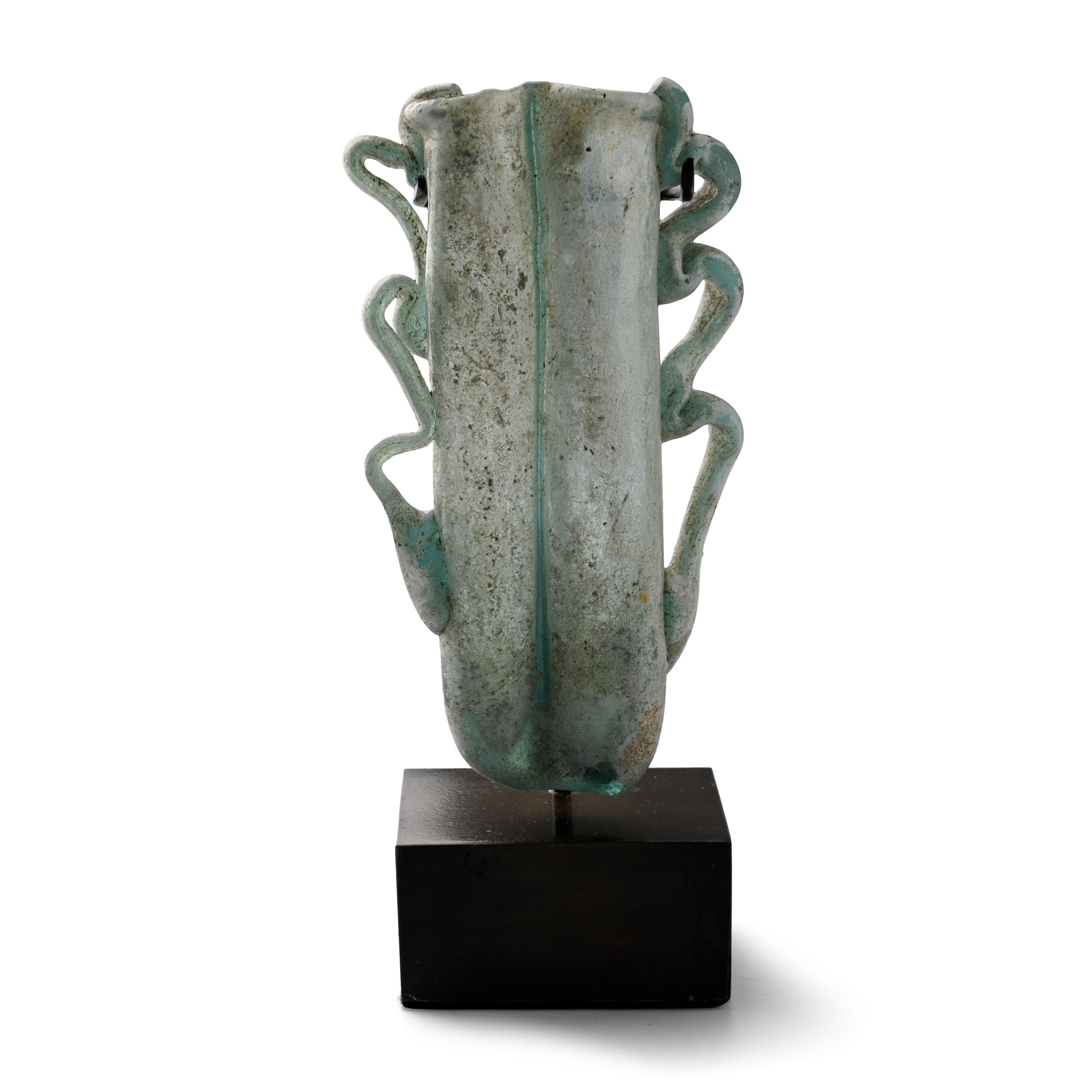
Roman Glass Twin Flask
3RD-5TH CENTURY A.D.
5 1/2 in. (136 grams total, 14 cm including stand).
Comprising two conjoined tapering tubular cells, with applied handles at the shoulder.
ProvenanceEx Mayfair, London, UK, gallery, 1990s-2000s.
From an important collection of glass, the property of a London gentleman.
This lot is accompanied by an illustrated lot declaration signed by the Head of the Antiquities Department, Dr Raffaele D'Amato.
Cf. Bergman, M. et al., Ancient Glass in the Carnegie Museum of Natural History, Pittsburgh, 1980, items 194-198, for similar.
CONDITIONTimeLine Auctions follows a vetting process to ensure the authenticity and legality of all items, reinforcing our commitment to integrity and responsible trading. Each antiquity, antique, and coin lot undergoes thorough examination by a vetting committee of at least ten external specialists, professional trade association members, scientists, and archaeologists: Our Vetting Process
AUCTIONS:
TimeLine is a leading auction house specialising in antiquities, ancient art, collectables, natural history, coins, medals, and books. Our auctions offer museums, collectors, historians, and enthusiasts the opportunity to acquire unique and historically significant pieces.
LOT 0941
Roman Glass Twin Flask
Estimate £350 - 450€410 - 520 (for guidance only)$470 - 610 (for guidance only)
-
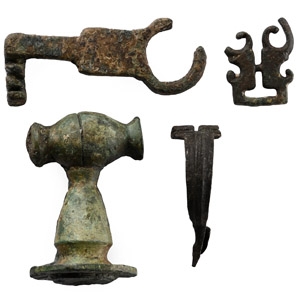
Roman Bronze Artefact Group
1st-4th century A.D.Sold for (Inc. bp): £20
Comprising of a bow fibula fragment, openwork mount, key with lateral lobe with teeth, a conical handle(?) with discoid base. 154 grams total, 28-65 mm
Private collection of a North London lady before 2000. Property of a London, UK, gentleman. This lot is accompanied by an illustrated lot declaration signed by the Head of the Antiquities Department, Dr Raffaele D'Amato. -
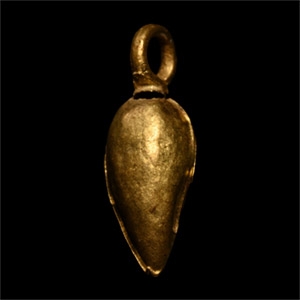
Roman Gold Teardrop Pendant
1st-4th century A.D.Sold for (Inc. bp): £234
A delicate pendant formed from sheet-gold with a loop above. 0.13 grams, 10 mm
From the collection of a late Japanese collector, 1970s. This lot is accompanied by an illustrated lot declaration signed by the Head of the Antiquities Department, Dr Raffaele D'Amato. -
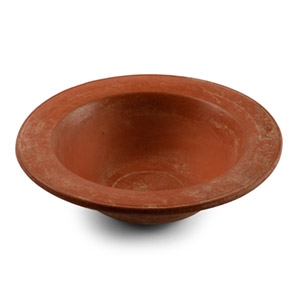
Roman Redware Deep Bowl with Wide Rim
3rd-4th century A.D.Sold for (Inc. bp): £65
Broad rim and deep central bowl with basal ring. 144 grams, 14.5 cm
From the private collection of a Canadian gentleman living in Essex, UK, formed since the 1920s-circa 1990. Property of an Essex lady until the late 1990s; thence by descent. From the private collection of an Essex gentleman since the late 1990s. This lot is accompanied by an illustrated lot declaration signed by the Head of the Antiquities Department, Dr Raffaele D'Amato.
