
Loading, please wait...
_900x900.jpg "Roman Glass Intaglio Showing Two Gryphons Attacking a Deer")
_200x200.jpg "Roman Glass Intaglio Showing Two Gryphons Attacking a Deer")
.jpg "Roman Glass Intaglio Showing Two Gryphons Attacking a Deer")
LOT 0600
Roman Glass Intaglio Showing Two Gryphons Attacking a Deer
2ND-3RD CENTURY A.D.
1 1/8 in. (18.57 grams, 30.95 mm overall, 22.99 mm internal diameter (approximate size British N 1/2, USA 6 3/4, Europe 14.35, Japan 13)).
Ellipsoid glass cloison with incuse image of two gryphons attacking a deer; set in a later silver ring. [No Reserve]
ProvenanceFrom the collection of a North American gentleman, formed in the 1990s.
LiteratureSee the mosaics of the Great Palace of Constantinople, 5th-6th century A.D. in Jobst, W., Behcet, E., Guriner, C., Istanbul, the Great Palace Mosaic, Istanbul, 1997, fig.23, for iconography.
FootnotesThe subject of griffins attacking a deer has a long history and remained popular during the Hellenistic and Roman period throughout the Mediterranean area and beyond. It may be a symbol of the inevitability of death.
CONDITIONTimeLine Auctions follows a vetting process to ensure the authenticity and legality of all items, reinforcing our commitment to integrity and responsible trading. Each antiquity, antique, and coin lot undergoes thorough examination by a vetting committee of at least ten external specialists, professional trade association members, scientists, and archaeologists: Our Vetting Process
AUCTIONS:
TimeLine is a leading auction house specialising in antiquities, ancient art, collectables, natural history, coins, medals, and books. Our auctions offer museums, collectors, historians, and enthusiasts the opportunity to acquire unique and historically significant pieces.
LOT 0600
Roman Glass Intaglio Showing Two Gryphons Attacking a Deer
Sold for (Inc. bp): £416
-
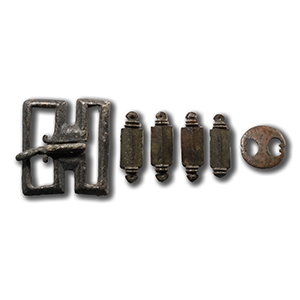
Roman Military Horse Harness Belt Fitting Group
Circa 2nd-3rd century A.D.Estimate: £200 - 300 (+bp*)
Opening Bid: £100
Comprising a massive buckle with two rectangular openings and pin, four rectangular appliqués and one pelta appliqué. 147 grams total, 30-64 mm
Acquired on the German art market before 2000. Property of a Surrey, UK, collector.
The assembly is linked to the horse harnesses of the 3rd century A.D., characterised by the presence of a peltate application and four decorative elements for the bridle or antilena/postilena straps, and by a massive buckle for the horse's girth strap. -
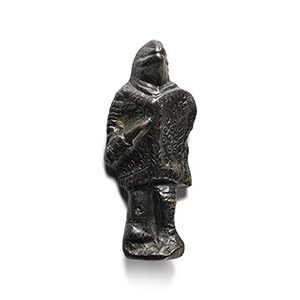
Roman Bronze Gladiator Mount
Circa 1st-2nd century A.D.Sold for (Inc. bp): £338
Modelled in the half-round with hollow reverse and fixing stud; gladiator advancing with a gladius short-sword drawn in right hand, holding a rectangular shield (scutum) and wearing greaves (ocreae); the arm protected by an armoured manica. 48 grams, 62 mm
From the French collection of M Garcia, 1990s.
The gladiator represented here belongs to the class of the scutarii (wearers of big shields) of the familia of the secutor or provocatores. The secutor was the chronological evolution of samnite gladiators. The title of secutor appears historically only in the imperial era and is closely linked to the title of contraretiarius, the retiarius being his true and only opponent. The secutor's armament consisted of the gladius and a large shield, a short ocrea on the left leg and a padded or armoured sleeve with chiroteca to protect his arm and hand. -
.jpg)
Roman Capricorn Intaglio Gemstone
Circa 1st century A.D.Estimate: £150 - 200 (+bp*)
Opening Bid: £75
Cabochon garnet with intaglio capricorn engraved on an earlier gemstone; supplied with a museum-quality impression. 0.6 grams, 10 mm
From the collection of a Swiss gentleman formed in Europe from 1970-1980s; thence by descent from the family in London.
