
Loading, please wait...
LOT 0155
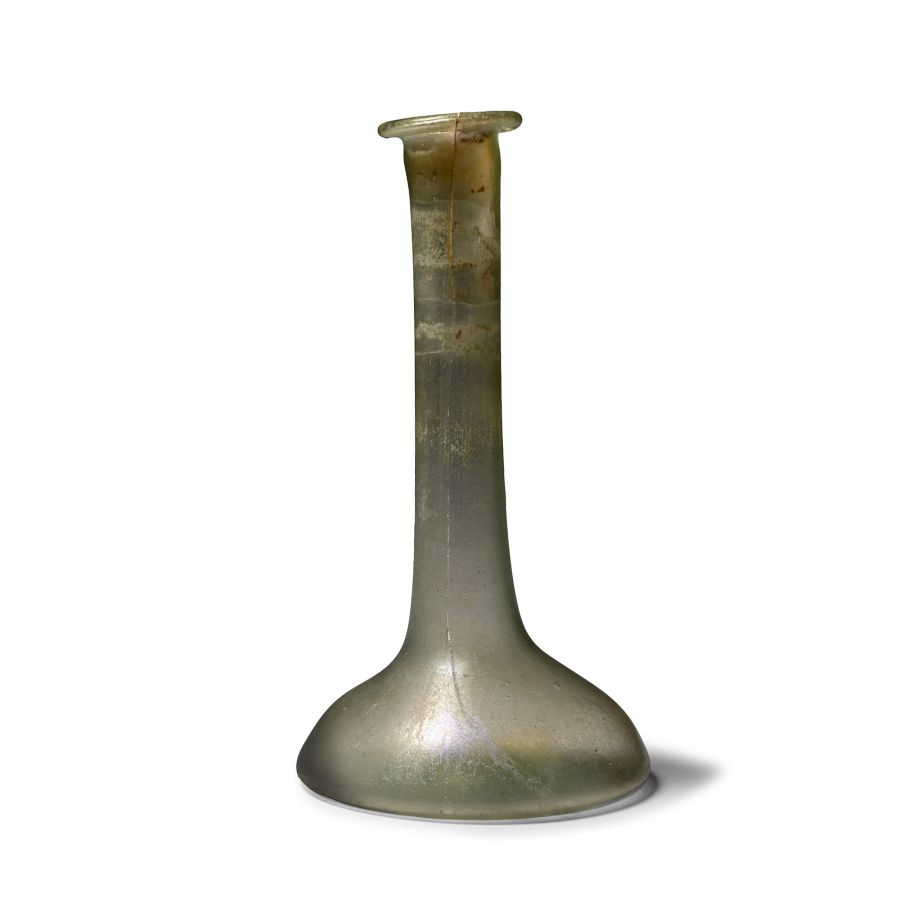
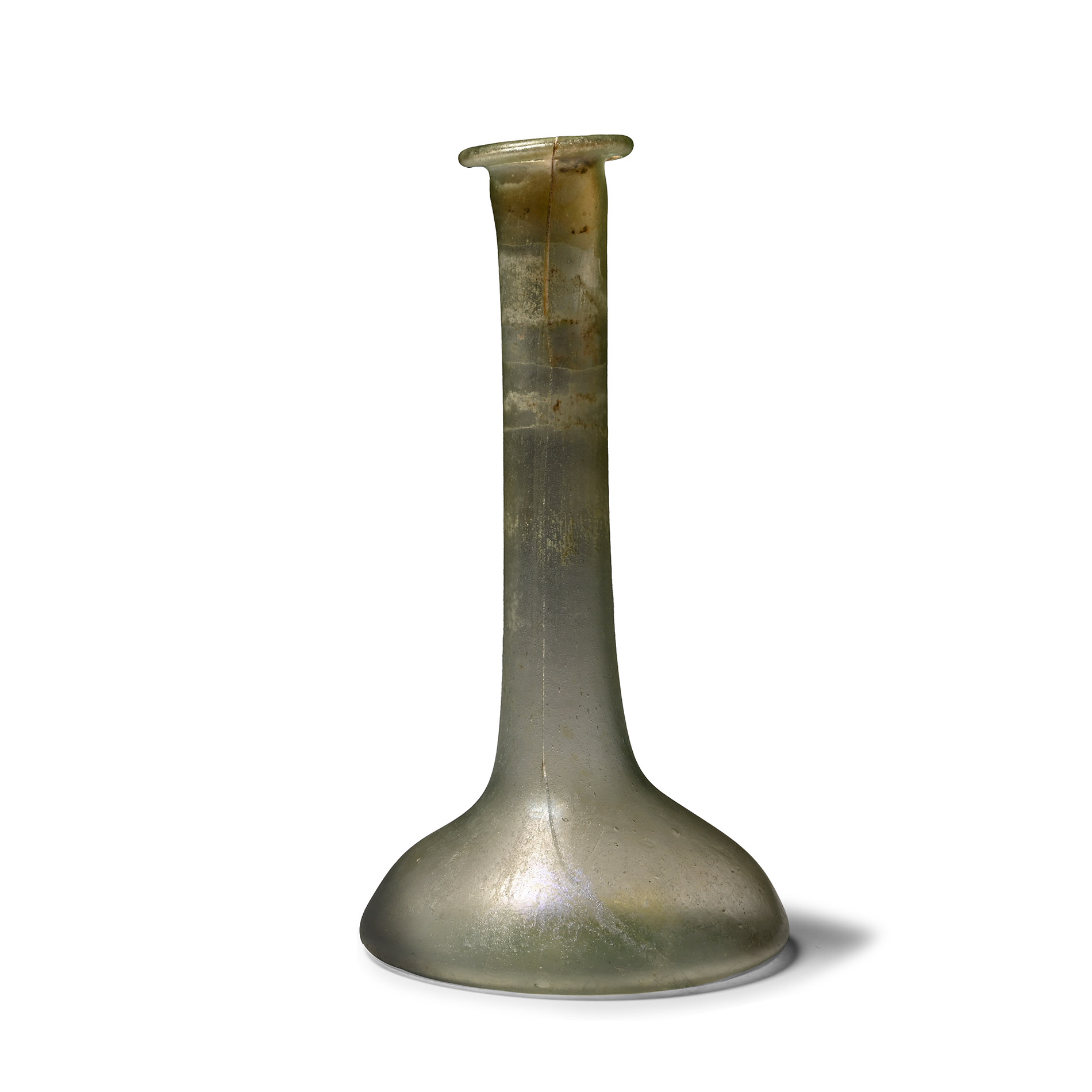
Roman Glass Candlestick Unguentarium
2ND-3RD CENTURY A.D.
5 3/8 in. (37.2 grams, 13.6 cm).
With low conical body and slightly convex wall, dimple base; tall cylindrical neck flaring to mouth with inward-folded rim; slightly iridescent surface.
ProvenanceEx P. Martens, The Netherlands, formed between 1974-1984.
Accompanied by a copy of an Art Loss Register certificate no.S00075481.
This lot is accompanied by an illustrated lot declaration signed by the Head of the Antiquities Department, Dr Raffaele D’Amato.
TimeLine Auctions follows a vetting process to ensure the authenticity and legality of all items, reinforcing our commitment to integrity and responsible trading. Each antiquity, antique, and coin lot undergoes thorough examination by a vetting committee of at least ten external specialists, professional trade association members, scientists, and archaeologists: Our Vetting Process
AUCTIONS:
TimeLine is a leading auction house specialising in antiquities, ancient art, collectables, natural history, coins, medals, and books. Our auctions offer museums, collectors, historians, and enthusiasts the opportunity to acquire unique and historically significant pieces.
LOT 0155
Roman Glass Candlestick Unguentarium
Estimate £600 - 800€700 - 930 (for guidance only)$810 - 1,080 (for guidance only)
-

Roman and Other Ancient Bead Group
1st millennium B.C. and laterSold for (Inc. bp): £124
A large quantity of mixed beads in stone, glass, lapis lazuli, and ceramic, including a large barrel-shaped bead. 181 grams total, 3-27 mm
Ex London, UK, collection, 1990s. This lot is accompanied by an illustrated lot declaration signed by the Head of the Antiquities Department, Dr Raffaele D’Amato. -
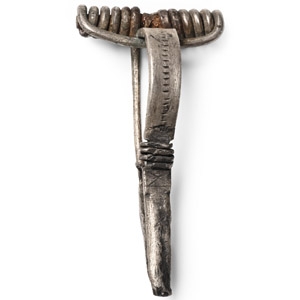
Roman Silver Bow Brooch
2nd-3rd century A.D.Sold for (Inc. bp): £910
P-shaped bow brooch comprising a deep bow with rouletted ornament, chord and integral spring, incised saltire, tapering foot with catch to reverse and wire extension coiled around the shank. 10.08 grams, 54 mm
Acquired from Coincraft, London, UK. From the private collection of Kenneth Machin (1936-2020), Buckinghamshire, UK; his collection of antiquities and natural history was formed since 1948; thence by descent. Accompanied by an original certificate of authenticity from Coincraft. This lot is accompanied by an illustrated lot declaration signed by the Head of the Antiquities Department, Dr Raffaele D’Amato. -
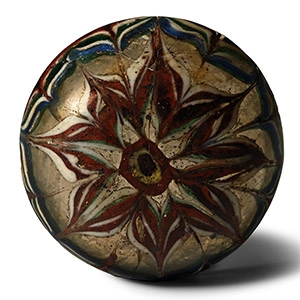
Polychrome Glass Bowl
Roman, 1st century A.D. or laterSold for (Inc. bp): £845
Shallow bowl with rounded rim, the outer face with dragged and marvered trails forming a rosette. 42.2 grams, 63 mm
S.S.H., South France, 1950s. Accompanied by a copy of an Art Loss Register certificate no.S00133093. This lot is accompanied by an illustrated lot declaration signed by the Head of the Antiquities Department, Dr Raffaele D’Amato.
Such decorated shallow bowls were mainly produced in the Eastern Provinces of the Roman Empire, and some scholars proposed Alexandria as the workshop. They were realised with mosaic glass technique, mould-pressed and tooled.
