
Loading, please wait...
LOT 0791
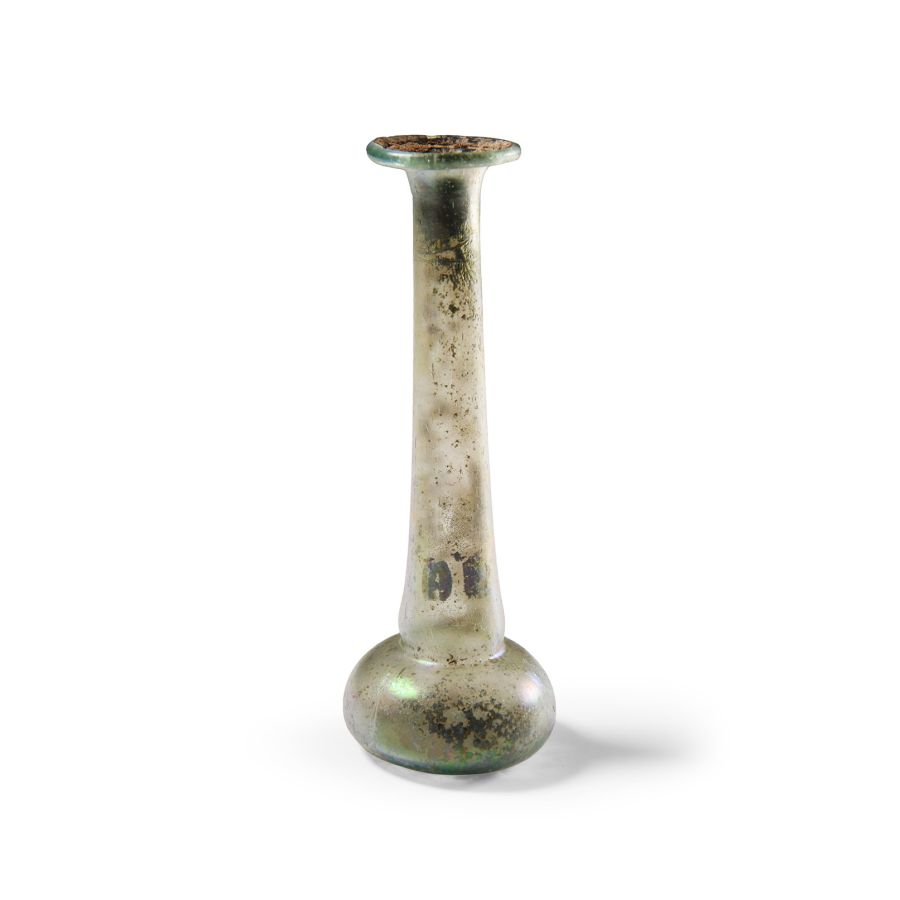
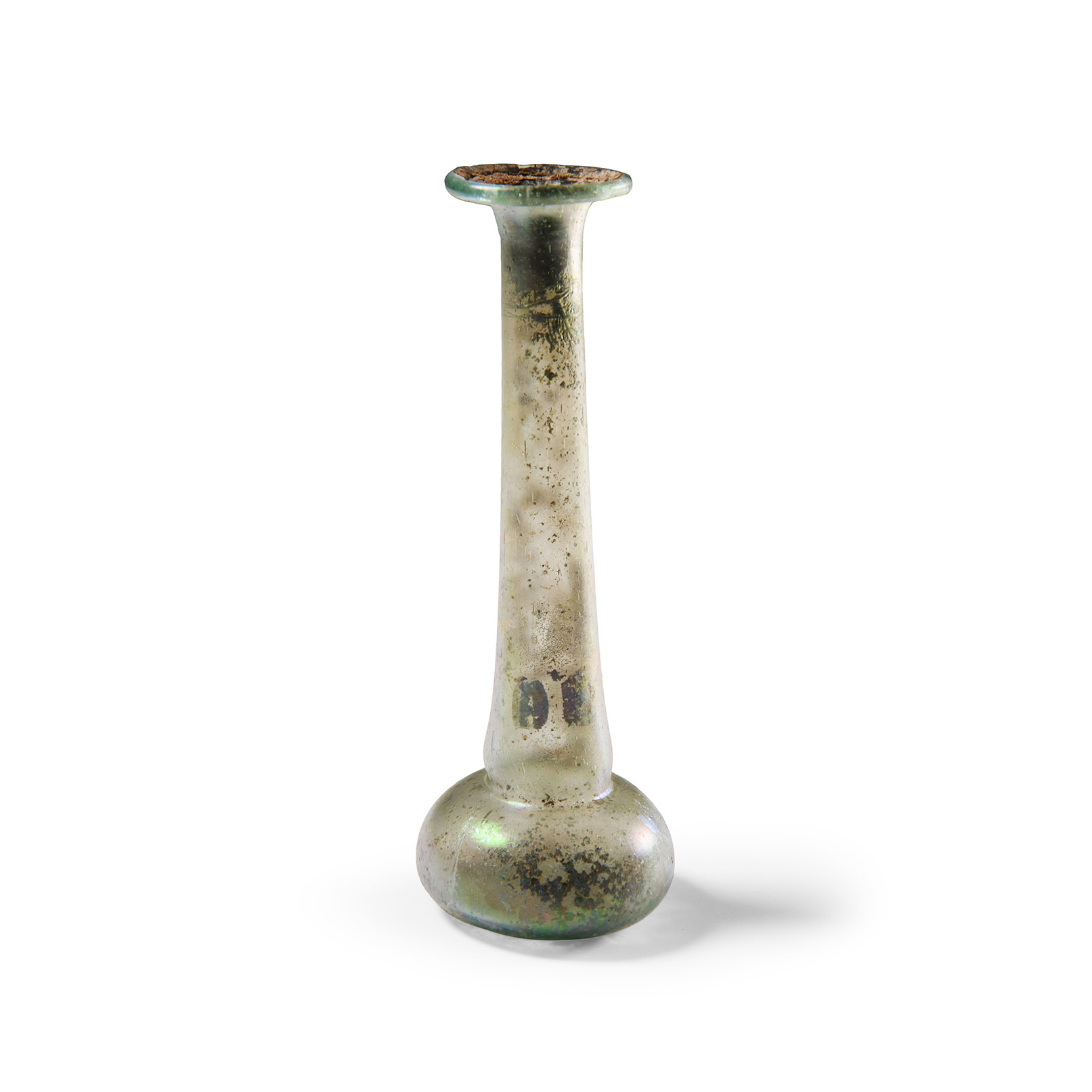
Roman Glass Candlestick Unguentarium
2ND-3RD CENTURY A.D.
4 3/4 in. (20.9 grams, 12 cm high).
Bulbous body with flat bottom, tall tapering neck with everted rim.
ProvenanceAcquired 1980-2015.
Ex Abelita family collection.
Cf. Whitehouse, D., Roman Glass in the Corning Museum of Glass, vol.1, New York, 1997, item 259.
CONDITIONTimeLine Auctions follows a vetting process to ensure the authenticity and legality of all items, reinforcing our commitment to integrity and responsible trading. Each antiquity, antique, and coin lot undergoes thorough examination by a vetting committee of at least ten external specialists, professional trade association members, scientists, and archaeologists: Our Vetting Process
AUCTIONS:
TimeLine is a leading auction house specialising in antiquities, ancient art, collectables, natural history, coins, medals, and books. Our auctions offer museums, collectors, historians, and enthusiasts the opportunity to acquire unique and historically significant pieces.
-
.jpg)
Large Roman Bronze Staff Finial with Bust of Serapis
Circa 2nd century A.D.Estimate: £80,000 - 100,000 (‡+bp*)
Opening Bid: £40,000
With luxuriant long wavy hair and characteristic vertical locks at the forehead, full beard with two large ringlets below the chin, wearing a chiton and a himation draped over the left shoulder, the head surmounted by a corn modius decorated with olive branch in relief, the bust supported on the back of an eagle standing atop an orb with spread wings, the eagle with its head slightly turned to the left, the feathers finely detailed; a finial from a staff or a ceremonial standard. 1.4 kg, 29.5 cm high
Repaired.
Ex private collection, South Germany, 1980. with Gorny and Mosch, Munich, 13 December 2003, lot 74. with Christie's, New York, 8 June 2012, lot 239. Accompanied by an academic report by Dr Raffaele D’Amato. This lot has been checked against the Interpol Database of stolen works of art and is accompanied by search certificate number no.11789-206489.
The Emperor Septimius Severus (193-211 A.D.) modelled many of his portraits based on Serapis. But it was under Hadrian that the refurbishment of the statue in the Serapeum increased the demand for small-scale images, like this one, probably made during his reign and used atop of a processional sceptre or standard for the cult of the god. -
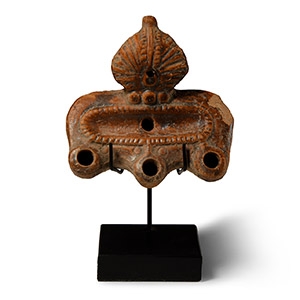
Roman Terracotta Triple-Spouted Lamp
Circa 2nd-1st millennium B.C.Sold for (Inc. bp): £598
An oblong vessel with three spouts and palmette reflector handle with pierced lug below to reverse; raised and notched discus; accompanied by a custom-made display stand. 209 grams total, 15 cm high including stand
From the collection of the German specialist Arno Jumpertz, Leverkusen, Germany, 1924-1984. Most of the collection was exhibited at Neus museum in 1985. -
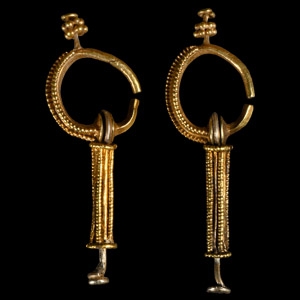
Roman Gold Earrings
2nd-3rd century A.D.Sold for (Inc. bp): £312
Each composed of a penannular hoop with filigree ornament, single granulated bead below, suspended on a cylindrical bar with vertical columns of filigree wire; elements joined with later silver wire; repaired. 10.33 grams total, 46-48 mm
From the collection of a North American gentleman, formed in the 1990s.
