
Loading, please wait...
LOT 0153
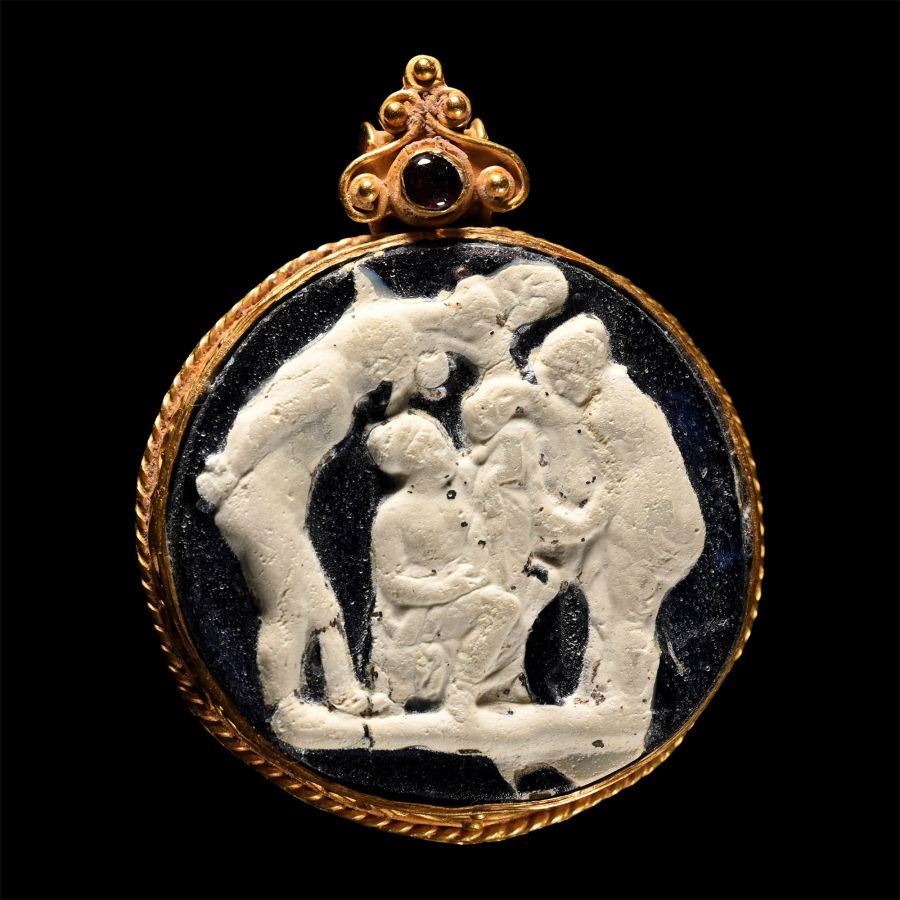
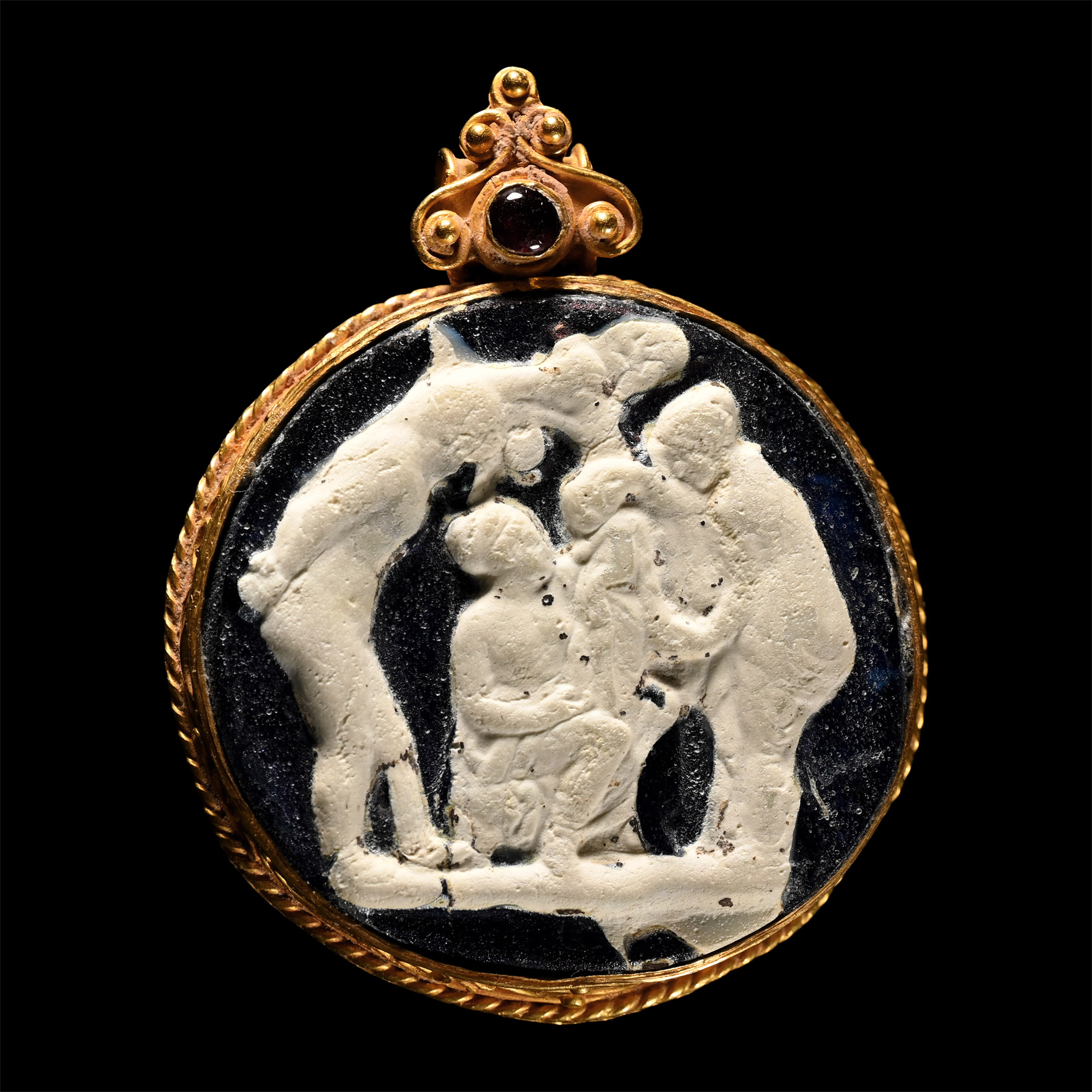
Roman Glass Cameo Tondo with Baby Dionysos, Raised by Nymphs on Mount Nysa, in Gold Pendant Setting
LATE 1ST CENTURY B.C.-1ST CENTURY A.D. AND LATER
1 7/8 in. (21.36 grams, 48 mm).
Blue glass disc with white glass past overlay imitating onyx, showing the nurturing of baby Dionysos, raised by nymphs on Mount Nysa: the infant god standing on the lap of a nymph, another standing right, Silenus standing left and leaning in on the scene, a tree in the background; set into a later gold setting with applied wire scrolls and tendrils on the sides with an applied filigree band below, wide loop above fronted by an applied decorative plaque set with a garnet cabochon.
ProvenancePrivate collection of a London gentleman, acquired between 1965-2020.
Accompanied by an academic report by Dr Ittai Gradel.
This lot has been checked against the Interpol Database of stolen works of art and is accompanied by a search certificate number no.12680-235465.
This lot has been cleared against the Art Loss Register database, and is accompanied by an illustrated lot declaration signed by the Head of the Antiquities Department, Dr Raffaele D'Amato.
See Henig, M., Molesworth, H., The Complete Content Cameos, 2018, 157, no.152; see also The British Museum, London, museum no.1923,0401.1022, for a similar example.
FootnotesDr Ittai Gradel writes: 'Cameos with Dionysiac motifs were especially popular in the mid- to later first century BC, and the prolific workshop of the gem carver Sostratos specialized in such motifs (see I. Gradel, ‘A tale of two fragments: a Sostratos cameo reconstructed’, The Burlington Magazine 162 (March 2020), 181-87). The original, lost stone cameo, from which this glass version was cast, belongs in this period and ambience. The glass cast was presumably contemporary with the original cameo, possibly slightly later, but the glass is in any case clearly ancient (corrosion, iridescence).'
CONDITIONTimeLine Auctions follows a vetting process to ensure the authenticity and legality of all items, reinforcing our commitment to integrity and responsible trading. Each antiquity, antique, and coin lot undergoes thorough examination by a vetting committee of at least ten external specialists, professional trade association members, scientists, and archaeologists: Our Vetting Process
AUCTIONS:
TimeLine is a leading auction house specialising in antiquities, ancient art, collectables, natural history, coins, medals, and books. Our auctions offer museums, collectors, historians, and enthusiasts the opportunity to acquire unique and historically significant pieces.
LOT 0153
Roman Glass Cameo Tondo with Baby Dionysos, Raised by Nymphs on Mount Nysa, in Gold Pendant Setting
Sold for (Inc. bp): £2,600
-
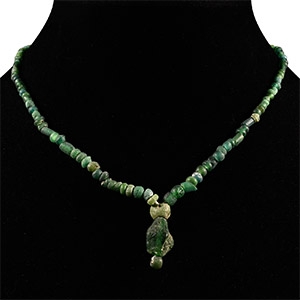
Roman Green Glass Bead Necklace String
1st-4th century A.D. and laterSold for (Inc. bp): £20
Restrung group of tubular, melon-shaped, biconvex and other beads with a polyhedral dangle. 11.82 grams, 34.5 cm
Ex London, UK, collection, 1990s. This lot is accompanied by an illustrated lot declaration signed by the Head of the Antiquities Department, Dr Raffaele D'Amato. -
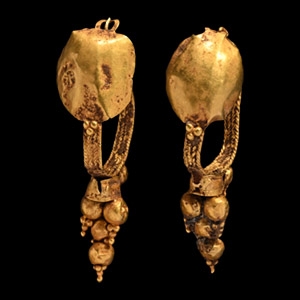
Roman Gold Earrings with Shield
3rd-4th century A.D.Estimate: £700 - 900 (‡+bp*)
Opening Bid: £315
A matched pair, each a braided hoop with an applied shield-shaped disc, collar with a cluster of hollow spherical grapes with granule clusters below. 6.57 grams total, 42-44 mm
Acquired in 1992. Private collection, Switzerland, thence by descent. Private collection, since the late 1990s. This lot is accompanied by an illustrated lot declaration signed by the Head of the Antiquities Department, Dr Raffaele D'Amato. -
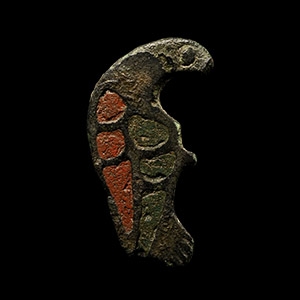
Roman Enamelled Bronze Eagle Plate Brooch
Circa 2nd century A.D.Sold for (Inc. bp): £98
Aviform plate with enamel-filled cells to body and wing, remains of catch and pin-lug to reverse. 2.64 grams, 26 mm
Found Wiltshire, UK, before 1974. Private collection, London. This lot is accompanied by an illustrated lot declaration signed by the Head of the Antiquities Department, Dr Raffaele D'Amato.
