
Loading, please wait...
_900x900.jpg "Roman Glass Amphoriskos")
_200x200.jpg "Roman Glass Amphoriskos")
.jpg "Roman Glass Amphoriskos")
LOT 0661
Roman Glass Amphoriskos
1ST CENTURY A.D.
2 7/8 in. (17.6 grams, 73 mm).
Comprising a Sidonian mould-blown glass vessel with ovoid body, cylindrical neck, everted rim and twin applied handles; decorated with a medial band of swirl motifs between fluting; iridescent surfaces; rim chipped.
ProvenanceFrench collection, 1990s-early 2000s.
Acquired at a Paris auction.
From an important Paris gallery, France.
Ex private Parisian collection.
Cf. The Metropolitan Museum, accession numbers and 17.194.223, for similar decorative motif and shape using different coloured glass.
CONDITIONTimeLine Auctions follows a vetting process to ensure the authenticity and legality of all items, reinforcing our commitment to integrity and responsible trading. Each antiquity, antique, and coin lot undergoes thorough examination by a vetting committee of at least ten external specialists, professional trade association members, scientists, and archaeologists: Our Vetting Process
AUCTIONS:
TimeLine is a leading auction house specialising in antiquities, ancient art, collectables, natural history, coins, medals, and books. Our auctions offer museums, collectors, historians, and enthusiasts the opportunity to acquire unique and historically significant pieces.
LOT 0661
Roman Glass Amphoriskos
Estimate £400 - 600€460 - 700 (for guidance only)$540 - 810 (for guidance only)
-
.jpg)
Roman Banded Agate Lion Attack Gemstone
Circa 2nd century A.D.Estimate: £200 - 300 (+bp*)
Opening Bid: £100
With intaglio scene of a lion attacking an ibex; supplied with a museum-quality impression. 1.55 grams, 14 mm
From the collection of a Swiss gentleman formed in Europe from 1970-1980s; thence by descent from the family in London. -
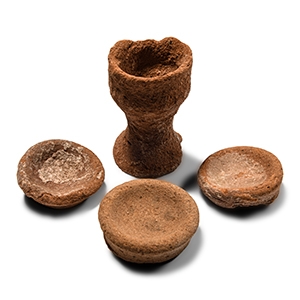
Roman Terracotta Vessel Collection
Circa 1st-4th century A.D.Sold for (Inc. bp): £52
Comprising a small chalice-shaped vessel with tall foot and three shallow miniature platters. 78 grams total, 34-54 mm
Property of a UK gentleman, acquired in the 1970s. Property of an East Sussex, UK, gentleman. -
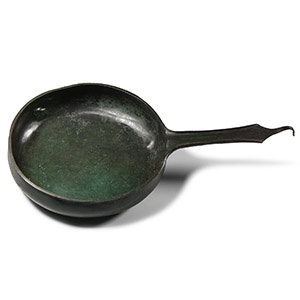
Roman Bronze Pan with Handle
1st century B.C.-1st century A.D.Estimate: £1,200 - 1,700 (+bp*)
Opening Bid: £667
The bowl with a wide flat bottom and convex sides; the inside with incised concentric circles; flat handle with raised edges and hooked finial for suspension. 483 grams, 39.5 cm
German private collection, Mr O., collecting in the 1950s-1960s; thence by descent. with Bonhams, London, 7 July 2016, lot 191. Accompanied by an academic report by Dr Raffaele D’Amato. This lot has been checked against the Interpol Database of stolen works of art and is accompanied by search certificate number no.11735-201189.
This vessel was part of Roman and provincial bronze instrumentum domesticum, i.e. culinary or domestic utility ware. Such cooking vessels are rare: some are found in central and northern Italy, in Pannonia, Germany and in Britain. The Aylesford Pan, today in the British Museum (inventory no.1886.1112.1), is one of the most important finds. This specimen (Eggers type 130), probably pre-Caesarian or Caesarian, was found in a grave together with a Celtic bucket and a jug.
