
Loading, please wait...
LOT 0109
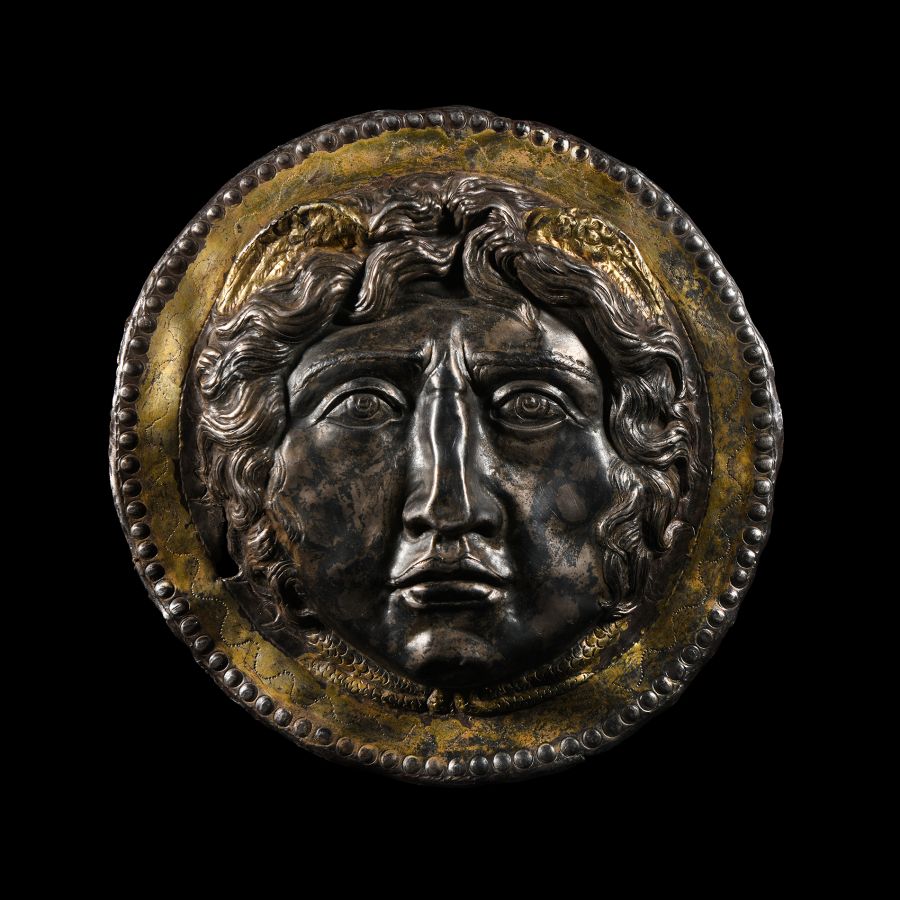
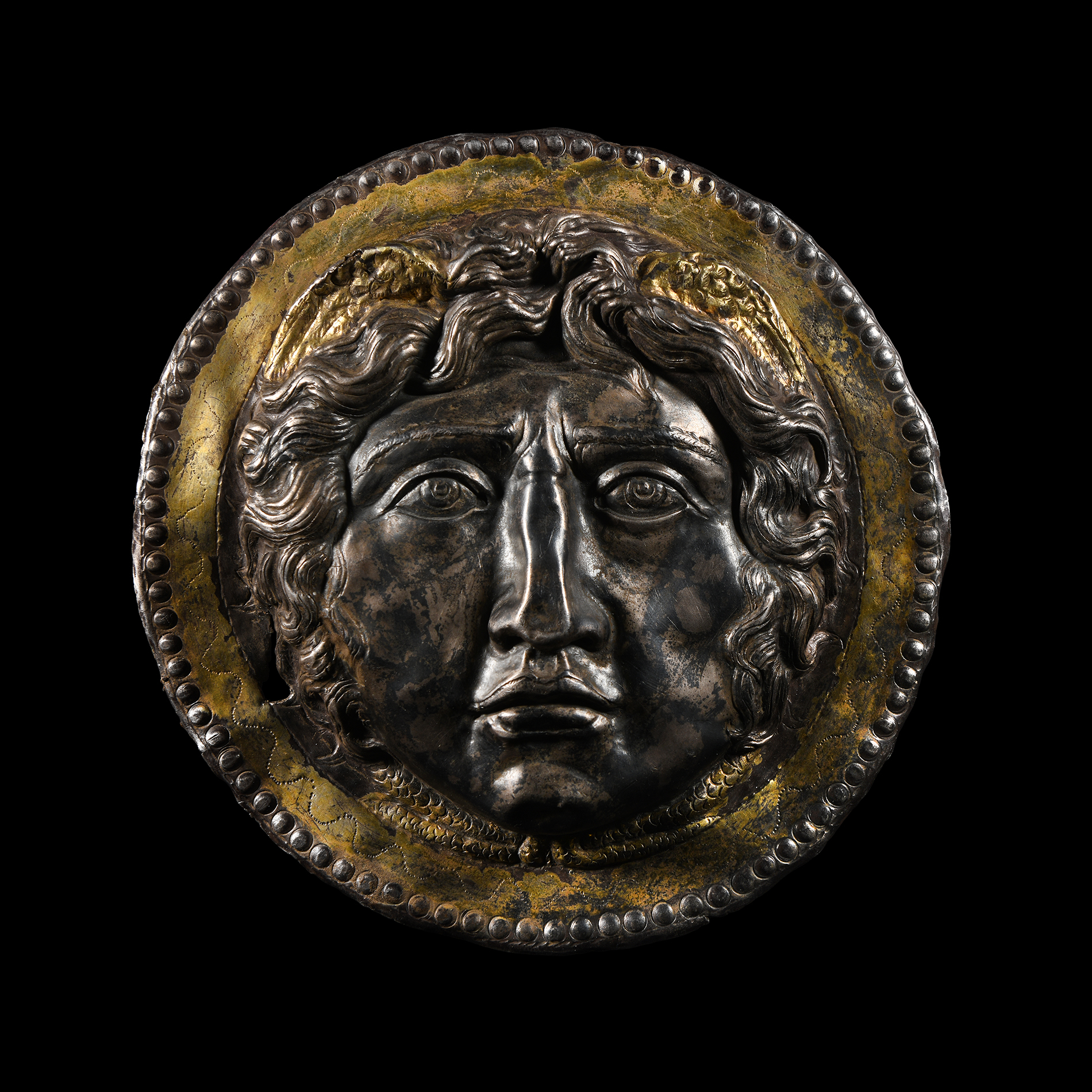
Roman Gilt-Silver Phalera with Winged Head of Medusa
1ST-2ND CENTURY A.D.
3 1/2 - 5 in. (113 grams total, 8.8-12.5 cm).
A substantial ornamental silver armour phalera with gilt detailing, embossed face of the Gorgon, Medusa, to the centre with detailed eyes, eyebrows and mouth, strong nasal ridge extending towards the forehead, furrowed brow with a pair of wings emerging from the curly hair framing the face, a pair of snakes knotted beneath the chin; wide edge with beaded rim and wavy pointillé decoration; accompanied by a discoid bronze sheet to which the fastening pins were attached to.
ProvenanceAcquired in 1970.
with Coins and Antiquities, formerly known as D.J. Crowther Ltd, Mayfair, London, UK.
Private collection of a London antiquarian.
English private collection.
Accompanied by an academic report by Dr Raffaele D’Amato.
This lot has been checked against the Interpol Database of stolen works of art and is accompanied by search certificate number no.10623-174245.
Cf. Jahn, O., Die Lauersforter Phalerae, Bonn, 1860, taf.1; Maxfield, V.A., The military decorations of the Roman Army, Los Angeles, 1981; D’Amato, R., Sumner, G., Arms and Armour of the Imperial Roman Soldier: From Marius to Commodus, 112 BC-AD 192, London, 2009, figs.157, 254-255; D’Amato, R., Roman Standards & Standard-Bearers (1), 112BC-AD192, Oxford, 2018, p.54; D’Amato, R. & Negin, A., Roman decorated armour, London, 2019, p.150, fig.137.
FootnotesDiscoid military decorations usually depicted the heads of the gods, spirits of the underworld, birds and lions, Medusa being the most popular subject. Sets of phalerae, similar to those shown on monuments dedicated to Marcus Caelius, Quintus Sertorius Festus and Celer Allius, were found in Neuss, Lauersfort and Newstead. Our phalera finds parallel in similar examples from the magnificent Lauersfort set, echoing the decoration visible on the gravestone of centurion Caelius from Bonn, depicted with a corona civica on his head, the best-known silver military decorations of the early Imperial Age. The higher officers in the Roman army had the custom of wearing such rich suits of phalerae with the straps attached directly to leather garments or doublets, worn over their armour.
One such example can be seen on the gravestone of the Aquilifer G. Musius (Jahn, 1860, taf.II; D’Amato, 2018, p.54), where the phalerae are worn over a leather structure like a doublet over the subarmalis. Wearing a double-padded armour under the doublet provided twice as much protection to the warrior and enhanced the phalerae worn over the doublet. These decorations were awarded in sets, commonly of nine, although the sources confirm that this was not an absolute rule. They were worn in a similar fashion to medals on the chest, attached to a leather harness of straps, which ran straight around and up and down the front of the chest, and continued over the shoulders and around the back where they were fastened with buckles (Maxfield, 1981, pp.92-93).
TimeLine Auctions follows a vetting process to ensure the authenticity and legality of all items, reinforcing our commitment to integrity and responsible trading. Each antiquity, antique, and coin lot undergoes thorough examination by a vetting committee of at least ten external specialists, professional trade association members, scientists, and archaeologists: Our Vetting Process
AUCTIONS:
TimeLine is a leading auction house specialising in antiquities, ancient art, collectables, natural history, coins, medals, and books. Our auctions offer museums, collectors, historians, and enthusiasts the opportunity to acquire unique and historically significant pieces.
-
.jpg)
'The Witherley' Roman Lead Pig Ingot
4th century A.D.Sold for (Inc. bp): £2,600
A substantial lead pig (ingot), sub-rectangular in plan and plano-convex in section, reserved partial numerical inscription to central recess on the upper face, possibly: ‘CCCXXXXI’ or 341 Roman libra, a denomination of weight and the original weight of the ingot. 74 kg, 48 cm
Fine condition. Rare.
Found while searching with a metal detector on Wednesday 2nd September 2020 in Witherley, Leicestershire, UK, at a depth of 57cm by Nick Thorpe. Accompanied by Portable Antiquities Scheme Report number LEIC-62F9AF. Accompanied by a copy of a full page article published in Treasure Hunting Magazine, March 2021. Accompanied by copies of four photographs taken during excavation, and a hand written letter from the finder explaining the circumstances of finding. Accompanied by an academic report by Dr Raffaele D’Amato. This lot has been checked against the Interpol Database of stolen works of art and is accompanied by search certificate number no.10791-178320.
Although ingots are known to have been made in many shapes, the plano-convex shape was the most commonly used during the Roman period (Tylecote, 1987, p.204). The Witherley lead pig is certainly, at the moment, one of the largest of its kind found in Britain. The inscription relates to its weight in Roman libra, and it seems that originally the weight of the complete ingot was circa 110 kg. Such inscriptions appear on Roman ingots from the early Imperial Age onwards, see for example Gale Brown (2011, no.61.3ff.) The high percentage of lead in our ingot (97.9% lead, 1.5 % iron by XRF), is far higher than many other known specimens. Roman ingots are particularly important in many respects: in addition to their use for dating various phases of commercial activity, they can reveal the extent to which standardisation of weights was practised. The presence of numerical markings has led to suggestions of the existence of a 'standard weight' of 195 Roman libra (63.85 kg). -
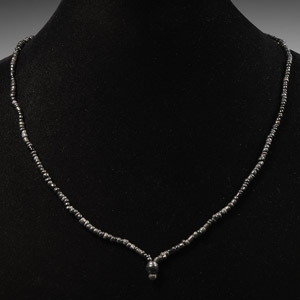
Roman and Other Bead Necklace
1st century A.D. and laterSold for (Inc. bp): £26
A restrung necklace composed of 'black' stone and glass beads of various sizes, dates and types, including barrel-shaped, annular, oblate, spherical and other types. 8.2 grams, 81 cm long
Acquired 1980-2015. Ex Abelita family collection. -
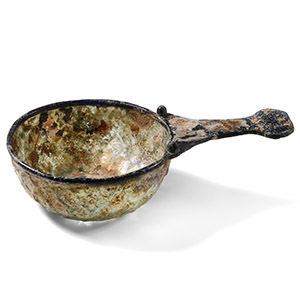
Roman Iridescent Pale Blue Glass Trulla
3rd-4th century A.D. or laterEstimate: £1,500 - 2,000 (‡+bp*)
Opening Bid: £375
A glass trulla (pan or handled cup) with an aqua-coloured hemispherical bowl and dark blue glass rim and handle with raised knops to the neck, the bowl with moulded lozengiform 'net' motif with kick-up to base surrounded by a moulded rosette; iridescent surfaces; handle reattached. 88 grams, 19 cm
handle re-attached.
Acquired early 1990s. Ex private American collection; thence by descent. Private collection since 1998.
