
Loading, please wait...
_900x900.jpg "Roman Gilt Bronze Eagle On Globe Holding a Victory Wreath")
_200x200.jpg "Roman Gilt Bronze Eagle On Globe Holding a Victory Wreath")
_900x900.jpg "Roman Gilt Bronze Eagle On Globe Holding a Victory Wreath")
_200x200.jpg "Roman Gilt Bronze Eagle On Globe Holding a Victory Wreath")
_900x900.jpg "Roman Gilt Bronze Eagle On Globe Holding a Victory Wreath")
_200x200.jpg "Roman Gilt Bronze Eagle On Globe Holding a Victory Wreath")
.jpg "Roman Gilt Bronze Eagle On Globe Holding a Victory Wreath")
.jpg "Roman Gilt Bronze Eagle On Globe Holding a Victory Wreath")
.jpg "Roman Gilt Bronze Eagle On Globe Holding a Victory Wreath")
LOT 0120
Roman Gilt Bronze Eagle On Globe Holding a Victory Wreath
2ND-3RD CENTURY A.D.
3 1/2 in. (193 grams, 88 mm).
Modelled in the round as a standing eagle with its wings spread and short tail; incised feather detailing to the body and wings, head with detailed eyes, victory wreath held in its hooked beak.
ProvenanceAcquired on the UK art market, 1990s.
Private collection, New York, USA.
This lot has been checked against the Interpol Database of stolen works of art and is accompanied by search certificate number no.13362-255446.
Cf. Rolland, H., Bronzes Antiques de Haute Provence, Paris, 1965, item 268.
FootnotesAs an animal associated with Jupiter, king of the Olympian gods, the eagle was a pre-eminent symbol of imperial power, including military power. The laurel wreath was a symbol of victory and was included among the military gifts (dona militaria).
CONDITIONTimeLine Auctions follows a vetting process to ensure the authenticity and legality of all items, reinforcing our commitment to integrity and responsible trading. Each antiquity, antique, and coin lot undergoes thorough examination by a vetting committee of at least ten external specialists, professional trade association members, scientists, and archaeologists: Our Vetting Process
AUCTIONS:
TimeLine is a leading auction house specialising in antiquities, ancient art, collectables, natural history, coins, medals, and books. Our auctions offer museums, collectors, historians, and enthusiasts the opportunity to acquire unique and historically significant pieces.
LOT 0120
Roman Gilt Bronze Eagle On Globe Holding a Victory Wreath
Estimate £2,000 - 3,000€2,320 - 3,480 (for guidance only)$2,700 - 4,050 (for guidance only)
-
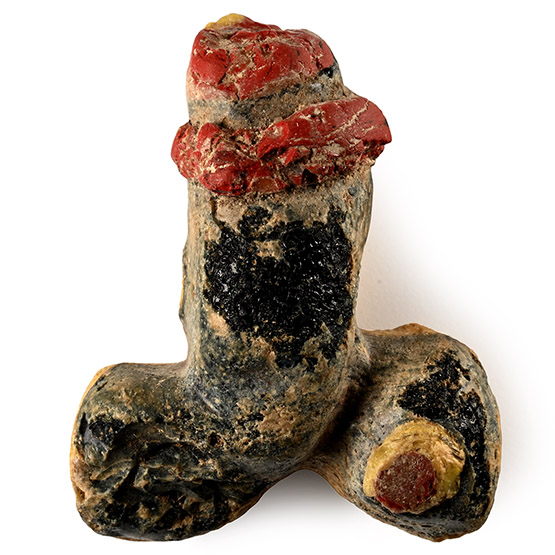
Roman Glass Phallic Amulet
1st century B.C.-1st century A.D.Sold for (Inc. bp): £468
Modelled in the round with applied red-glass collar, pierced through the shaft for suspension. 11.4 grams, 32 mm
Acquired in the mid 1980s-1990s. Private collection, Switzerland, thence by descent. Private collection, since the late 1990s.
In the Roman world, the phallus was a symbol of luck or fertility, and it was believed to have apotropaic functions. Pendants, amulets and small objects were worn by all sorts of people as symbols of protection, especially by young children, according to Varro and Pliny the Elder. The phallus is also commonly found on reliefs, frescoes and lamps from the Graeco-Roman world. -
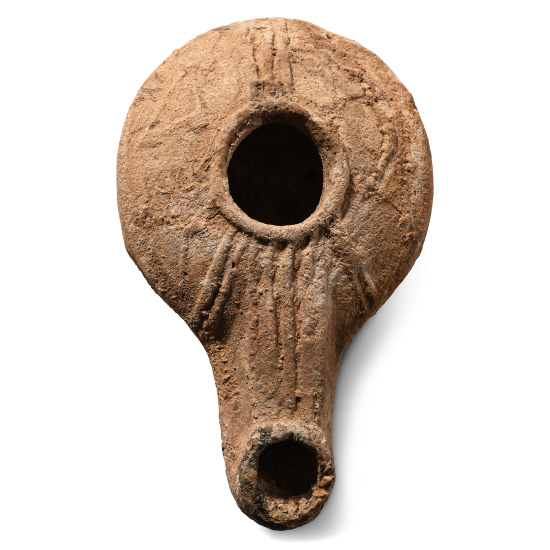
Roman Terracotta Oil Lamp with Extended Nozzle
Holy Land, circa 4th-7th century A.D.Sold for (Inc. bp): £72
Round body with an elongated nozzle, raised ribs extending from the rear of the lamp to the edge of the nozzle. 64.2 grams, 94 mm
Ex Ancient Art Shop, Windsor, UK, 1990s. Ex private West County, UK, collection. -
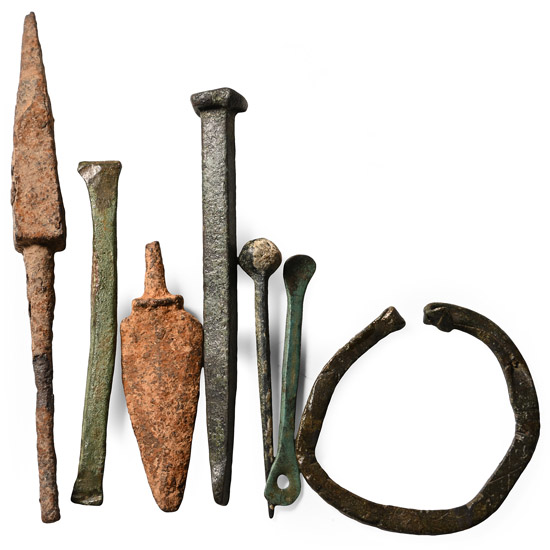
Roman Bronze and Iron Artefact Collection
Circa 1st-4th century A.D.Sold for (Inc. bp): £98
Comprising: ball-headed dess pin; stylus with eraser; cosmetic scoop; penannular quoit brooch with recurved ends; clout nail; leaf-shaped arrowhead; quarrel head with long tang. 50 grams total, 45-87 mm
From the private collection of Mr Brian Edwards, New Malden, Surrey, UK, formed from the late 1970s-early 1980s; thence by descent. Accompanied by the original collector's data sheet(s) with reference nos.A63, A64, A65, A74, A96, A97 & A107.
