
Loading, please wait...
LOT 0897
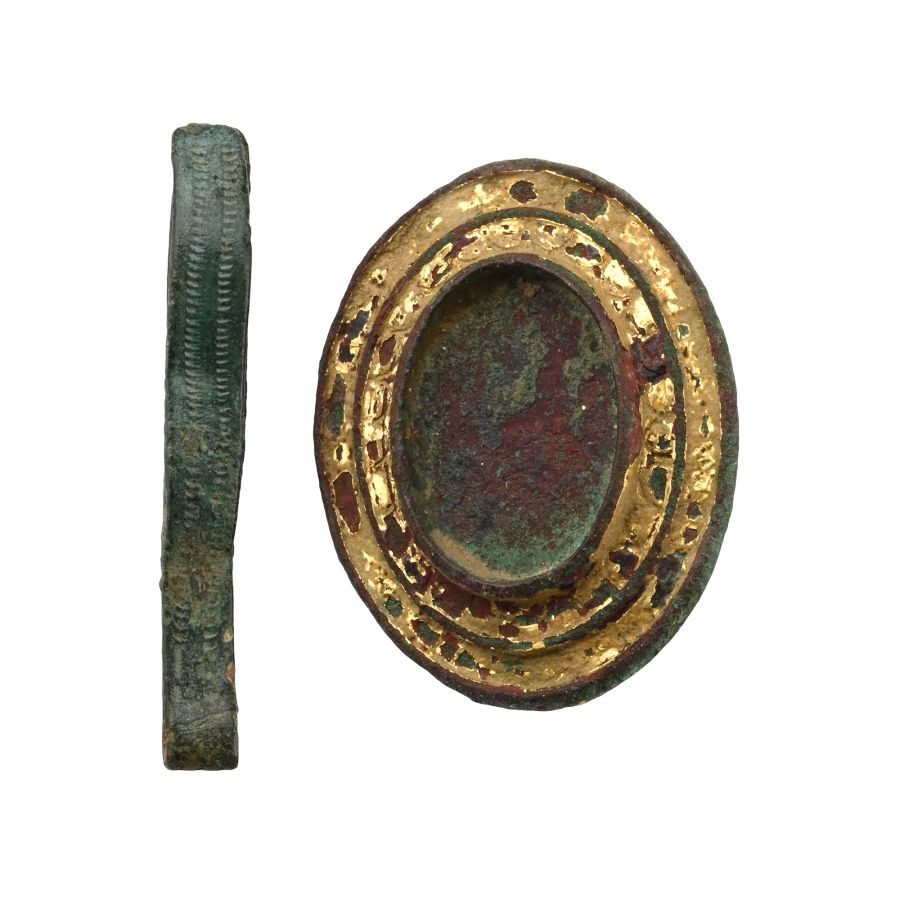
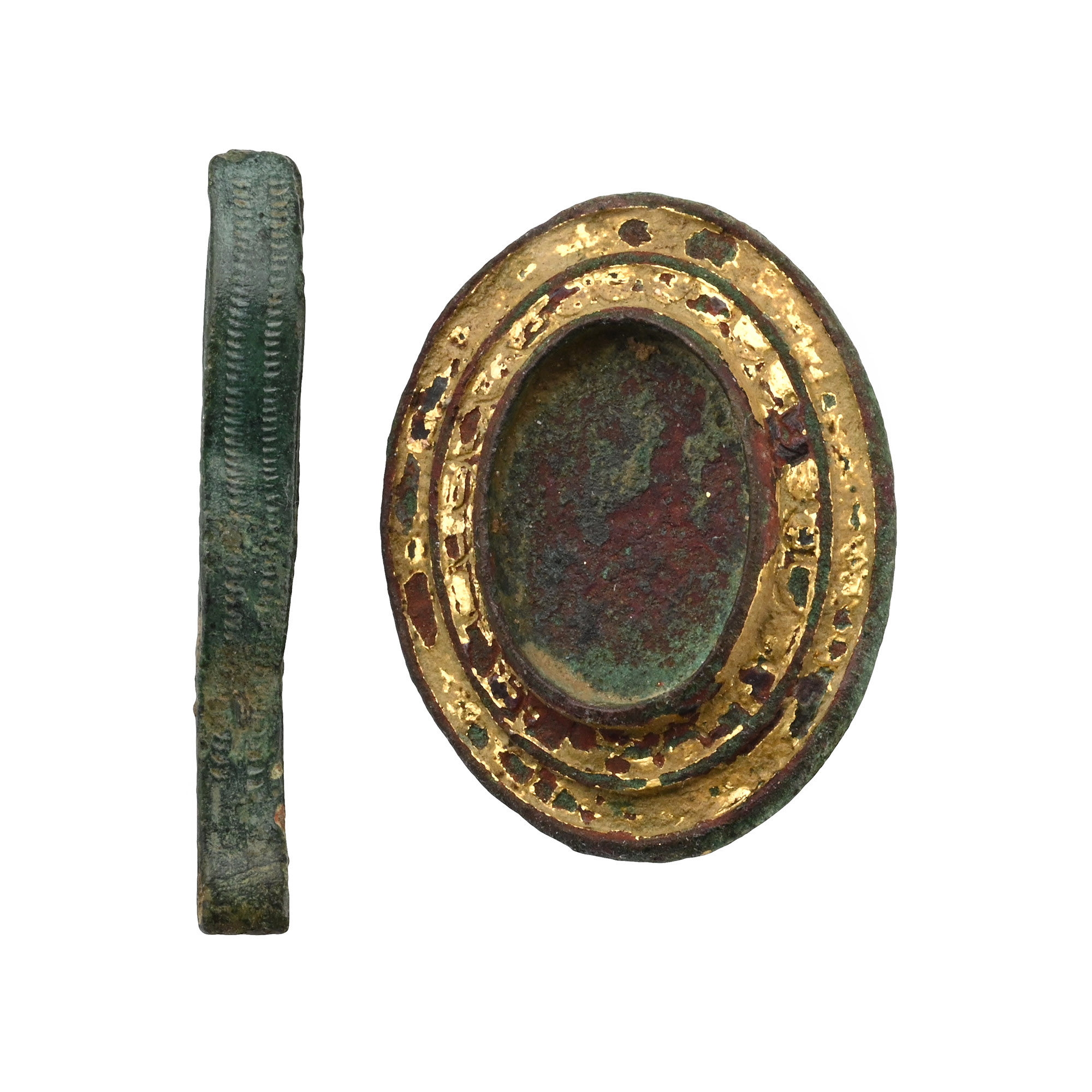
Roman Gilt Bronze Brooch and Medieval Tweezers
2ND-15TH CENTURY A.D.
11/4 - 1 3/8 in. (12.5 grams total, 32-37.6 mm).
Comprising: ellipsoid plate brooch with gilt border and central cell, pin-lug and catch to reverse; flat-section tweezers found in association with the brooch. [2, No Reserve]
ProvenanceFound whilst searching with a metal detector near Dullingham, East Cambridgeshire, UK, on Friday 13th December 2024 and Thursday 1st May 2025.
Accompanied by copies of the British Museum's Portable Antiquities Scheme (PAS) report nos.SF-9D6556 and SF-CF180C.
Cf. Mackreth, D.F., Brooches in Late Iron Age and Roman Britain, Oxford, 2011, vol.2, item 107.
CONDITIONTimeLine Auctions follows a vetting process to ensure the authenticity and legality of all items, reinforcing our commitment to integrity and responsible trading. Each antiquity, antique, and coin lot undergoes thorough examination by a vetting committee of at least ten external specialists, professional trade association members, scientists, and archaeologists: Our Vetting Process
AUCTIONS:
TimeLine is a leading auction house specialising in antiquities, ancient art, collectables, natural history, coins, medals, and books. Our auctions offer museums, collectors, historians, and enthusiasts the opportunity to acquire unique and historically significant pieces.
-
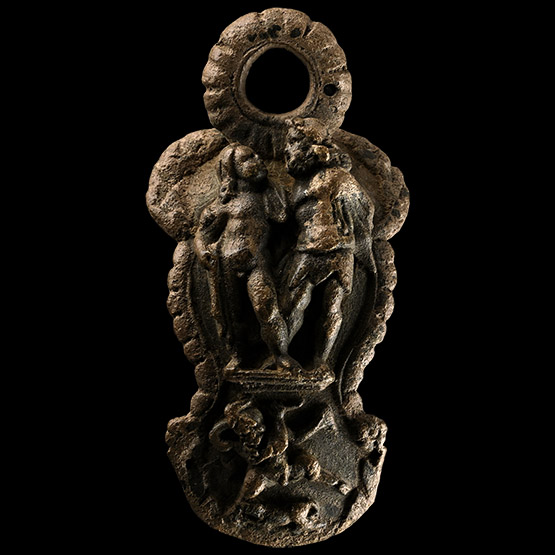
Roman Bronze Three-Dimensional Vessel Mount
2nd-3rd century A.D.Estimate: £3,000 - 4,000 (‡+bp*)
Opening Bid: £1,500
Comprising a plaque of three conjoined lobes with segmented border; at the top, a loop with segmented rim; vignette with a nude male with shoulder-length hair embracing a taller bearded figure with kilt and mantle to left shoulder (Hercules?); below, a satyr with horns and goat's legs beset by hunting dogs. 286 grams, 13.8 cm
Acquired in 1992. Private collection, thence by descent. Private collection, since the late 1990s. This lot has been checked against the Interpol Database of stolen works of art and is accompanied by a search certificate number no.12865-241702.
Vessel mounts of this form are not a commonly recovered artefact type and the presence of two figures instead one is a very singular feature. We can suppose that the mount was attached to a vessel of large dimensions and of a certain importance. -
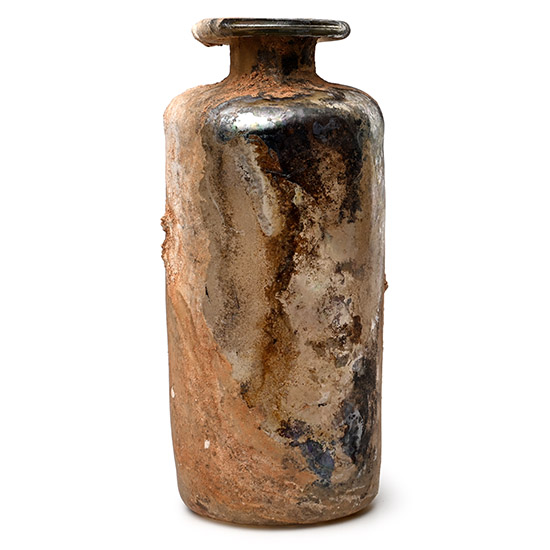
Roman Glass Bottle
Circa 1st-4th century A.D.Sold for (Inc. bp): £208
Comprising a flat-based tubular body and short neck with everted flange rim. 87 grams, 13.9 cm
From a London, UK, collection of glass, 1970-2000s. -
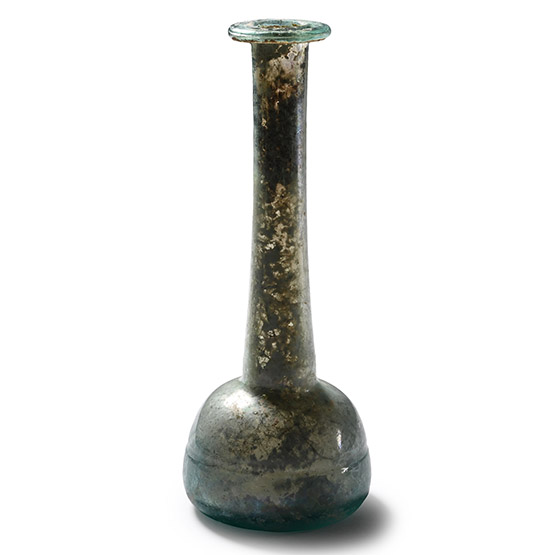
Roman Glass Unguentarium
1st-3rd century A.D.Sold for (Inc. bp): £130
With plano-convex body and dimple base, tall slender neck, folded rim; iridescent green surface. 78 grams, 15 cm
From an important London collection of glass, 1990s.
This kind of toilet bottle was called ‘candlestick unguentarium’ by the academics due to the shape of its neck. This specific type, with its transparent grayish green glass, is especially found in Roman Cyprus (Hayes's fabric 2 of Cypriot blown glass).
