
Loading, please wait...
LOT 0092
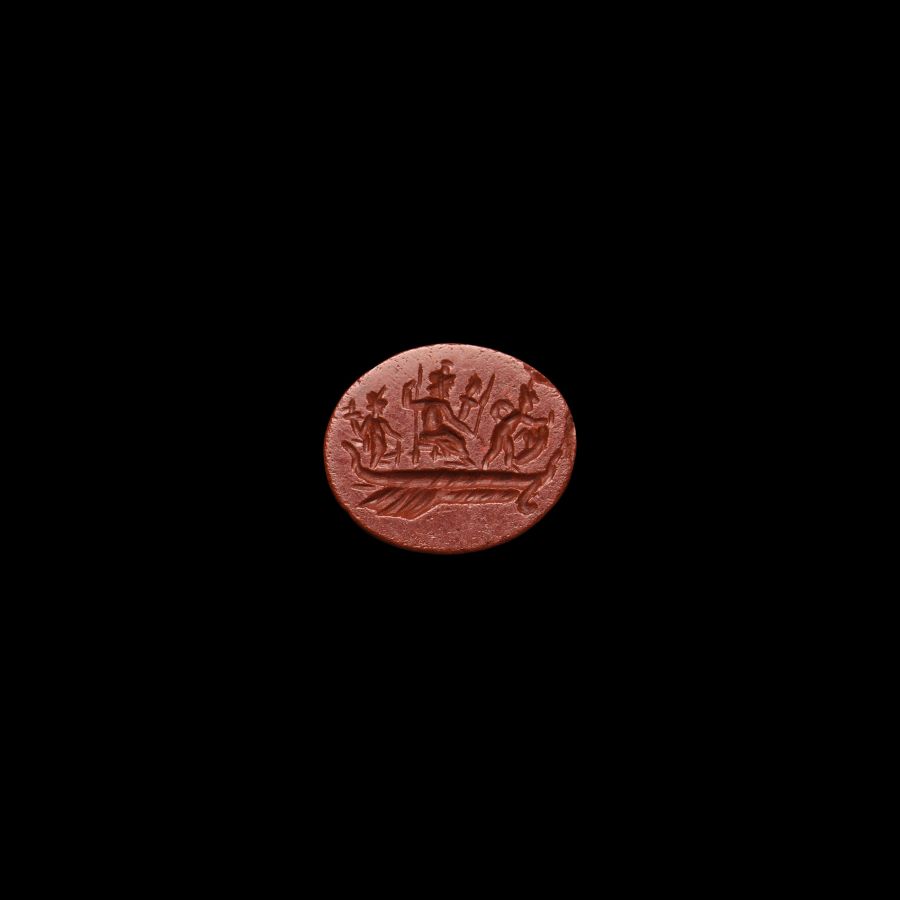
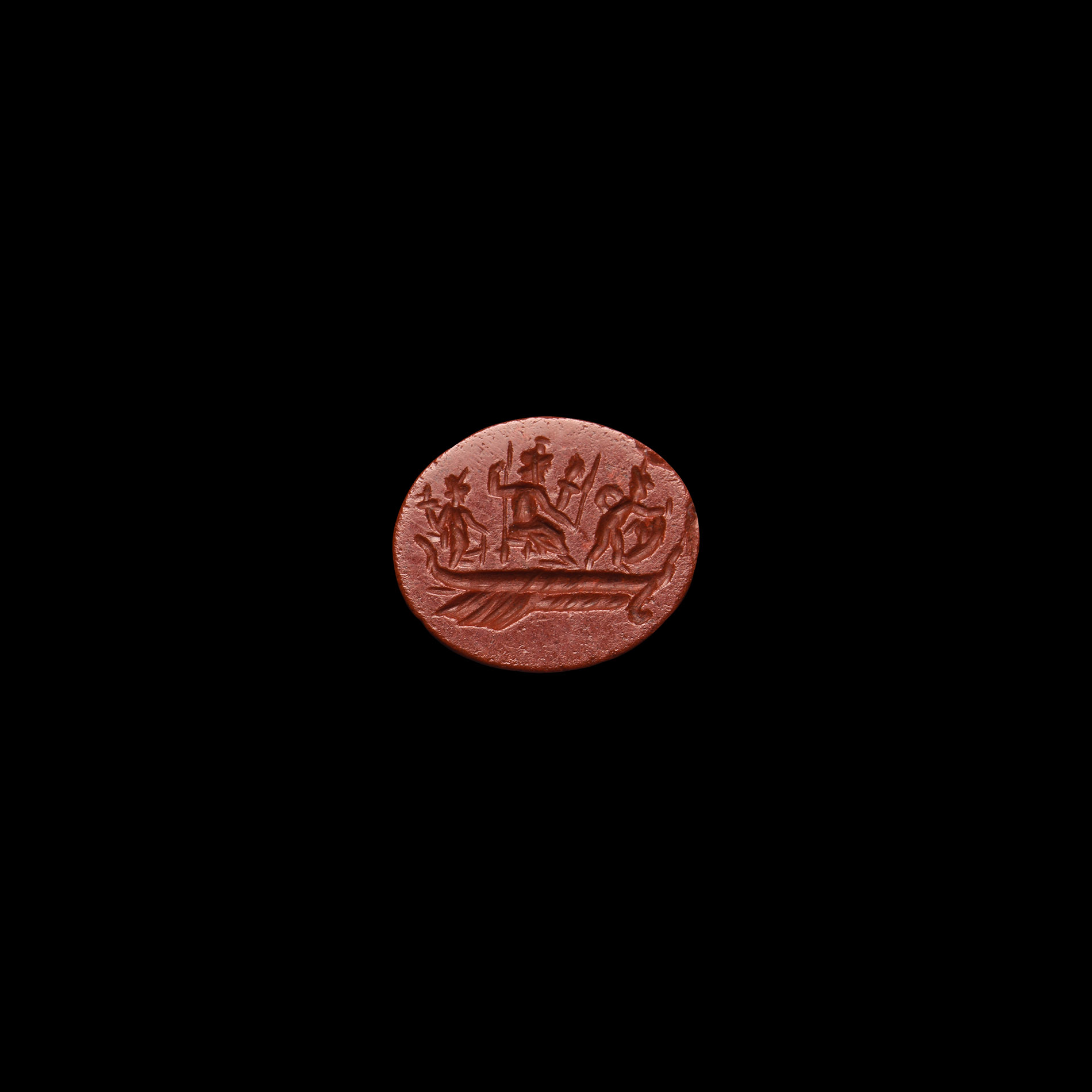
Roman Gemstone with Zeus Serapis and Isis
2ND-3RD CENTURY A.D. OR LATER
3/8 in. (0.28 grams, 10 mm).
A gem with a representation of Zeus Serapis enthroned, modius on his head, sceptre and eagle by his side, Isis Gubernatrix to his right and Isis sail-bearer to his left, all three figures riding a galley or cargo ship.
ProvenanceAcquired before 1988.
Ex family collection, by descent, Geneva.
Cf. Bricault, L., Isis Pelagia: Images, Names and Cults of a Goddess of the Seas, Leiden-Boston, 2020, figs. 75, 78, 80, for similar gemstones.
FootnotesThis triad formed by Serapis and the two aspects of Isis (Gubernatrix and sail-bearer) aboard a ship, appears in several examples of Alexandrian coinage and gemstones. This imagery is linked to the image of Isis, goddess of the sea, and Serapis, god of vegetation and protector of the sailors.
CONDITIONTimeLine Auctions follows a vetting process to ensure the authenticity and legality of all items, reinforcing our commitment to integrity and responsible trading. Each antiquity, antique, and coin lot undergoes thorough examination by a vetting committee of at least ten external specialists, professional trade association members, scientists, and archaeologists: Our Vetting Process
AUCTIONS:
TimeLine is a leading auction house specialising in antiquities, ancient art, collectables, natural history, coins, medals, and books. Our auctions offer museums, collectors, historians, and enthusiasts the opportunity to acquire unique and historically significant pieces.
-
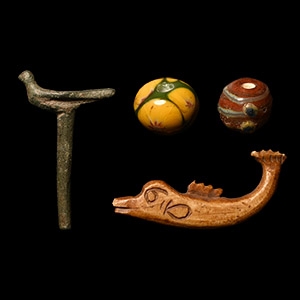
Roman and Later Artefact Group
2nd century A.D. and laterSold for (Inc. bp): £33
A mixed group comprising: a bone dolphin with slot to the raised; the tip of a bronze hair-pin; and two later glass beads. 11.56 grams total, 12-38 mm
Acquired in the late 1990s-2000. Property of an East London gentleman. -
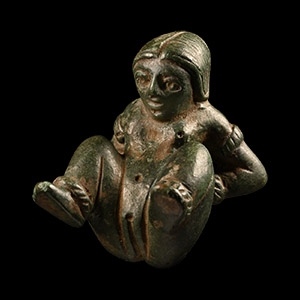
Roman Nude Crouching Woman Gaming Piece
3rd century A.D.Sold for (Inc. bp): £1,755
A bronze figure or gaming piece of a nude female in crouching pose with hands placed on the hips, possibly giving birth; the hair shown drawn up in a bun, segmented armband to each upper arm. 30.4 grams, 28 mm high
Private Swiss collection, acquired 2002.
The dice features six attitudes on which it could land when rolled, one of which includes the figure's head. The earliest concrete historical evidence of games played with dice originated from ancient Egypt, circa 3000 B.C., although it is generally believed by historians that dice pre-dated the ancient Egyptian civilisation. The Romans played two games using dice: Tali and Tesserae. The former originated in Greece and features four animal bones. The aim was to roll in such a way that each die displayed a different number-the higher the combined number, the greater the score. The latter was played using three dice, the goal being to roll triple six, or to achieve the highest combined numbers out of the contestants; it was a game of chance and the most common street and tavern gambling game in ancient Rome. ‘Dogs’ referred to poor scores and ‘Venus’ to high ones. Roman players rolled dice from a special cup called a fritillium onto wood, bronze, or marble boards, depending on their class and wealth. Roman elites boasted ornate boards inscribed with their names. The gambling which ensued from dice games caused extreme social issues in Roman society, leading the government to eventually outlaw dice games, although these laws were largely ignored. -
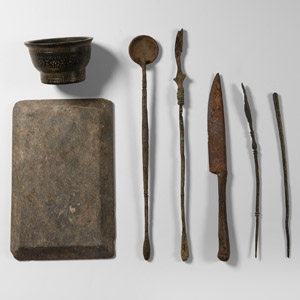
Roman Medical Implements and Palette
1st-4th century A.D.Estimate: £600 - 800 (+bp*)
Opening Bid: £300
A copper-alloy medical instrument group comprising: a bowl with incised geometric decoration; a rectangular palette with bevelled edges; knife with single-edged iron blade and decoratively incised pommel; spoon with circular bowl, collared stem with expanded waist and finial formed as a probe; pin with tapering round-section body, shallow conical finial and decoratively incised head; a scoop probe with remains of elongated shallow scoop, expanded neck with collars, slender ribbed stem and bulbous probe to terminal; scoop with leaf-shaped bowl and balustered stem. 332 grams total, 4.8-17 cm
Acquired before 2000. From the collection of a European gentleman living in the UK.
