
Loading, please wait...
_900x900.jpg "Roman Gemstone with Victory Coronation Scene with Hebrew Script")
_200x200.jpg "Roman Gemstone with Victory Coronation Scene with Hebrew Script")
.jpg "Roman Gemstone with Victory Coronation Scene with Hebrew Script")
LOT 0101
Roman Gemstone with Victory Coronation Scene with Hebrew Script
2ND-3RD CENTURY A.D.
3/4 in. (2.11 grams, 20 mm).
A bifacial oval-shaped carnelian gemstone with bevelled edge, the obverse engraved with a scene composed of multiple figures standing on a ground line, crescent moon between two stars above, from left possibly the god Helios (or Serapis) being crowned by Victory, the central standing figure of Isis holding a cornucopia, fronted by an eagle holding a wreath in its beak, crowned by another winged Victory; partial inscription below; reverse bearing five lines of later inscribed text, in Hebrew script; supplied with a museum-quality impression.
ProvenanceAcquired 1970-1999.
Property of a late London Mayfair gentleman, by descent.
Acquired on the UK art market.
Private collection, London, UK.
This lot is accompanied by an illustrated lot declaration signed by the Head of the Antiquities Department, Dr Raffaele D’Amato.
TimeLine Auctions follows a vetting process to ensure the authenticity and legality of all items, reinforcing our commitment to integrity and responsible trading. Each antiquity, antique, and coin lot undergoes thorough examination by a vetting committee of at least ten external specialists, professional trade association members, scientists, and archaeologists: Our Vetting Process
AUCTIONS:
TimeLine is a leading auction house specialising in antiquities, ancient art, collectables, natural history, coins, medals, and books. Our auctions offer museums, collectors, historians, and enthusiasts the opportunity to acquire unique and historically significant pieces.
LOT 0101
Roman Gemstone with Victory Coronation Scene with Hebrew Script
Sold for (Inc. bp): £1,950
-
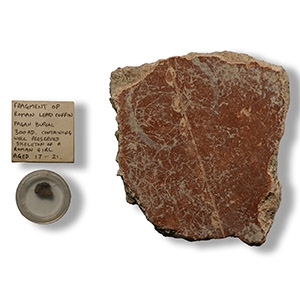
Roman Lead Coffin and Painted Fresco Fragments
3rd-4th century A.D.Sold for (Inc. bp): £91
Wall-plaster fragment with remains of laths to the reverse, dressed surface with painted red and white detailing; with a fragment of a lead coffin believed to have contained the remains of a Roman girl about 17-21 years of age; with old collector's ticket. 218 grams total, 9-98 mm
The coffin fragment found at Brough, Nottinghamshire, UK, 1970s-1980s. Acquired from Ancient & Oriental, UK, in the 1990s. Ian Wilkinson collection, Nottinghamshire, UK, formed since 1985. This lot is accompanied by an illustrated lot declaration signed by the Head of the Antiquities Department, Dr Raffaele D’Amato. -
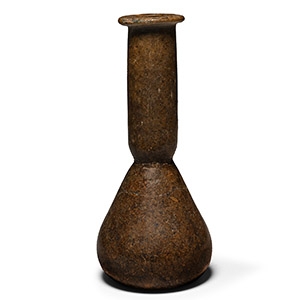
Roman Glass Unguentarium
2nd-4th century A.D.Sold for (Inc. bp): £78
With piriform body and flat base, tall neck with waisted joint to body, mouth with everted rim; old collector's labels to underside 'L-15439' and '2970'. 97 grams, 15.5 cm
with H.A.C., Basel, prior 1999. This lot is accompanied by an illustrated lot declaration signed by the Head of the Antiquities Department, Dr Raffaele D’Amato. -
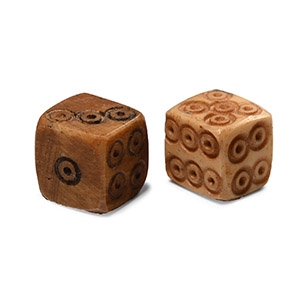
Roman Bone Dice Pair
1st-4th century A.D.Sold for (Inc. bp): £286
Each cuboid with ring-and-dot markings disposed 1:6, 2:4, 3:5. 1.92 grams total, 8 mm each
From an English collection formed before 2000. This lot is accompanied by an illustrated lot declaration signed by the Head of the Antiquities Department, Dr Raffaele D’Amato.
