
Loading, please wait...
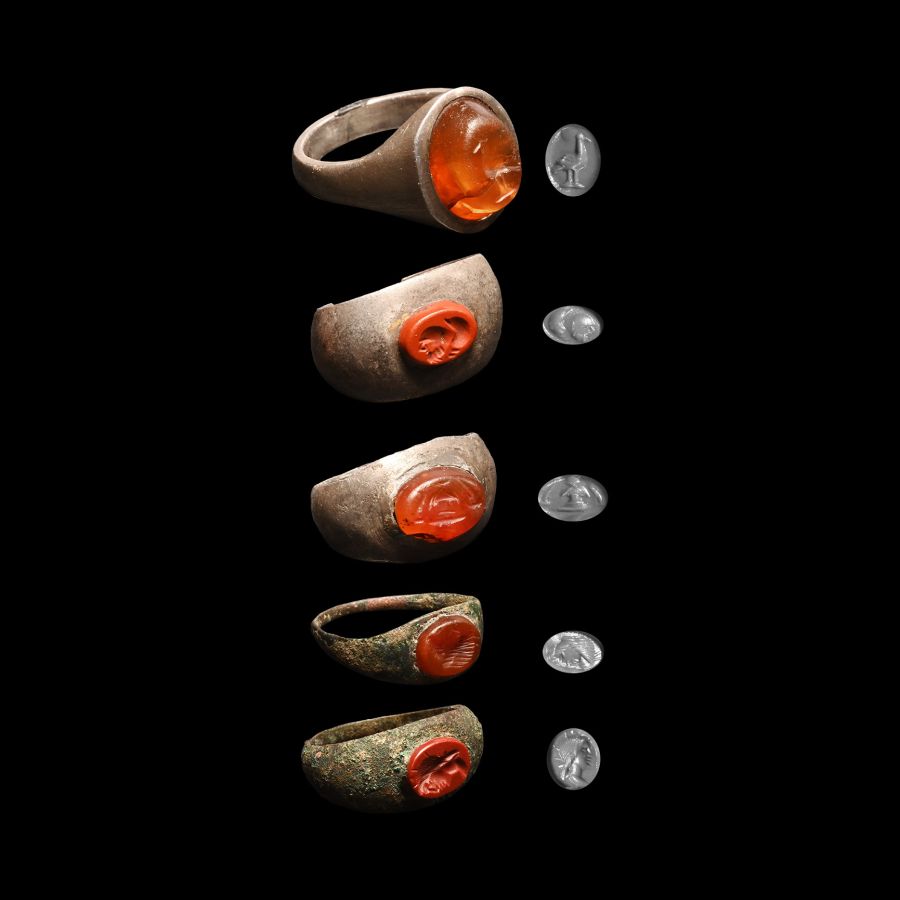
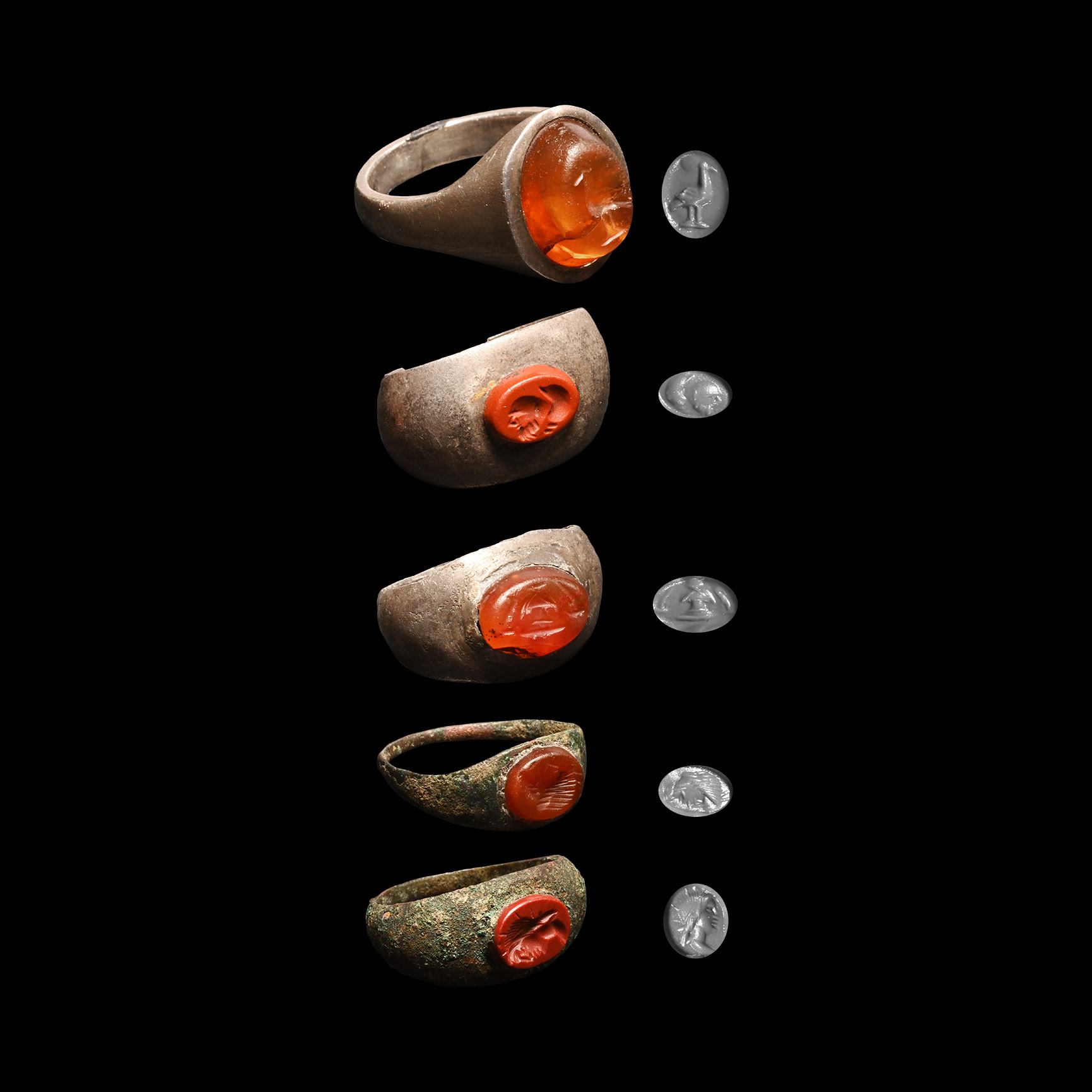
LOT 0776
Roman Gemstone Collection
2ND-3RD CENTURY A.D.
3/4 - 1 1/8 in. (28.6 grams total, 19-29 mm).
A mixed group of stone intaglios each with an carnelian or jasper cloison with intaglio image including bird, profile bust and other types, all set bronze and silver finger rings [5]
ProvenanceAcquired on the European art market.
Ex private Bavarian collection H.W.
with Gorny and Mosch, München, Germany, 12 December 2019, 656 [Part].
English private collection.
Cf. Ruseva-Slokoska, L., Roman Jewellery, Sofia, 1991, item 192, for type.
CONDITIONTimeLine Auctions follows a vetting process to ensure the authenticity and legality of all items, reinforcing our commitment to integrity and responsible trading. Each antiquity, antique, and coin lot undergoes thorough examination by a vetting committee of at least ten external specialists, professional trade association members, scientists, and archaeologists: Our Vetting Process
AUCTIONS:
TimeLine is a leading auction house specialising in antiquities, ancient art, collectables, natural history, coins, medals, and books. Our auctions offer museums, collectors, historians, and enthusiasts the opportunity to acquire unique and historically significant pieces.
LOT 0776
Roman Gemstone Collection
Estimate £600 - 800€700 - 930 (for guidance only)$810 - 1,080 (for guidance only)
-
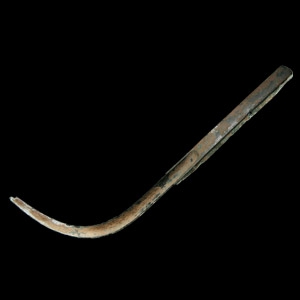
Roman Bronze Strigil with Leaf Design
2nd century B.C.-2nd century A.D.Estimate: £500 - 700 (‡+bp*)
Opening Bid: £250
A bronze strigil with C-section profile to the blade, rectangular handle with lateral flanges. 44 grams, 22 cm
Acquired early 1990s. Ex private American collection; thence by descent. Private Swiss collection since 1998. -
.jpg)
Roman Terracotta Bust of a Boy
1st-century B.C.-1st century A.D.Sold for (Inc. bp): £351
A terracotta bust of a boy mounted on an integral channeled plinth base, modelled with semi-naturalistic facial features and a cropped hairstyle, wearing a bulla and a sash over the left shoulder. 341 grams, 17 cm high
Ex private German collection, 1960; thence by descent. with Auktionshaus Owl, Bielefeld, Germany, 5 September 2015, Lot 40605.
In ancient Rome, the bulla was an amulet given to every boy nine days after his birth. The meaning, origins and use of the bulla are in some ways enigmatic and still a subject of research for scholars. The bulla was worn around the neck during childhood and adolescence. Depending on the social status and wealth of the family who commissioned it, different materials were used; on rare occasions it was made fully in gold, if the child belonged to a family of the high Roman aristocracy, or more commonly made in lead covered with a gold foil. The bulla was also made for the poorer classes in lesser materials, such as fabric or leather. -
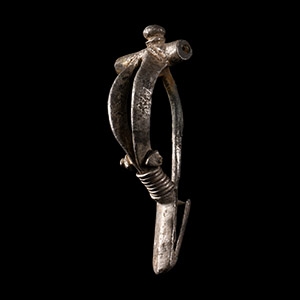
Late Roman Silver Double-Bow Brooch
3th-4th century A.D.Sold for (Inc. bp): £117
A silver sprung-prin or proto-crossbow brooch, the two separate bows joining at the top of the foot and above the spring case. 9.33 grams, 48 mm
Acquired before 2000. From the collection of a European gentleman living in the UK.
These fibulae were the prototypes from which the crossbow brooch developed. Like crossbow brooch, the structure copmprises two essential parts: the upper part an arched bow and the lower part comprising a fairly long foot with a long and narrow catch-plate.
