
Loading, please wait...
_900x900.jpg "Roman Garnet Cameo of Eros the Greek God of Love")
_200x200.jpg "Roman Garnet Cameo of Eros the Greek God of Love")
.jpg "Roman Garnet Cameo of Eros the Greek God of Love")
LOT 0098
Roman Garnet Cameo of Eros the Greek God of Love
1ST CENTURY A.D. OR LATER
3/8 in. (0.42 grams, 8 mm).
Discoid in plan with a high-relief plastic head of Cupid (Greek Eros).
ProvenancePrivate English collection, formed between the late 1970s and early 1990s.
Private collection, London, UK.
Cf. Spier, J., Ancient Gems and finger Rings, catalogue of the collections, the J. Paul Getty Museum, Malibu, 1992, nos.228-229, for gemstones with a similar head of Eros.
FootnotesThe finely engraved head on the cameo represents a young child, probably intended as Eros (Cupid). Such depictions were produced in numerous variations to illustrate the stages of childhood and the capacity of children to undertake meaningful or symbolic actions. The high relief type appears to have been especially popular and was probably derived from metalwork, like the plaster medallion from Begram, Afghanistan.
CONDITIONTimeLine Auctions follows a vetting process to ensure the authenticity and legality of all items, reinforcing our commitment to integrity and responsible trading. Each antiquity, antique, and coin lot undergoes thorough examination by a vetting committee of at least ten external specialists, professional trade association members, scientists, and archaeologists: Our Vetting Process
AUCTIONS:
TimeLine is a leading auction house specialising in antiquities, ancient art, collectables, natural history, coins, medals, and books. Our auctions offer museums, collectors, historians, and enthusiasts the opportunity to acquire unique and historically significant pieces.
-
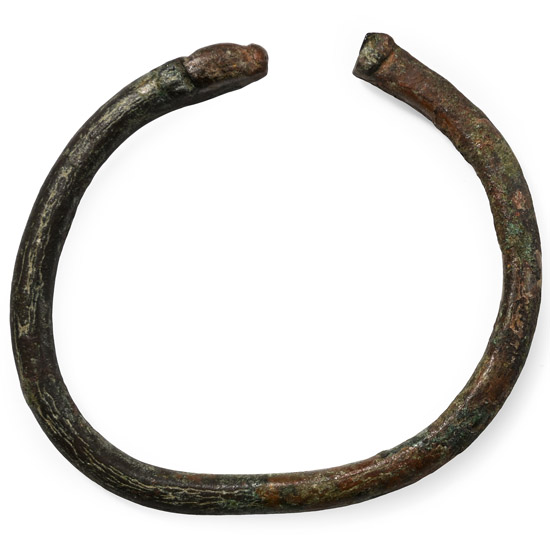
Roman Bronze Bracelet with Animal Head Terminal
1st-4th century A.D.Sold for (Inc. bp): £46
Lentoid in section with opposed beast-head finials, one absent. 39.2 grams, 67 mm
From the private collection of Mr Brian Edwards, New Malden, Surrey, UK, formed from the late 1970s-early 1980s; thence by descent. -
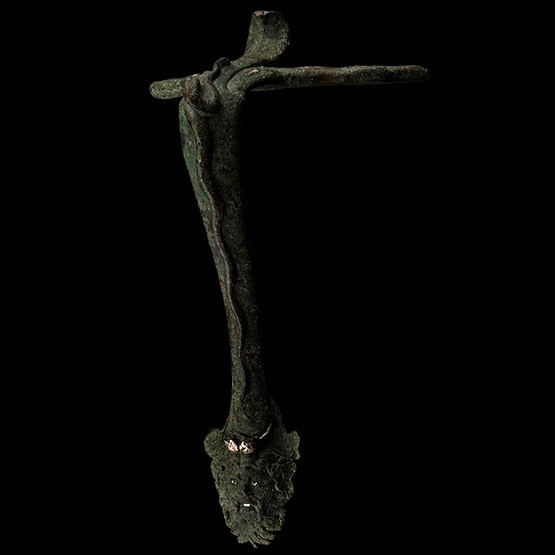
Roman Bronze Vessel Handle with Face
1st century A.D.Estimate: £1,500 - 2,000 (‡+bp*)
Opening Bid: £833
Swept in profile, comprising a horizontal crescentic panel to attach to the rim, with inlaid silver detailing, recurved cobra-shaped thumb pad, raised serpent to the outer face of the tapering handle, finial a mask of Bacchus or Pan, facing with volute scrolls to the brow and thick splayed beard; silver diadem and eyes. 110 grams, 14.2 cm
Private collection. with Christie's, London, 11 June 1997, no.97 (part). with Bonhams, 13 April 2000, no.198. Private collection, Europe. Accompanied by copies of the relevant Christie's and Bonhams catalogue pages. Accompanied by a copy of an Art Loss Register certificate. This lot has been checked against the Interpol Database of stolen works of art and is accompanied by a search certificate number no.12529-232161.
These handles, which formed a leafy plant element and an S- or T-shaped animal at the top, were usually attached to the belly of the bronze vessel by a human head. In our example, the broad head of the mask, with its broad moustache and beard, characterised by abundant hair, seems to hark back to the iconography of the Sileni or Pan. -
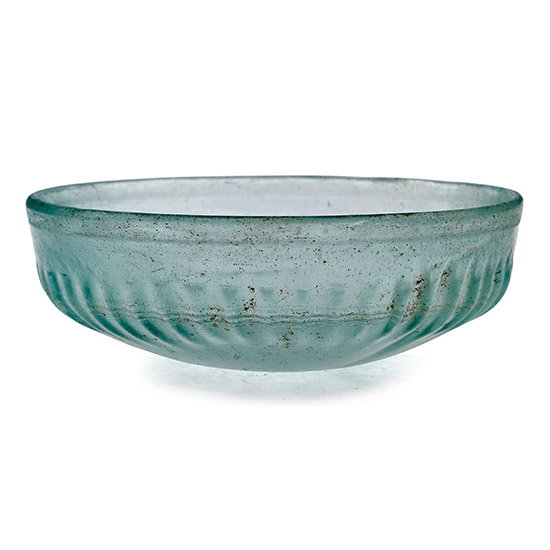
Roman Pillar-Moulded Pale Green Glass Bowl
1st century B.C.-1st century A.D.Sold for (Inc. bp): £1,235
Shallow bowl with moulded pillar detailing on the outer face. 142 grams, 12.6 cm wide
Acquired from Millennium Antiquities, Lancashire, UK, in 2001. From the collection of a Bedfordshire, UK, lady. Accompanied by an original Millennium Antiquities certificate of authenticity dated 13 October 2001.
Ribbed bowls were typical cast tableware belonging to the early Imperial period, and parallels have been found throughout the Roman provinces and beyond. In Cyprus, as elsewhere in the eastern half of the Empire, bowls with short, close-set ribs concentrated around the middle of the body constitute a large group.
