
Loading, please wait...

LOT 0982
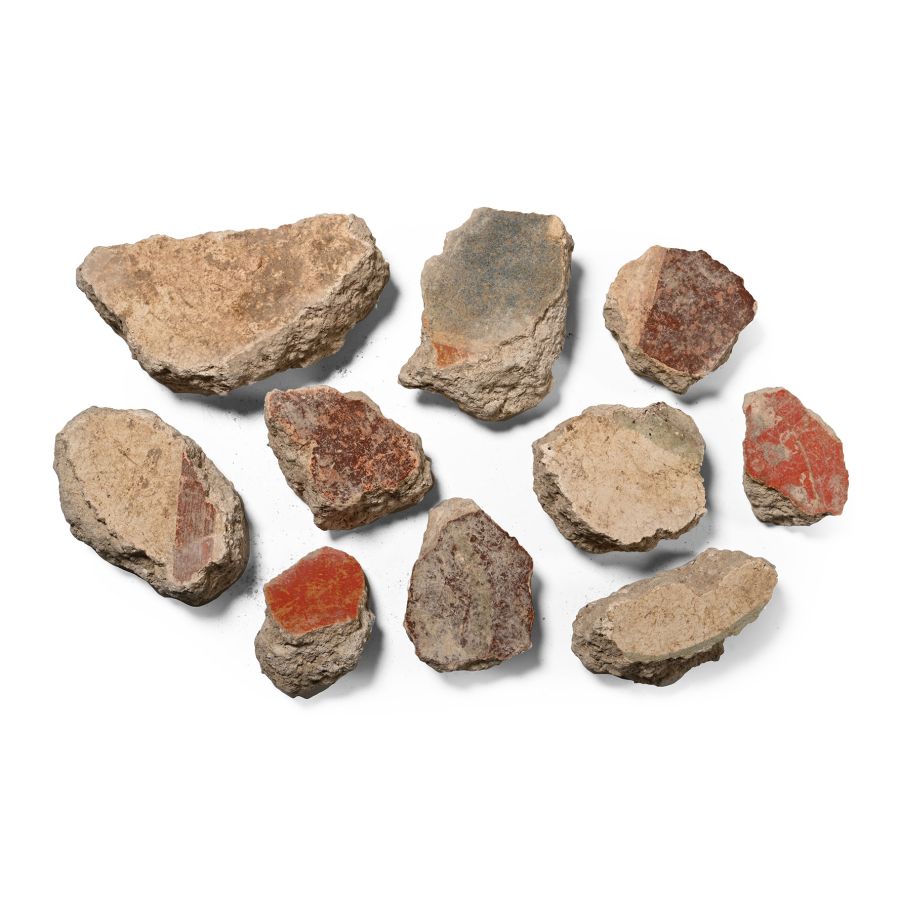
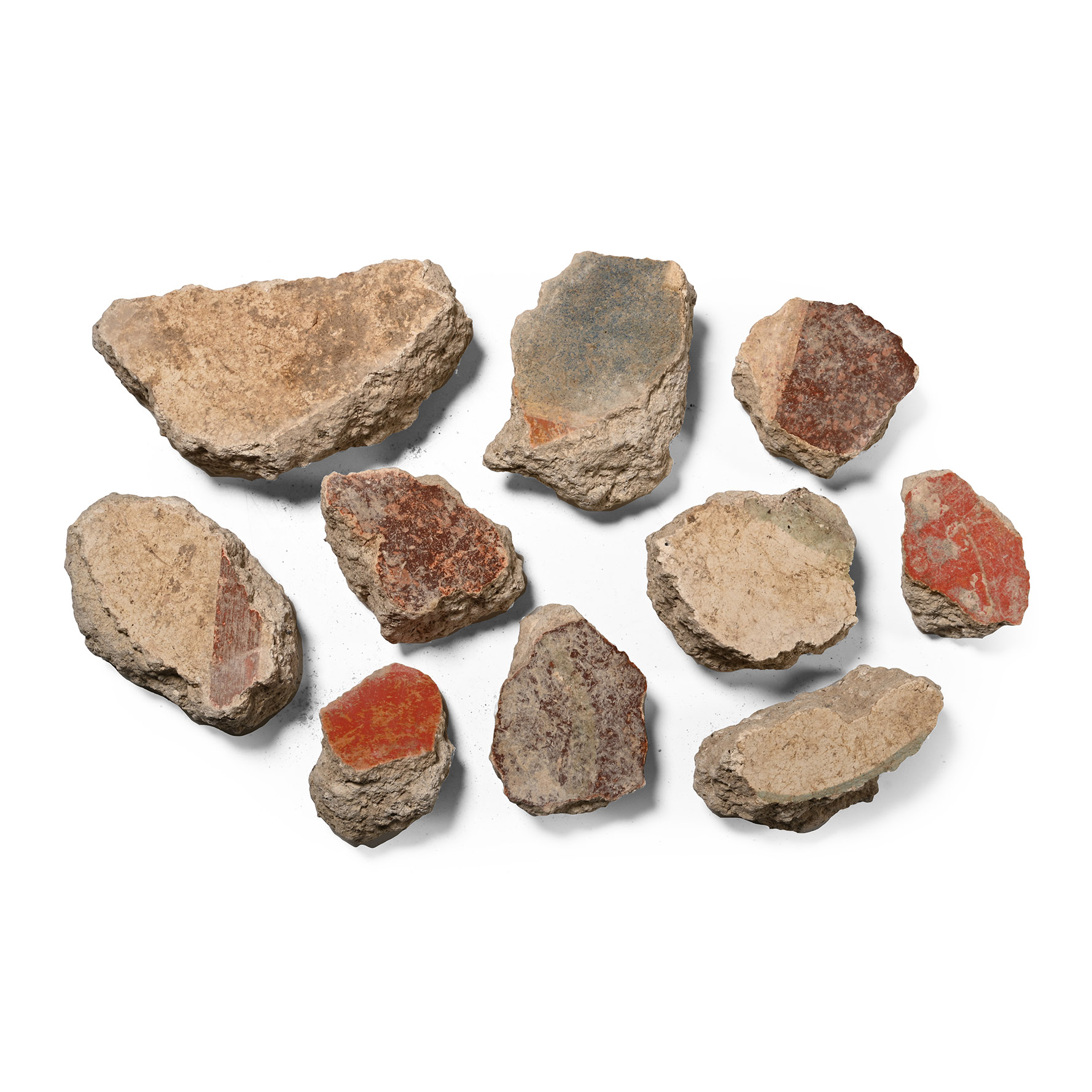
Roman Fresco Wall Plaster Collection
1ST CENTURY A.D.
2 - 4 1/2 in. (770 grams total, 5.2-11.6 cm).
Fragments of wall plaster with rendered surface painted with mainly red, blue and white detailing; some with impression of timber laths to the reverse. [10, No Reserve]
ProvenanceAcquired in the 19th century.
Ex Jeger collection, Switzerland.
UK gallery, early 2000s.
This lot is accompanied by an illustrated lot declaration signed by the Head of the Antiquities Department, Dr Raffaele D’Amato.
Cf. Hakanen, V., 'VI Wall Plaster Fragments' in Berg, R., Kuivalainen, I., Domus Pompeiana M. Lucretii, IX,3, 5.24, The inscriptions, Works of Art and Finds from the Old and New Excavations, Vantaa, 2019, pp.196-224, figs.3-4.
FootnotesThese small fragments, for analogies with the fragments of Pompeii, seems to belong to the second style of Roman painting, red panels representing highlight and shadow, decorated with vegetal interlaces. Some panels were probably framed by a red grenade fillet. A fragment shows alternate blue and red colour over a cream background, maybe pertinent to a socle.
CONDITIONTimeLine Auctions follows a vetting process to ensure the authenticity and legality of all items, reinforcing our commitment to integrity and responsible trading. Each antiquity, antique, and coin lot undergoes thorough examination by a vetting committee of at least ten external specialists, professional trade association members, scientists, and archaeologists: Our Vetting Process
AUCTIONS:
TimeLine is a leading auction house specialising in antiquities, ancient art, collectables, natural history, coins, medals, and books. Our auctions offer museums, collectors, historians, and enthusiasts the opportunity to acquire unique and historically significant pieces.
-
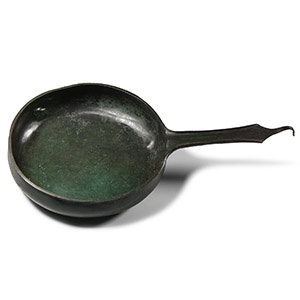
Roman Bronze Patera with Handle
1st century B.C.-1st century A.D.Estimate: £800 - 1,000 (+bp*)
Opening Bid: £400
The bowl with a wide flat bottom and convex sides; the inside with incised concentric circles; flat handle with raised edges and hooked finial for suspension. 483 grams, 39.5 cm
German private collection, Mr O., collecting in the 1950s-1960s; thence by descent. with Bonhams, London, 7 July 2016, lot 191 (£3,000-5,000). Accompanied by an academic report by Dr Raffaele D’Amato. Accompanied by copies of the relevant Bonhams printed catalogue pages (full page). This lot has been checked against the Interpol Database of stolen works of art and is accompanied by search certificate number no.11735-201189. This lot is accompanied by an illustrated lot declaration signed by the Head of the Antiquities Department, Dr Raffaele D’Amato.
This vessel was part of Roman and provincial bronze instrumentum domesticum, i.e. culinary or domestic utility ware. Such cooking vessels are rare: some are found in central and northern Italy, in Pannonia, Germany and in Britain. The Aylesford Pan, today in the British Museum (inventory no.1886.1112.1), is one of the most important finds. This specimen (Eggers type 130), probably pre-Caesarian or Caesarian, was found in a grave together with a Celtic bucket and a jug. -
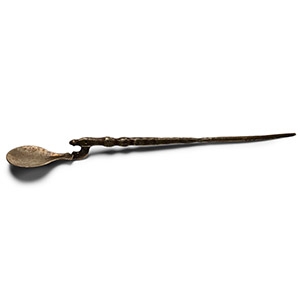
Roman Silver Cochlearium Spoon
2nd-4th century A.D.Sold for (Inc. bp): £260
With 'swan-neck' junction; facetted, round-section tapering shank; shallow bowl shaped like a flask in profile. 19.7 grams, 17.5 cm
Property of a Bedfordshire, UK, private collector. Accompanied by an illustrated collector's identification tag. This lot is accompanied by an illustrated lot declaration signed by the Head of the Antiquities Department, Dr Raffaele D’Amato.
The spoon's shaft tapers to a point; it was used for extracting seafood or snails from their shells. Spoons executed in precious metals were highly valued items in this period in history, so much so that historians and classicists see them recorded in inventories compiled for noble households. Cochlearia like this one have even been discovered in treasure hoards. The absence of Christian symbolism or of a Christian inscription on this spoon might suggest that it dates from a pre-Christian era, or that its owner/commissioner was pagan. -
.jpg)
Roman Bronze Silenus Mount
1st-2nd century A.D.Sold for (Inc. bp): £117
Domed mount with a bearded satyr face to the centre, short horns projecting from his head; hollow to the reverse. 7.68 grams, 26 mm
Ex German art market, 2000s. Acquired from an EU collector living in London. From the collection of Surrey, UK, gentleman. This lot is accompanied by an illustrated lot declaration signed by the Head of the Antiquities Department, Dr Raffaele D’Amato.
