
Loading, please wait...
LOT 0158
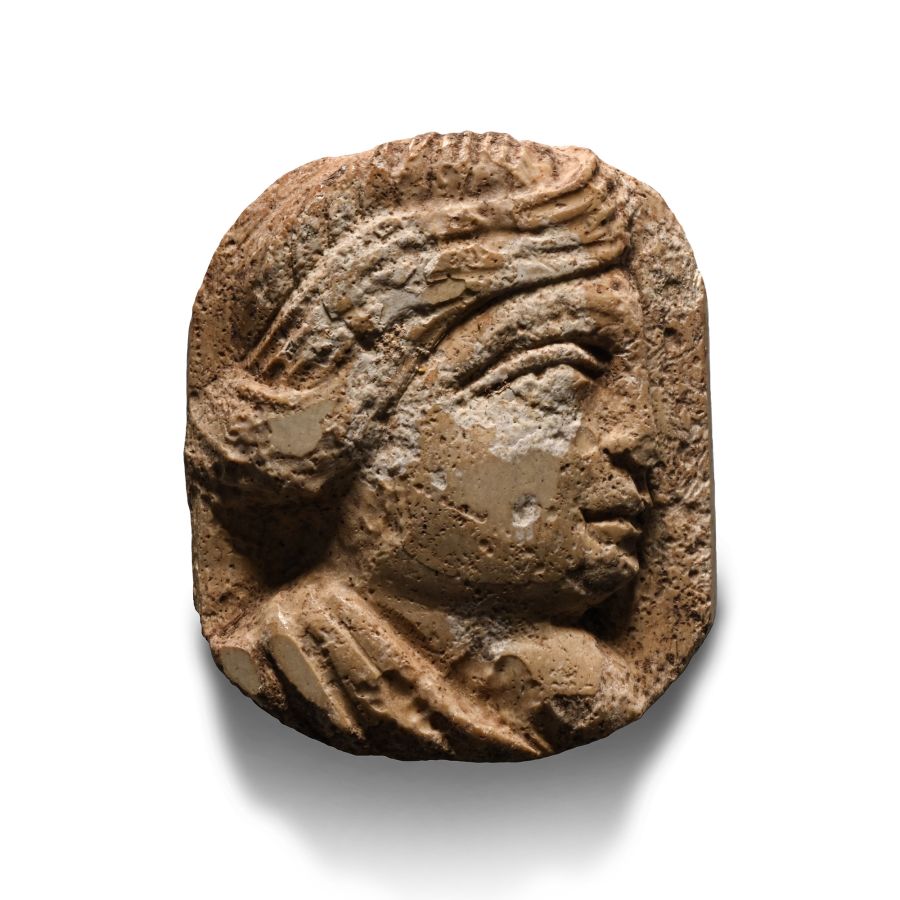
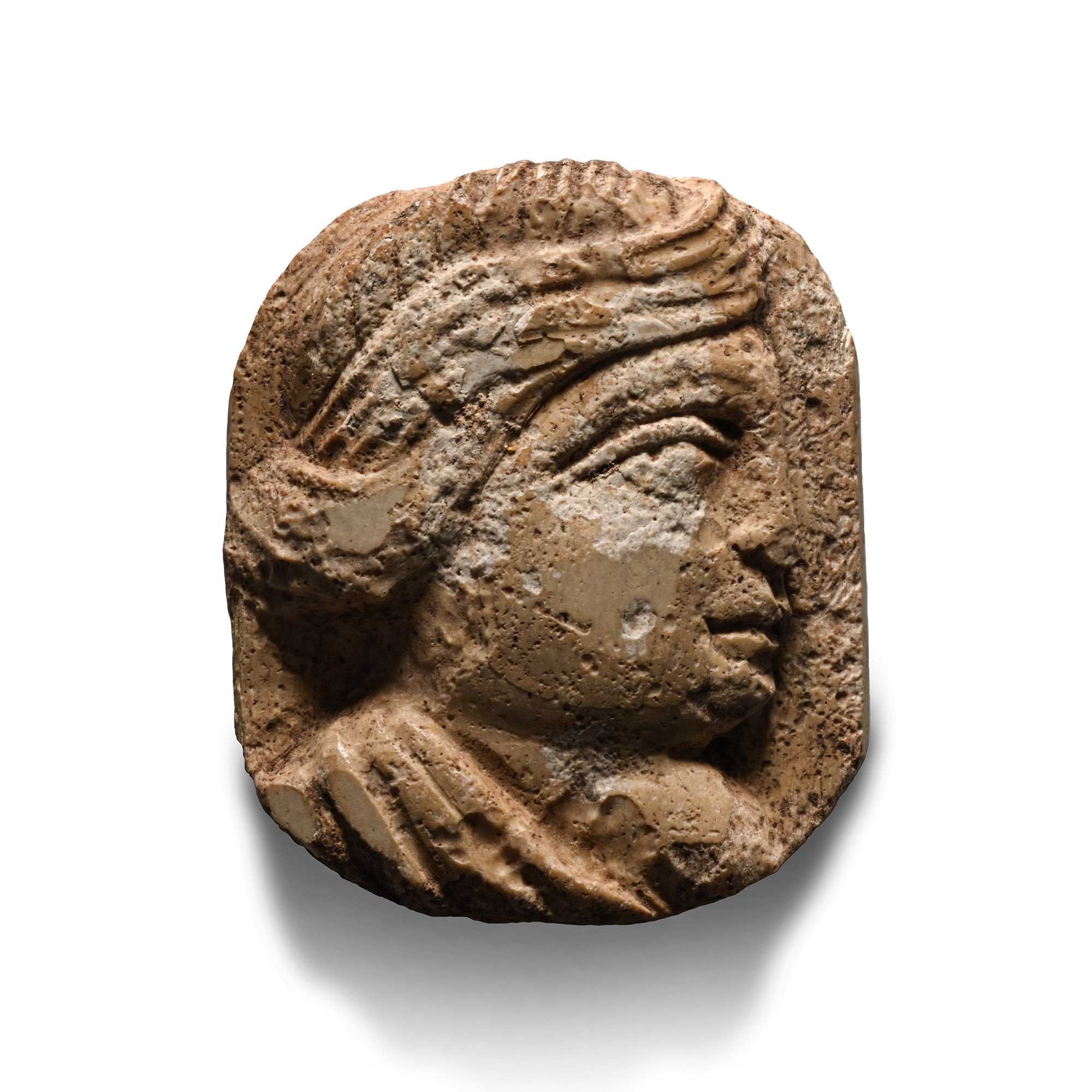
Roman Fitting in the Form of a Female Bust
COPTIC, 4TH-6TH CENTURY A.D.
2 in. (17.81 grams, 49 mm).
Carved bone with concave reverse; profile female bust with neatly dressed hair, himation at the shoulder; old collector's label '10' to the reverse.
ProvenanceEuropean collection formed in the early 1980s.
with Bonhams London, 27 April 2006, lot 356.
Accompanied by a copy of an IADAA Interpol search certificate.
Accompanied by a copy of the relevant Bonham's catalogue pages.
TimeLine Auctions follows a vetting process to ensure the authenticity and legality of all items, reinforcing our commitment to integrity and responsible trading. Each antiquity, antique, and coin lot undergoes thorough examination by a vetting committee of at least ten external specialists, professional trade association members, scientists, and archaeologists: Our Vetting Process
AUCTIONS:
TimeLine is a leading auction house specialising in antiquities, ancient art, collectables, natural history, coins, medals, and books. Our auctions offer museums, collectors, historians, and enthusiasts the opportunity to acquire unique and historically significant pieces.
LOT 0158
Roman Fitting in the Form of a Female Bust
Estimate £300 - 400€350 - 460 (for guidance only)$410 - 540 (for guidance only)
-
Roman Iron Knife with Bone Handle
1st-4th century A.D.Sold for (Inc. bp): £391
With single-edged blade gently curving towards the tip; applied bone handle with diagonally striated banding. 38.1 grams, 17.5 cm
Found near Wetwang, East Yorkshire, UK. Acquired from the finder in 2007. Property of a Nottinghamshire gentleman.
Tools which cannot be assigned to one of the more specific categories, such as agricultural or military equipment especially knife blades, tool handles, and hones. Three methods of attaching a handle to the tang of a knife or tool are distinguishable in the Roman culter. Rivetting was used on two-piece handles (like in our specimen). Driving the tang into the marrow-cavity of the bone, which was usually packed with wood-shavings, so that the irregularities of cancellous tissue and the wood-shavings prevented the tang from twisting or slipping out (often a collar was also used with this method). Lastly, the tang could be fixed to the handle by means of an iron clip. -
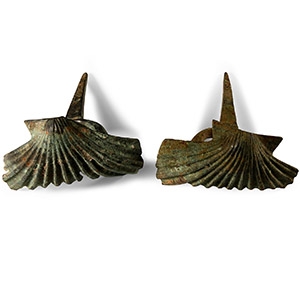
Roman Bronze Scallop Shell Attachment Pair
Circa 2nd-3rd century A.D.Estimate: £1,200 - 1,700 (+bp*)
Opening Bid: £667
Each composed of shell-shaped body with a D-shaped lug to reverse, the lug with tapering spike to the centre. 343 grams total, 12.5 cm each
Private collection, Rosenheim, Germany, 1960s.
This pair could have been used as a double key or door lock, based on comparison with some keys from the territory of Gaul (Boucher, 1971, pp.200-201). They comprised a strong ring with polygonal-section stem and a rectangular point. -
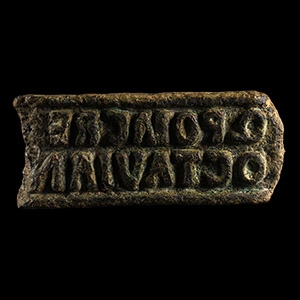
Roman Bronze Stamp for Octavian
Circa 1st century A.D.Sold for (Inc. bp): £650
Formed as a tablet-shaped stamp (signaculum), with raised border above and below containing an inscription in Latin in reverse over two lines, reading: 'Q[UINTI] POM [PONII] CRE [SCONII} ? / OCTAVIAN[I]' possibly translating to: 'Of Quintus Pomponius Cresconius Octavianus', this latter being the owner; with a large loop to verso. 92 grams, 64 mm
From an old private collection formed before 1985. Accompanied by a copy of a previous dealer's certificate of authenticity including provenance.
Used to stamp documents and a broad range of different materials and food, signacula came into use in the Roman res publica during the 2nd century B.C., becoming both popular and widely used in many areas of everyday life during the Imperial period. These signacula were not exclusively used in the sphere of economy and property administration, but also in public and private sphere, determining the identity of their owners. The bronze stamp - also definable as a tessera, like the wooden one - was an instrumentum vicarium (auxiliary tool) of the annulus signatorius (seal ring), but compared to the annulus, it was much stronger and more practical, capable of leaving a better recognisable imprint. By analogy, the press note of a wooden or terracotta stamp also had an important certifying function, but the object that produced it only lasted a limited time, while the signaculum ex aere (bronze stamp) lasted a lifetime.
