
Loading, please wait...
LOT 0100
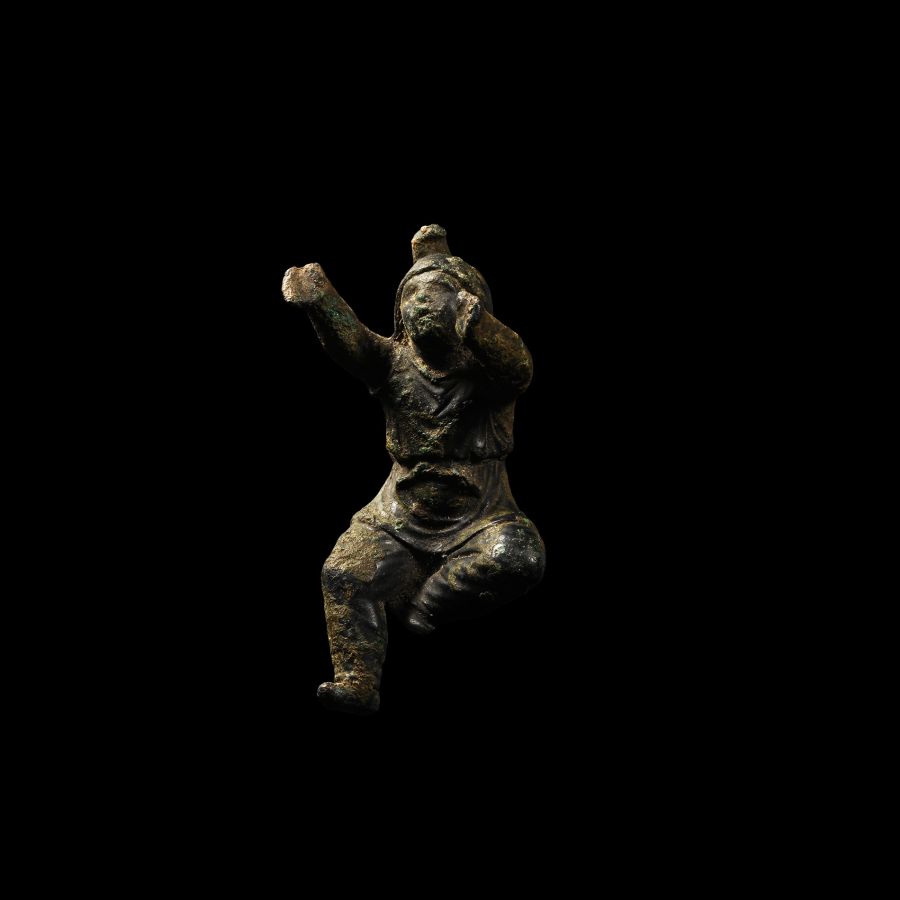
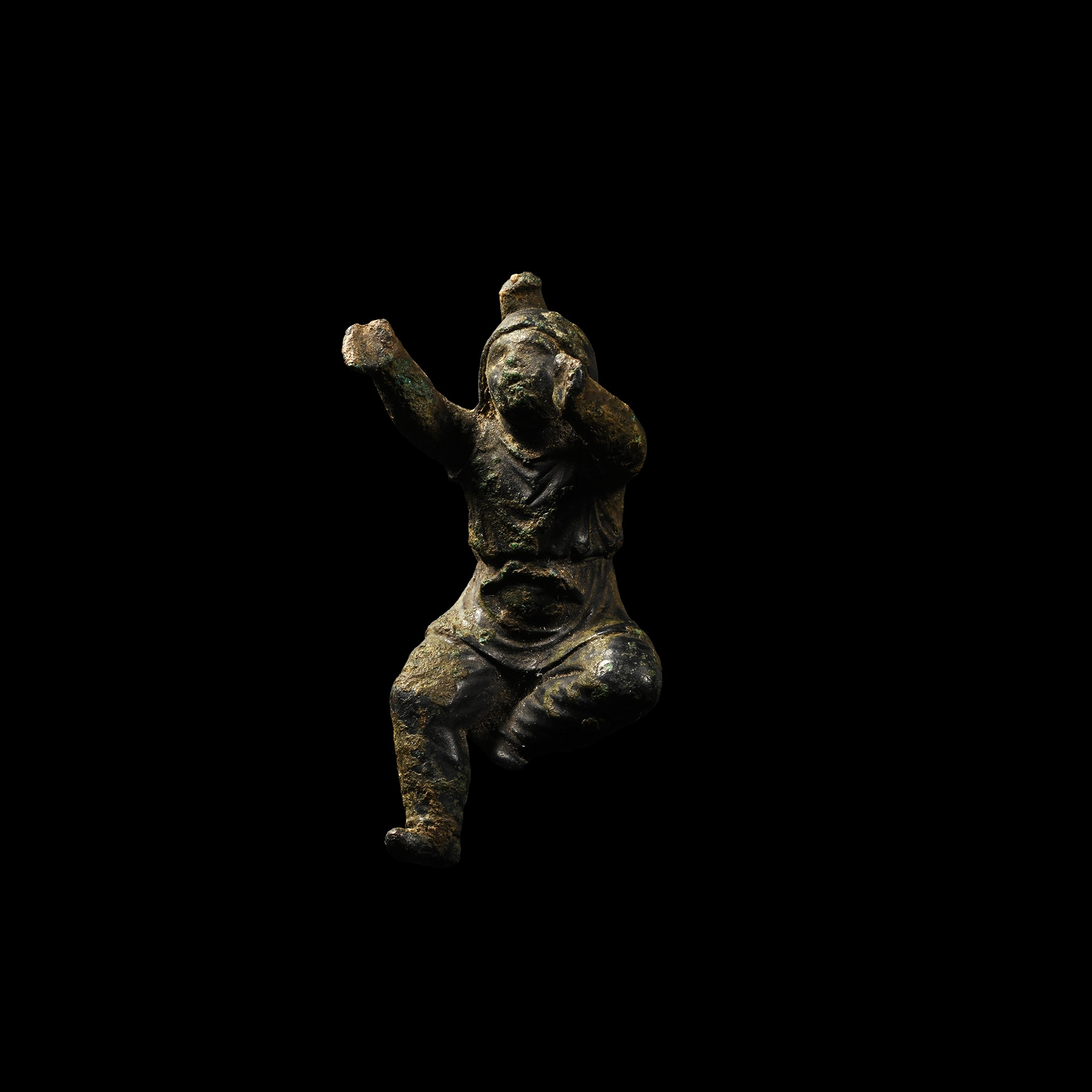
Roman Figure of a Boy in Oriental Dress
1ST-2ND CENTURY A.D.
2 3/8 in. (14.6 grams, 61 mm).
A bronze figure of a child sitting with one leg extended and the other bent beneath the body, arms raised in supplication; loose fitting trousers and knee-length tunic gathered at the waist, boots on the feet and a separate pointed hood on the head; Scythian or similar costume.
ProvenancePrivate Swiss collection, acquired 2001.
LiteratureSee Jacobson, E., The Art of the Scythians: The Interpenetration of Cultures at the Edge of the Hellenic World, Leiden, 1995, for discussion.
CONDITIONTimeLine Auctions follows a vetting process to ensure the authenticity and legality of all items, reinforcing our commitment to integrity and responsible trading. Each antiquity, antique, and coin lot undergoes thorough examination by a vetting committee of at least ten external specialists, professional trade association members, scientists, and archaeologists: Our Vetting Process
AUCTIONS:
TimeLine is a leading auction house specialising in antiquities, ancient art, collectables, natural history, coins, medals, and books. Our auctions offer museums, collectors, historians, and enthusiasts the opportunity to acquire unique and historically significant pieces.
LOT 0100
Roman Figure of a Boy in Oriental Dress
Estimate £1,000 - 1,400€1,160 - 1,620 (for guidance only)$1,350 - 1,890 (for guidance only)
-
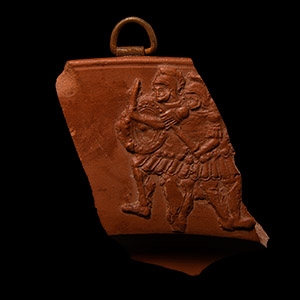
Roman Redware Sherd with Giant Geryon
3rd-4th century A.D.Sold for (Inc. bp): £124
A fragment of redware ceramic from a moulded vessel, low-relief design depicting the giant Geryon as a helmetted Roman Miles advancing, with gladius held ready in both his left hands and a studded round shield; modern mounting loop to the reverse. 36 grams, 78 mm
Acquired 1960s-1990s. From the late Alison Barker collection, a retired London barrister.
The image is a representation of the giant Geryon, a monster killed by Herakles usually represented with three bodies and three heads, or three heads and one body, or three bodies and one head. In the Roman iconography (but already visible in Greek iconography) he is often represented as an armoured warrior. The original pottery to which the fragment belonged was probably originally decorated with the labours of Hercules. -
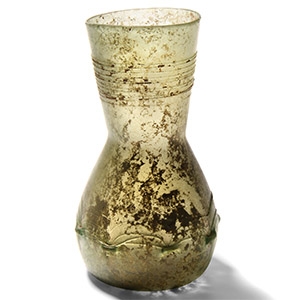
Roman Glass Flask with Trails
1st-3rd century A.D.Sold for (Inc. bp): £338
A pear-shaped pale green glass flask with broad flared neck, applied trails to the neck and broader, undulating trails to the equator embellished with raised ledges; areas of iridescence; old French collection label to base dated c.1900 A.D. 59 grams, 12 cm high
French collection, 1960s-early 2000s. From an important Paris gallery, France. -
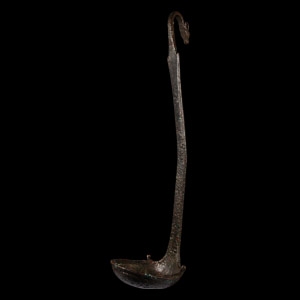
Roman Animal-Headed Ladle
Circa 2nd century A.D.Estimate: £300 - 400 (+bp*)
Opening Bid: £150
A bronze ladle (simpulum) with broad bowl featuring two spurs to the rim flanking the junction with the handle, carinated band below the rim, concentric rings to the base; flat-section handle with gussets to the edges and rear, hooked ibex-head finial. 147 grams, 25 cm
Acquired 1980-2015. Ex Abelita family collection.
