
Loading, please wait...
LOT 0771
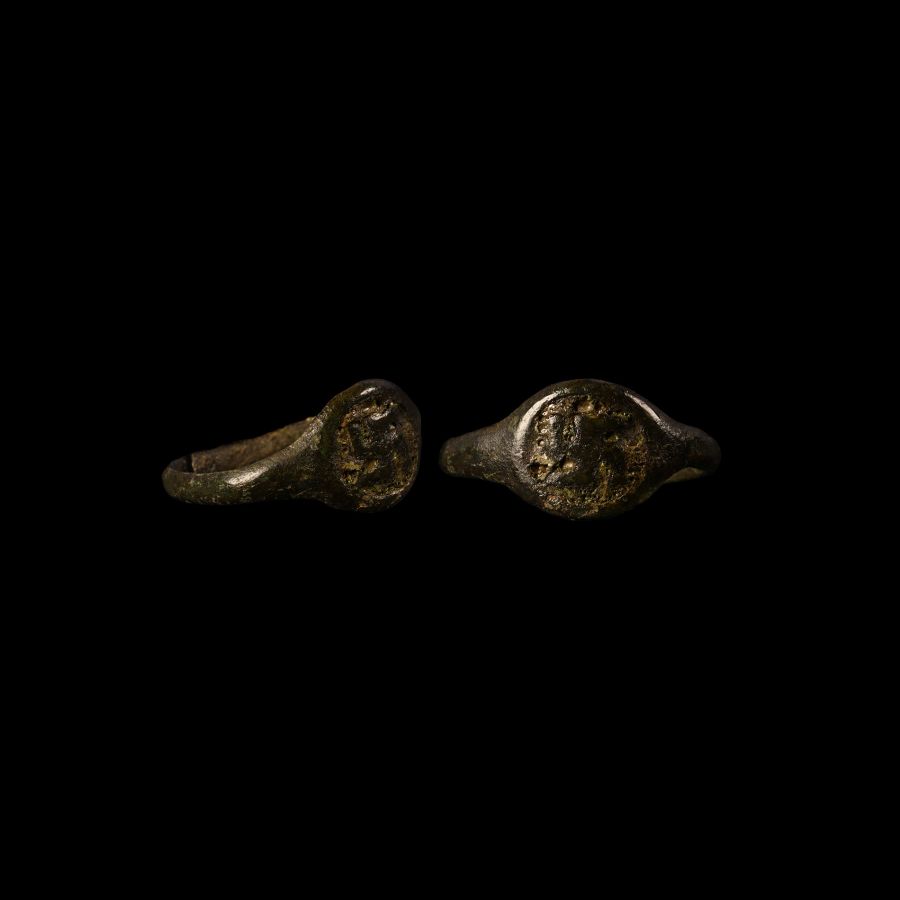
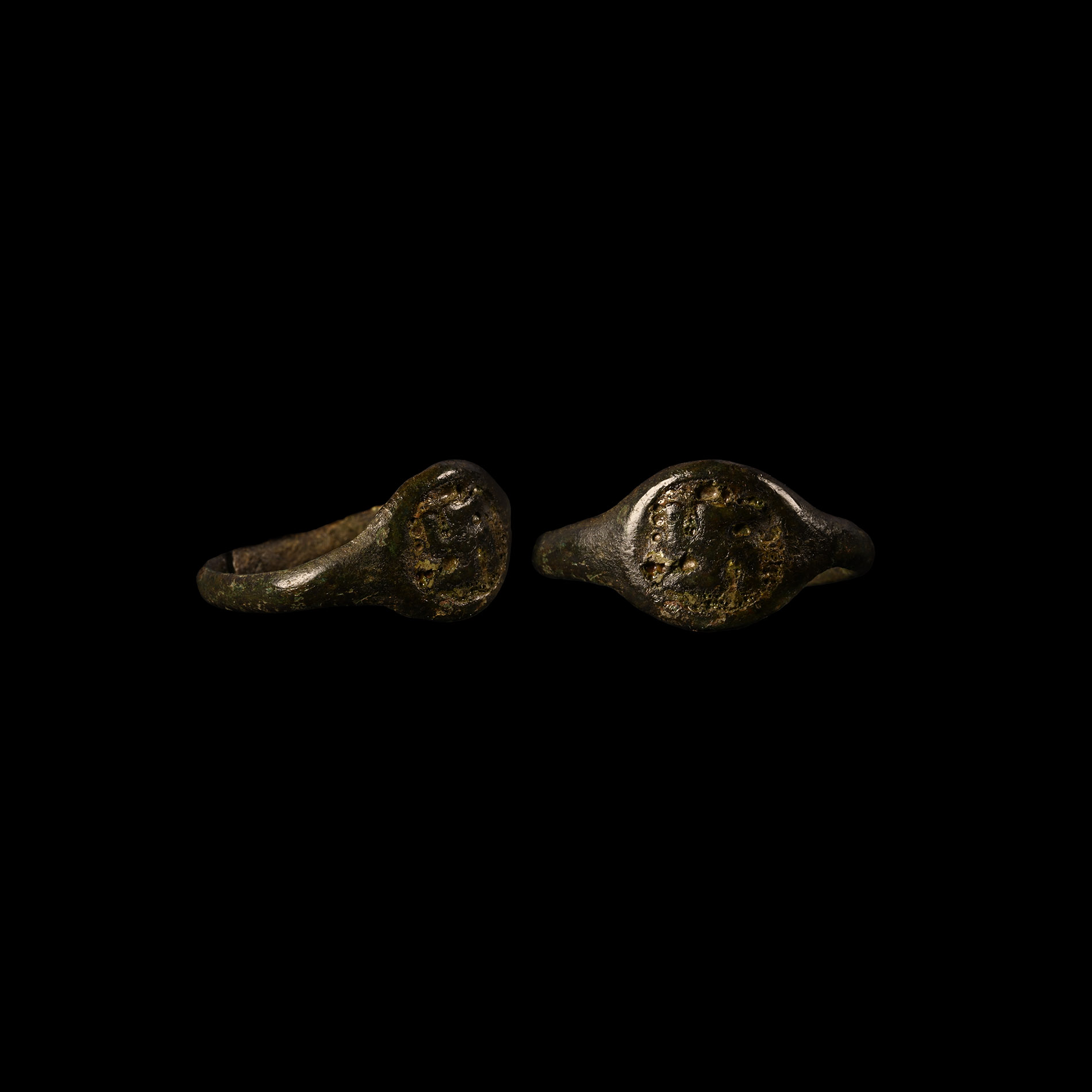
Roman Enamelled Ring with Fylfot
3RD-4TH CENTURY A.D.
7/8 in. (2.17 grams, 22.62 mm overall, 19.94 mm internal diameter (approximate size British Q, USA 8, Europe 17.49, Japan 16)).
A bronze ring composed of a D-section hoop with overlapping arms, the discoid bezel displaying a fylfot with remains of an enamelled field. [No Reserve]
ProvenancePrivate collection formed since the 1940s.
UK art market.
Property of an Essex gentleman.
TimeLine Auctions follows a vetting process to ensure the authenticity and legality of all items, reinforcing our commitment to integrity and responsible trading. Each antiquity, antique, and coin lot undergoes thorough examination by a vetting committee of at least ten external specialists, professional trade association members, scientists, and archaeologists: Our Vetting Process
AUCTIONS:
TimeLine is a leading auction house specialising in antiquities, ancient art, collectables, natural history, coins, medals, and books. Our auctions offer museums, collectors, historians, and enthusiasts the opportunity to acquire unique and historically significant pieces.
-
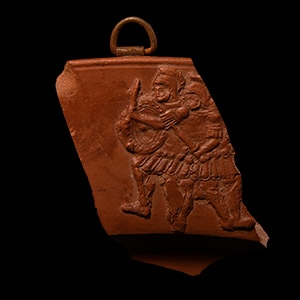
Roman Redware Sherd with Giant Geryon
3rd-4th century A.D.Sold for (Inc. bp): £124
A fragment of redware ceramic from a moulded vessel, low-relief design depicting the giant Geryon as a helmetted Roman Miles advancing, with gladius held ready in both his left hands and a studded round shield; modern mounting loop to the reverse. 36 grams, 78 mm
Acquired 1960s-1990s. From the late Alison Barker collection, a retired London barrister.
The image is a representation of the giant Geryon, a monster killed by Herakles usually represented with three bodies and three heads, or three heads and one body, or three bodies and one head. In the Roman iconography (but already visible in Greek iconography) he is often represented as an armoured warrior. The original pottery to which the fragment belonged was probably originally decorated with the labours of Hercules. -
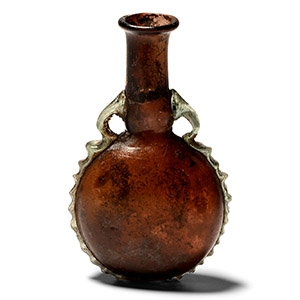
Roman Miniature Glass Flask
1st-3rd century A.D.Sold for (Inc. bp): £585
An aubergine-coloured glass flask with tubular neck and rolled rim, applied clear glass handles and wavy trail to circumference; iridescent surfaces; repaired. 30 grams, 97 mm high
French collection, 1960s-early 2000s. From an important Paris gallery, France. -
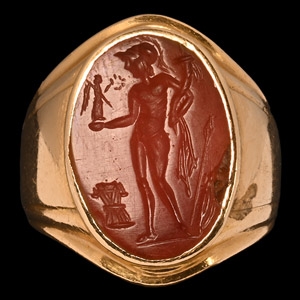
Roman Mars Gemstone in Gold Ring
1st-2nd century A.D. and laterSold for (Inc. bp): £1,690
An ellipsoid carnelian gemstone with intaglio figure of Mars wearing a helmet and bearing a cornucopia in one hand and a miniature figure of Victory in the other; set in a later gold ring. 8.93 grams, 21.88 mm overall, 17.70 mm internal diameter (approximate size British N, USA 6 1/2, Europe 13.72, Japan 13)
Ex Marianne Maspero, 1980. with Pierre Berge & Associes, Paris, France, 16 May 2018, lot 230. English private collection.
Mars was the ancient Roman god of war and agriculture; the majority of his festivals were held in March, when the season for military campaigning commenced, whilst the season for farming ended. Mars symbolised military power as a method for securing peace and stability and was believed a protective father of the Roman people. In Roman mythology, Mars raped Silvia, thus fathering Romulus and Remus, the famous twins suckled by the She-wolf and founders of the city of Rome. The animals most closely associated with Mars are the woodpecker, wolf and bear.
