
Loading, please wait...
_900x900.jpg "Roman Enamelled Bronze Openwork 'Camp Gate' Plate Brooch")
_200x200.jpg "Roman Enamelled Bronze Openwork 'Camp Gate' Plate Brooch")
.jpg "Roman Enamelled Bronze Openwork 'Camp Gate' Plate Brooch")
LOT 0177
Roman Enamelled Bronze Openwork 'Camp Gate' Plate Brooch
1ST-2ND CENTURY A.D.
1 3/4 in. (21.2 grams, 44 mm).
Tongue-shaped openwork plate with knob finial and yellow enamel; pin, pin-lugs and catchplate to the reverse. [No Reserve]
ProvenanceEx property of an Essex, UK, gentleman collector.
From the private collection of a Colchester, UK, gentleman.
TimeLine Auctions follows a vetting process to ensure the authenticity and legality of all items, reinforcing our commitment to integrity and responsible trading. Each antiquity, antique, and coin lot undergoes thorough examination by a vetting committee of at least ten external specialists, professional trade association members, scientists, and archaeologists: Our Vetting Process
AUCTIONS:
TimeLine is a leading auction house specialising in antiquities, ancient art, collectables, natural history, coins, medals, and books. Our auctions offer museums, collectors, historians, and enthusiasts the opportunity to acquire unique and historically significant pieces.
LOT 0177
Roman Enamelled Bronze Openwork 'Camp Gate' Plate Brooch
Sold for (Inc. bp): £325
-
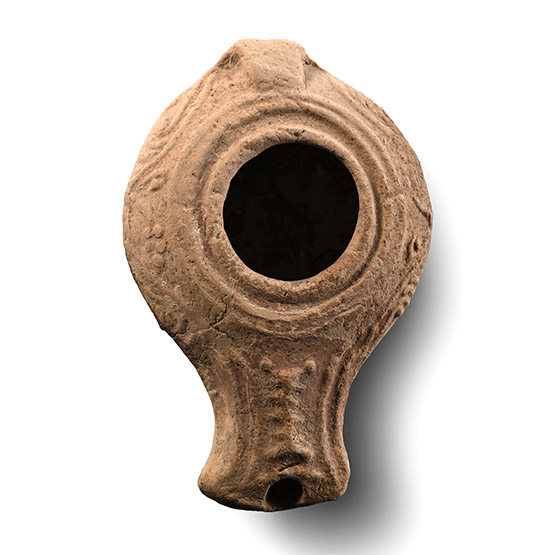
Roman Terracotta Oil Lamp
Circa 1st century B.C.-2nd century A.D.Sold for (Inc. bp): £59
Biconvex in section with chamfered shoulder, stub handle to rear, volute nozzle; low-relief tendril pattern to the shoulder and ribbed motif to nozzle. 81 grams, 10.1 cm
Ex Israeli collection, 1980s. -
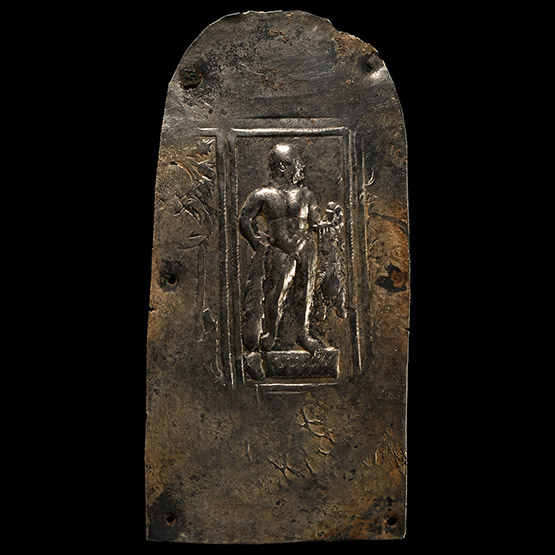
Roman Silver Votive Plaque with Hercules
2nd-4th century A.D.Sold for (Inc. bp): £780
Tongue-shaped with central repoussé motif of Hercules standing nude on a plinth supporting his club and with lionskin mantle draped over his bent forearm; rectangular frame surrounding; traces of similar frames to both sides; six holes for attachment. 30 grams, 99 mm
Acquired in the mid 1980s-1990s. Private collection, Switzerland, thence by descent. Private collection, since the late 1990s.
The panel has clearly been cut from a larger sheet of silver which was stamped with low-relief figures: to the left of Hercules is a frame with fronds at the top and the bent arms of a figure wearing a palla. -
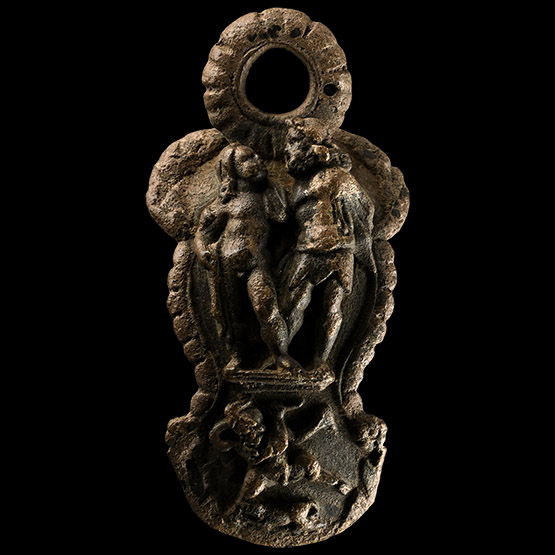
Roman Bronze Three-Dimensional Vessel Mount
2nd-3rd century A.D.Estimate: £3,000 - 4,000 (‡+bp*)
Opening Bid: £1,500
Comprising a plaque of three conjoined lobes with segmented border; at the top, a loop with segmented rim; vignette with a nude male with shoulder-length hair embracing a taller bearded figure with kilt and mantle to left shoulder (Hercules?); below, a satyr with horns and goat's legs beset by hunting dogs. 286 grams, 13.8 cm
Acquired in 1992. Private collection, thence by descent. Private collection, since the late 1990s. This lot has been checked against the Interpol Database of stolen works of art and is accompanied by a search certificate number no.12865-241702.
Vessel mounts of this form are not a commonly recovered artefact type and the presence of two figures instead one is a very singular feature. We can suppose that the mount was attached to a vessel of large dimensions and of a certain importance.
