
Loading, please wait...
LOT 0685
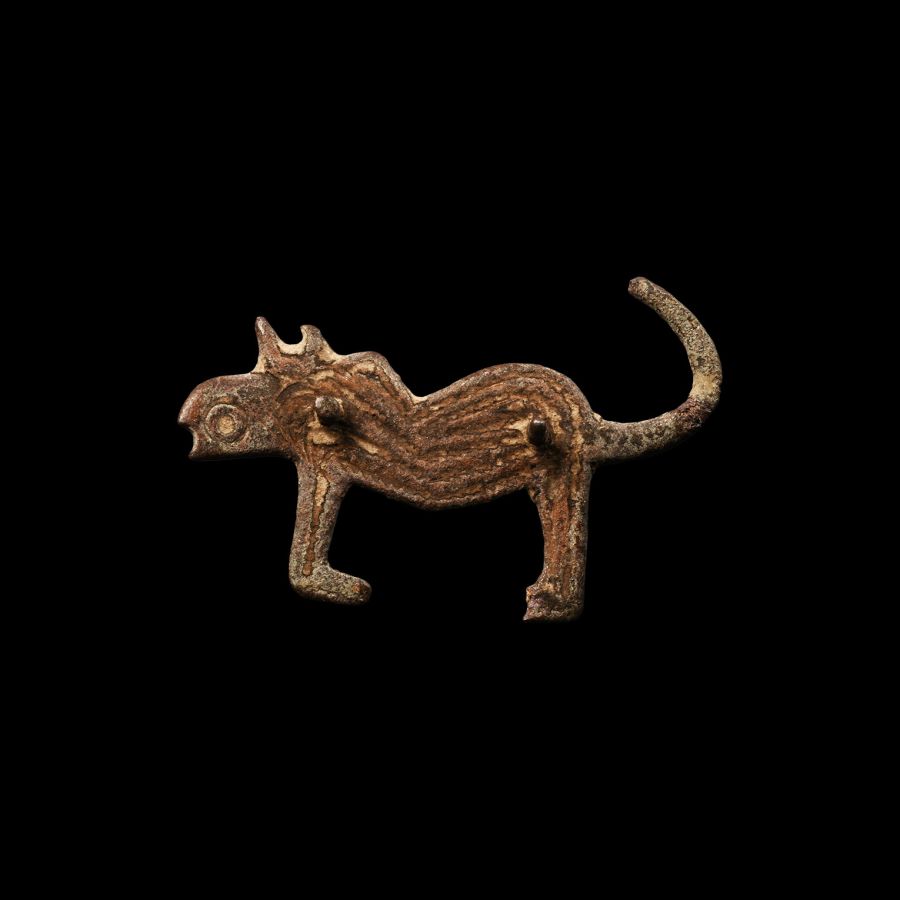
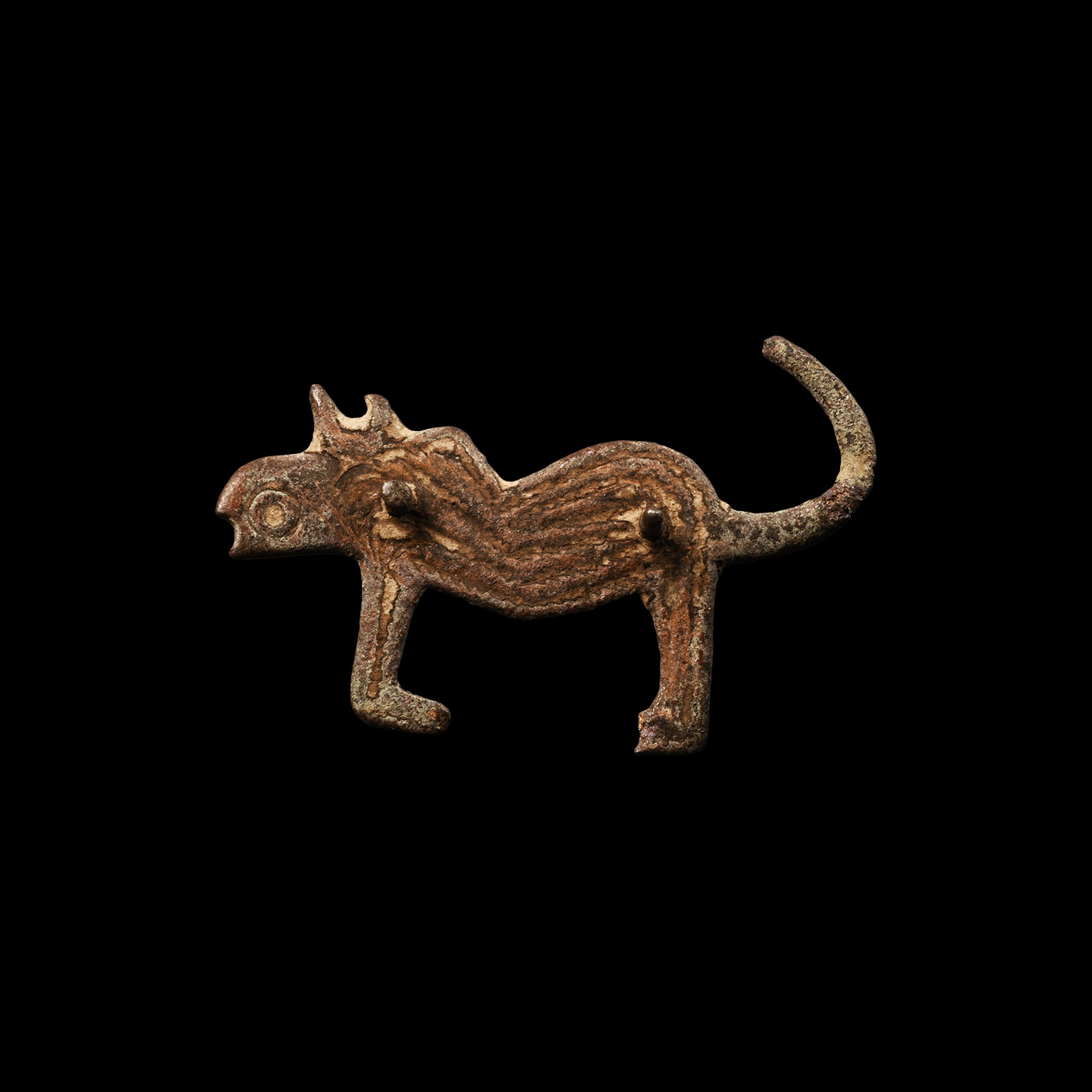
Roman Dog brooch
2ND-3RD CENTURY A.D.
1 3/8 in. (2.5 grams, 34 mm).
An unusual copper-alloy zoomorphic plate brooch in the shape of a dog with two legs and a long tail, the body characterised by a series of horizontal grooves, raised pins to the front and back, the ones on the back probably for the attachment of the hinged pin.
ProvenanceAcquire in the 1990s.
Ex Cambridgeshire, UK, collection.
Cf. Melchart, W., Antike Kostbarkeiten aus Osterreichischem privatbesitz, Wien, 1997, fig.47, for a similar specimen.
FootnotesThis unusual fibula was probably a provincial production. The dog was connected to the Celtic divinities and also with Silvanus, who was associated with healing, hunting, and dogs.
CONDITIONTimeLine Auctions follows a vetting process to ensure the authenticity and legality of all items, reinforcing our commitment to integrity and responsible trading. Each antiquity, antique, and coin lot undergoes thorough examination by a vetting committee of at least ten external specialists, professional trade association members, scientists, and archaeologists: Our Vetting Process
AUCTIONS:
TimeLine is a leading auction house specialising in antiquities, ancient art, collectables, natural history, coins, medals, and books. Our auctions offer museums, collectors, historians, and enthusiasts the opportunity to acquire unique and historically significant pieces.
LOT 0685
Roman Dog brooch
Estimate £150 - 200€170 - 230 (for guidance only)$200 - 270 (for guidance only)
-
Late Roman Ring with Man Catching Fish
3rd century A.D.Sold for (Inc. bp): £70
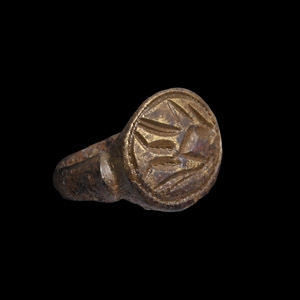
A silvered bronze finger ring with stepped shoulders, large ellipsoid bezel with incuse ropework border and stylised figure raising a fish. 6.43 grams, 24.13 mm overall, 17.48 mm internal diameter (approximate size British O, USA 7, Europe 14.98, Japan 14)
Fine condition.
with M. Labarbe, Toulouse, France, 27 November 2011, lot 228. Property of a London gentleman -
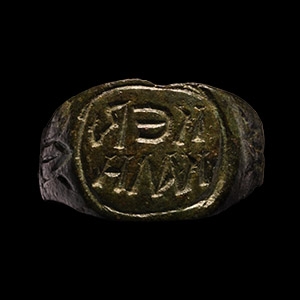
Post Roman Ring with Inscription
6th-7th century A.D.Sold for (Inc. bp): £169
A bronze finger ring with raised ellipsoid bezel, the shoulders decorated with engraved foliage, on the bezel incised in Greek letters the inscription 'ΚΕΡΙ ΚАΛΗ' (written backwards). 4.33 grams, 23.12 mm overall, 21.00 mm internal diameter (approximate size British U 1/2, USA 10 1/4, Europe 23.15, Japan 22)
Acquired in the late 1990s-2000. Property of an East London gentleman.
The ring corresponds to the 1d type of Hadjadj's classification. The Greek inscription is probably a barbaric interpretation of 'ΚΗΡΙ ΚАΛΗ' (kind-hearted). The Merovingian typology of the ring suggests a late Roman product under the Roman-Barbarian kingdoms of Gaul or the Iberian Peninsula. -
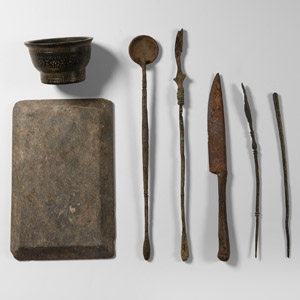
Roman Medical Implements and Palette
1st-4th century A.D.Estimate: £600 - 800 (+bp*)
Opening Bid: £300
A copper-alloy medical instrument group comprising: a bowl with incised geometric decoration; a rectangular palette with bevelled edges; knife with single-edged iron blade and decoratively incised pommel; spoon with circular bowl, collared stem with expanded waist and finial formed as a probe; pin with tapering round-section body, shallow conical finial and decoratively incised head; a scoop probe with remains of elongated shallow scoop, expanded neck with collars, slender ribbed stem and bulbous probe to terminal; scoop with leaf-shaped bowl and balustered stem. 332 grams total, 4.8-17 cm
Acquired before 2000. From the collection of a European gentleman living in the UK.
