
Loading, please wait...
_900x900.jpg "Roman Decorated Glass Bowl")
_200x200.jpg "Roman Decorated Glass Bowl")
.jpg "Roman Decorated Glass Bowl")
LOT 0605
Roman Decorated Glass Bowl
3RD-5TH CENTURY A.D.
5 5/8 in. (131 grams, 14.3 cm wide).
A transparent glass bowl with gently tapering sidewalls and iridescent surfaces; base displaying a geometric motif with cut or engraved shallow dimples at centre surrounded by curved, radiating lines, circular dimples around the perimeter, with possible shallow ovals to the exterior wall.
ProvenanceAcquired in the 1980s-1990s.
Previously with Mansour Gallery, London W1.
Property of a North West London gentleman.
Cf. Whitehouse, D., Roman Glass in The Corning Museum Of Glass, Volume One, New York, 1997, pp.261-265, esp. item 450.
CONDITIONTimeLine Auctions follows a vetting process to ensure the authenticity and legality of all items, reinforcing our commitment to integrity and responsible trading. Each antiquity, antique, and coin lot undergoes thorough examination by a vetting committee of at least ten external specialists, professional trade association members, scientists, and archaeologists: Our Vetting Process
AUCTIONS:
TimeLine is a leading auction house specialising in antiquities, ancient art, collectables, natural history, coins, medals, and books. Our auctions offer museums, collectors, historians, and enthusiasts the opportunity to acquire unique and historically significant pieces.
-
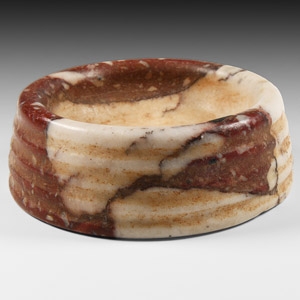
Roman Veined Porphyry Dish
1st-2nd century A.D.Sold for (Inc. bp): £494
A shallow mottled 'red' and 'white' marble dish, possibly porphyry marble, with gently sloping gusseted sidewall. 134 grams, 65 mm wide
French collection, 1960s-early 2000s. From an important Paris gallery, France. -
.jpg)
Roman Schist Dolphin
1st-2nd century A.D.Sold for (Inc. bp): £130
A carved schist dolphin figure with stylised detailing to the fins and face; mounted on a custom-made display stand. 30 grams total, 59 mm long (58 mm high including stand)
Fine condition.
Acquired 1970s-1996. Property of a North American collector. London collection, 2016.
The dolphin was among the animals sacred to Aphrodite, but in Graeco-Roman mythology it was also considered to be the animal accompanying the souls of the dead into the afterlife. -
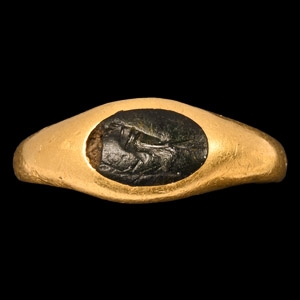
Roman Gold Ring with Bird Gemstone
2nd century A.D.Estimate: £400 - 600 (+bp*)
Opening Bid: £200
A slender gold finger ring with inset green glass intaglio of a perching bird. 2.00 grams. 14.97 mm overall, 13.23 mm internal diameter
Acquired at Auction. English private collection.
