
Loading, please wait...
_900x900.jpg "Roman Decorated Bronze Armour Clasp")
_200x200.jpg "Roman Decorated Bronze Armour Clasp")
.jpg "Roman Decorated Bronze Armour Clasp")
LOT 0840
Roman Decorated Bronze Armour Clasp
1ST-4TH CENTURY A.D.
2 5/8 in. (5.28 grams, 68 mm).
Formed of a rectangular plaque with punched decoration, hook to one end and an open loop to the other. [No Reserve]
ProvenanceEx Californian collection, USA, 1980s.
This lot is accompanied by an illustrated lot declaration signed by the Head of the Antiquities Department, Dr Raffaele D’Amato.
TimeLine Auctions follows a vetting process to ensure the authenticity and legality of all items, reinforcing our commitment to integrity and responsible trading. Each antiquity, antique, and coin lot undergoes thorough examination by a vetting committee of at least ten external specialists, professional trade association members, scientists, and archaeologists: Our Vetting Process
AUCTIONS:
TimeLine is a leading auction house specialising in antiquities, ancient art, collectables, natural history, coins, medals, and books. Our auctions offer museums, collectors, historians, and enthusiasts the opportunity to acquire unique and historically significant pieces.
-
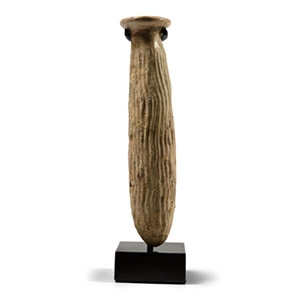
Roman White Elongated Glass Date Flask
1st century A.D.Estimate: £800 - 1,000 (+bp*)
Opening Bid: £400
Mould-blown with elliptical body, short neck and thick everted rim, with modelled wrinkles. 13 grams, 10.5 cm (46 grams total, 12 cm including stand)
From an important glass collection, London, UK, 1980-1990. This lot is accompanied by an illustrated lot declaration signed by the Head of the Antiquities Department, Dr Raffaele D’Amato. -
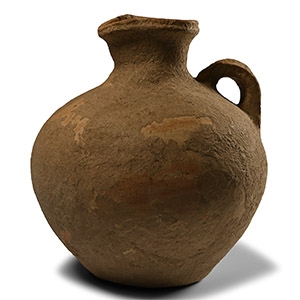
Roman Terracotta Trefoil Mouth Jug
1st-4th century A.D.Sold for (Inc. bp): £78
Bulbous body with narrow flat base, broad shoulder, short neck, pinched mouth with stepped rim, ribbed strap handle to rear. 300 grams, 11.2 cm
From a London, UK, gentleman's collection of ancient pottery and artefacts, 1990s. This lot is accompanied by an illustrated lot declaration signed by the Head of the Antiquities Department, Dr Raffaele D’Amato. -
.jpg)
Roman Bronze Legionary Signum
1st-3rd century A.D.Estimate: £4,000 - 6,000 (‡+bp*)
Opening Bid: £2,000
Hollow-formed with fine detailing to the fingers and nails; with fixing points for a military standard (signum) used by each unit under a centurion, originally fixed with the palm facing forwards inside a wreath. 718 grams, 21 cm
Acquired in Europe before 2000. European private collection. Accompanied by an academic report by Dr Raffaele D'Amato. This lot has been checked against the Interpol Database of stolen works of art and is accompanied by a search certificate number no.12003-211851. This lot has been cleared against the Art Loss Register database, and is accompanied by an illustrated lot declaration signed by the Head of the Antiquities Department, Dr Raffaele D’Amato.
Roman military signa decorated by phalerae and surmounted by a right hand were used from the Late Consular Age. The hand (manus) symbolised the fides, i.e. the allegiance between the soldiers and the Res Publica. It is also possible that the hand belonged to a statue in which it was extended as a sign of silence, to allow the speaker to speak. However, the iconography of military hands, and also the resemblance to a bronze hand (military signum) preserved in the Vindonissa museum (Windisch), support the possibility that the object was part of a military standard.
