
Loading, please wait...
LOT 0697
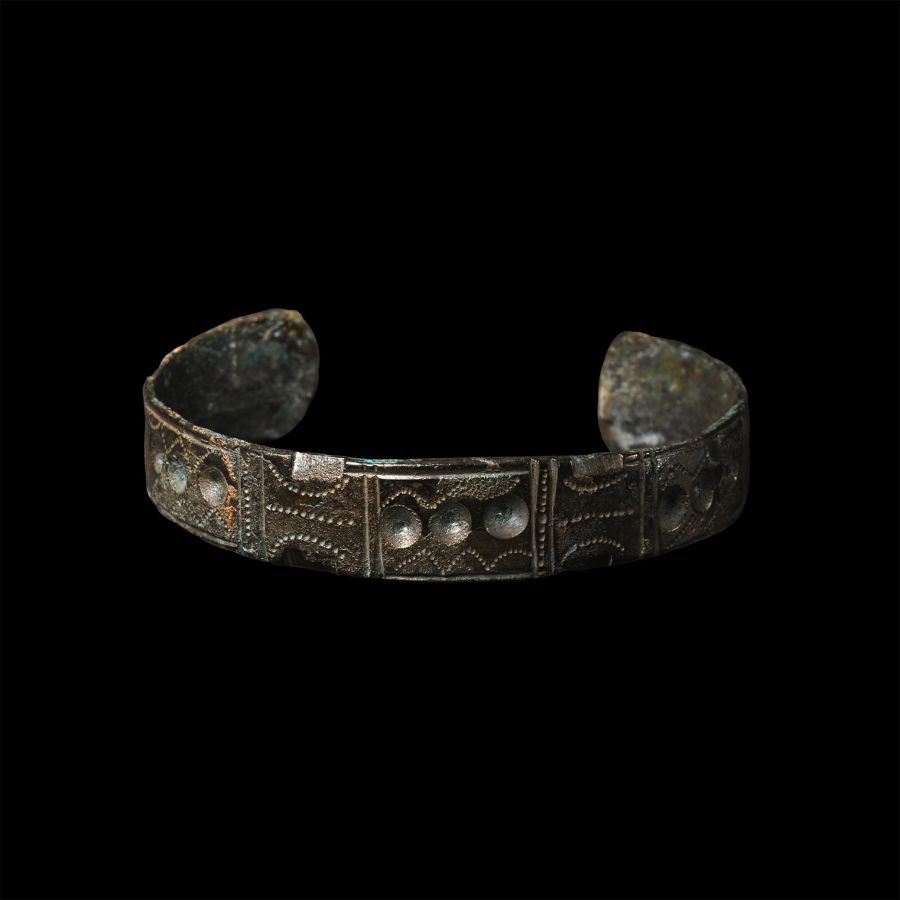
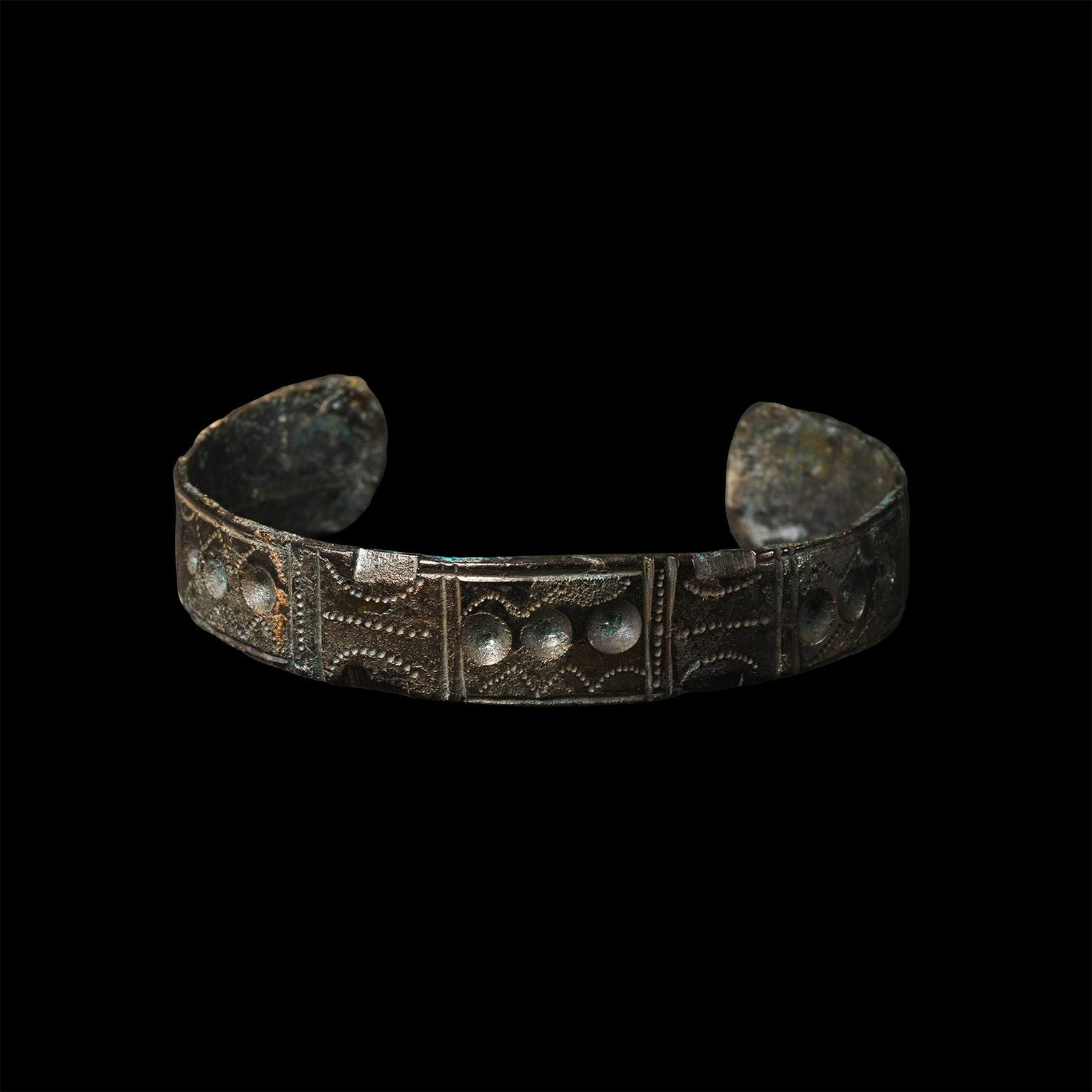
Roman Decorated Bracelet
CIRCA 1ST-2ND CENTURY A.D.
2 1/2 in. (24.5 grams, 65 mm).
A copper-alloy bracelet formed as a penannular hoop with rounded terminals, the exterior face divided into rectangular segments, each decorated with one of various repeating decorative schemes: five recessed dots with pricked dotted borders; dotted arcs and lines; horizontal cluster of three recessed dots with dotted chevrons above and below; slender vertical panels with central dotted columns. [No Reserve]
ProvenanceAcquired since the 1970s.
Ex property of an Austrian private collector.
TimeLine Auctions follows a vetting process to ensure the authenticity and legality of all items, reinforcing our commitment to integrity and responsible trading. Each antiquity, antique, and coin lot undergoes thorough examination by a vetting committee of at least ten external specialists, professional trade association members, scientists, and archaeologists: Our Vetting Process
AUCTIONS:
TimeLine is a leading auction house specialising in antiquities, ancient art, collectables, natural history, coins, medals, and books. Our auctions offer museums, collectors, historians, and enthusiasts the opportunity to acquire unique and historically significant pieces.
-
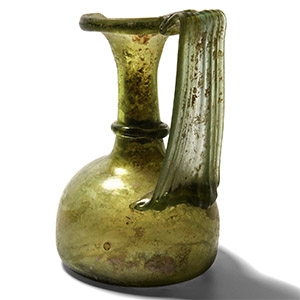
Large Roman Green Glass Jug
1st-4th century A.D.Sold for (Inc. bp): £351
A green glass jug with squat body domed shoulder, tubular neck and rolled rim, applied ribbed handle and trail to neck base; iridescent surfaces; rim chipped. 279 grams, 15.2 cm high
Acquired early 1990s. Ex private American collection; thence by descent. Private collection since 1998. -
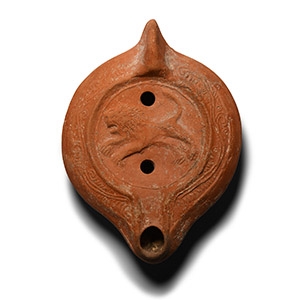
Large Roman Redware Lamp with Lion
4th century A.D. or laterEstimate: £250 - 350 (+bp*)
Opening Bid: £125
A clay lamp with rounded lug handle, shoulder with foliage in relief on each side, separated from the slightly concave discus by a ridge, which continues toward the round-tipped nozzle forming a wide channel between the discus and the wick hole; two equal-sized filling-holes at upper and lower part of the discus decorated with a lion running left, raised slightly convex base-ring with an additional inner ring. 163 grams, 13.5 cm
Acquired from a central London Antiquities Dealers Association (ADA) member's gallery in 1990. From the estate of a Lancashire gentleman.
The present lamps seems to be molded in Terra Sigillata Africana (TSA) = African Red Slip (ARS) and can be related to Atlante types VI. The passage from lamps of Loeschcke type VIII in TSA with a heart-shaped nozzle ( = Atlante form I) to the channelled so-called Christian lamps ( = Atlante forms VIII and X, or Hayes types I and II) was progressively achieved by three factors: the transformation of the initially circular discus into an oval shape, the elongation of the nozzle, and the increased width and length of the channel. -
.jpg)
Roman Bone Dice Pair
1st-4th century A.D.Sold for (Inc. bp): £130
A pair of bone dice with punched ring-and-dot numbering, each composed: 1:6; 2:5; 3:4. 3.4 grams total, 10 mm each
Fine condition.
German art market, 1990s. Mr A.H., a North American collector living in the UK.
