
Loading, please wait...
_900x900.jpg "Roman Dark Green Gemstone with Erotic Scene")
_200x200.jpg "Roman Dark Green Gemstone with Erotic Scene")
.jpg "Roman Dark Green Gemstone with Erotic Scene")
LOT 0011
Roman Dark Green Gemstone with Erotic Scene
2ND-3RD CENTURY A.D.
1/2 in. (0.52 grams, 13.13 mm).
With intaglio nude figures, a herm of Priapus with an erect phallus adorned by a female worshipper with a wreath; supplied with a museum-quality impression. [No Reserve]
ProvenanceFrom the private collection of a European gentleman (1942-2024), formed since the 1970s.
CONDITIONTimeLine Auctions follows a vetting process to ensure the authenticity and legality of all items, reinforcing our commitment to integrity and responsible trading. Each antiquity, antique, and coin lot undergoes thorough examination by a vetting committee of at least ten external specialists, professional trade association members, scientists, and archaeologists: Our Vetting Process
AUCTIONS:
TimeLine is a leading auction house specialising in antiquities, ancient art, collectables, natural history, coins, medals, and books. Our auctions offer museums, collectors, historians, and enthusiasts the opportunity to acquire unique and historically significant pieces.
-
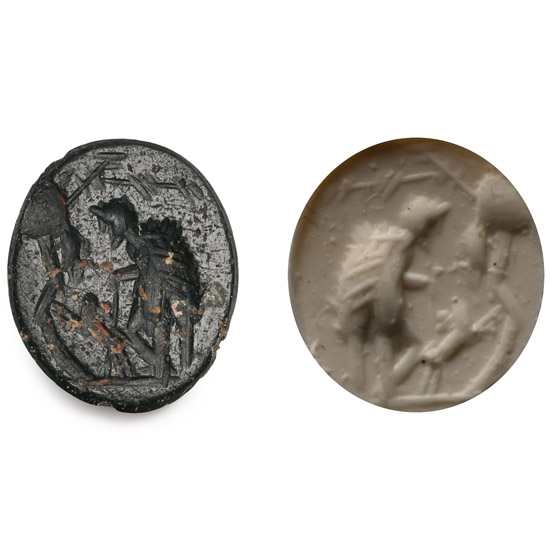
Roman Black Gemstone with Bird
2nd-3rd century A.D.Sold for (Inc. bp): £59
With intaglio bird perching on a branch; supplied with a museum-quality impression. 0.56 grams, 12.46 mm.
From the private collection of a European gentleman (1942-2024), formed since the 1970s. -
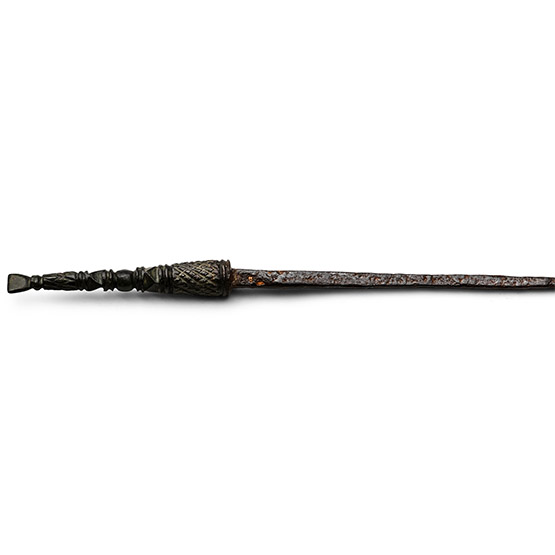
Roman Iron-Shafted Bronze Stylus with Eraser
1st-4th century A.D.Sold for (Inc. bp): £156
Comprising a rectangular-section point with a balustered bronze finial with an eraser. 10.39 grams, 13.5 cm
Ex German art market, 2000s. Acquired from an EU collector living in London. From the collection of a Surrey, UK, gentleman. -
.jpg)
Roman Gold Ring with Engraved Agate Gemstone
1st century B.C.-1st century A.D.Estimate: £2,000 - 3,000 (‡+bp*)
Opening Bid: £1,000
Hollow-formed with inset banded agate cloison, intaglio vine-leaf motif. 3.26 grams, 23.66 mm overall, 18.15 x 14.73 mm internal diameter (approximate size British J 1/2, USA 5, Europe 9.32, Japan 9)
Private collection, acquired on the German art market in 1993; thence by descent. This lot has been checked against the Interpol Database of stolen works of art and is accompanied by search certificate number no.13184-249301.
These rings were characterised by an oval opening with a flat rim for a banded agate gem, which tapered towards the top. Both ring and gem are of the same date, 1st century B.C.-1st century A.D.
